
How to File Taxes for the First Time With Your First W-2
Updated for the 2026 tax year (returns due April 15, 2027). Figures checked against IRS sources on November 22, 2026.
Around the end of January, your employer will give you a one-page form called a W-2. It’s full of boxes and codes, and nobody explains it. If you’re figuring out how to file taxes for the first time, that form is where it all starts.
The good news: for most people with one job, filing takes an evening, it can be completely free, and there’s a decent chance the government owes you money.
I’m Vera. I’m not a tax professional, and I’ll say so when something needs one. I filed my first return off a single W-2 with no idea what I was doing. This guide is what I wish I’d had.
It uses the real rules for the 2026 tax year: the return you file between late January and April 15, 2027. A few things changed this year that most guides haven’t caught up with. The IRS’s own free filing tool is gone, paper refund checks are mostly gone, and your W-2 has new codes for overtime and tips. Every money word gets explained the first time it shows up.
Educational only, not tax advice. Rules change, so confirm anything important at IRS.gov or with a tax professional.
Key Takeaways
- Filing settles up what came out of your paychecks. It’s not a new tax.
- Single and earned $16,100+ in 2026? You must file. Earned less but had tax withheld? File anyway to get it back.
- Talk to your parents first: if they can claim you, check the dependent box on your return.
- Use Box 1 of your W-2 as your wages, never Box 3 or 5.
- File free with IRS Free File, Fillable Forms or VITA. Direct File isn’t available.
- Never filed before? Sign with $0 as last year’s AGI.
- Use direct deposit, since paper refund checks are mostly gone.
- The deadline is April 15, 2027.
Taxes in 60 Seconds
Every paycheck, your employer took some money out and sent it to the government. That’s called withholding: paying your taxes in small pieces all year, before you knew what you’d owe.
A tax return is the once-a-year form where you add it all up and settle the score:
- Paid more than you owed? The government sends the extra back. That’s a refund.
- Paid less than you owed? You pay the difference. That’s a balance due.
- About right? Nothing much happens.
So filing isn’t paying a new tax on top of what you already paid. It’s checking whether what came out of your paychecks was the right amount.
One more idea you need: you don’t pay tax on every dollar. Almost everyone gets a tax-free chunk called the standard deduction, which is $16,100 for a single person in 2026. Earn $30,000, and only $13,900 of it gets taxed. There’s a full example below.
What’s New for the 2027 Filing Season
If an older guide or a friend explained this to you, here’s what’s different now:
- IRS Direct File isn’t available. It was the IRS’s own free filing website. It didn’t run in the 2026 season, and the IRS hasn’t announced a comeback. Free options still exist (Step 3).
- Paper refund checks are basically gone. They started being phased out on September 30, 2025. File without bank details, and the IRS can freeze your refund until you provide them.
- Your W-2 has new codes. Box 12 can show TT (overtime) and TP (tips), and Box 14 is now split into 14a and 14b. They connect to two new deductions.
- Freelance forms changed. A company only has to send you a 1099-NEC if it paid you $2,000 or more in 2026 (it used to be $600). The income is still taxable either way.
- The numbers went up a little for inflation, including the standard deduction and the tax brackets.
Do You Even Have to File?
“Have to” and “should” aren’t the same here.
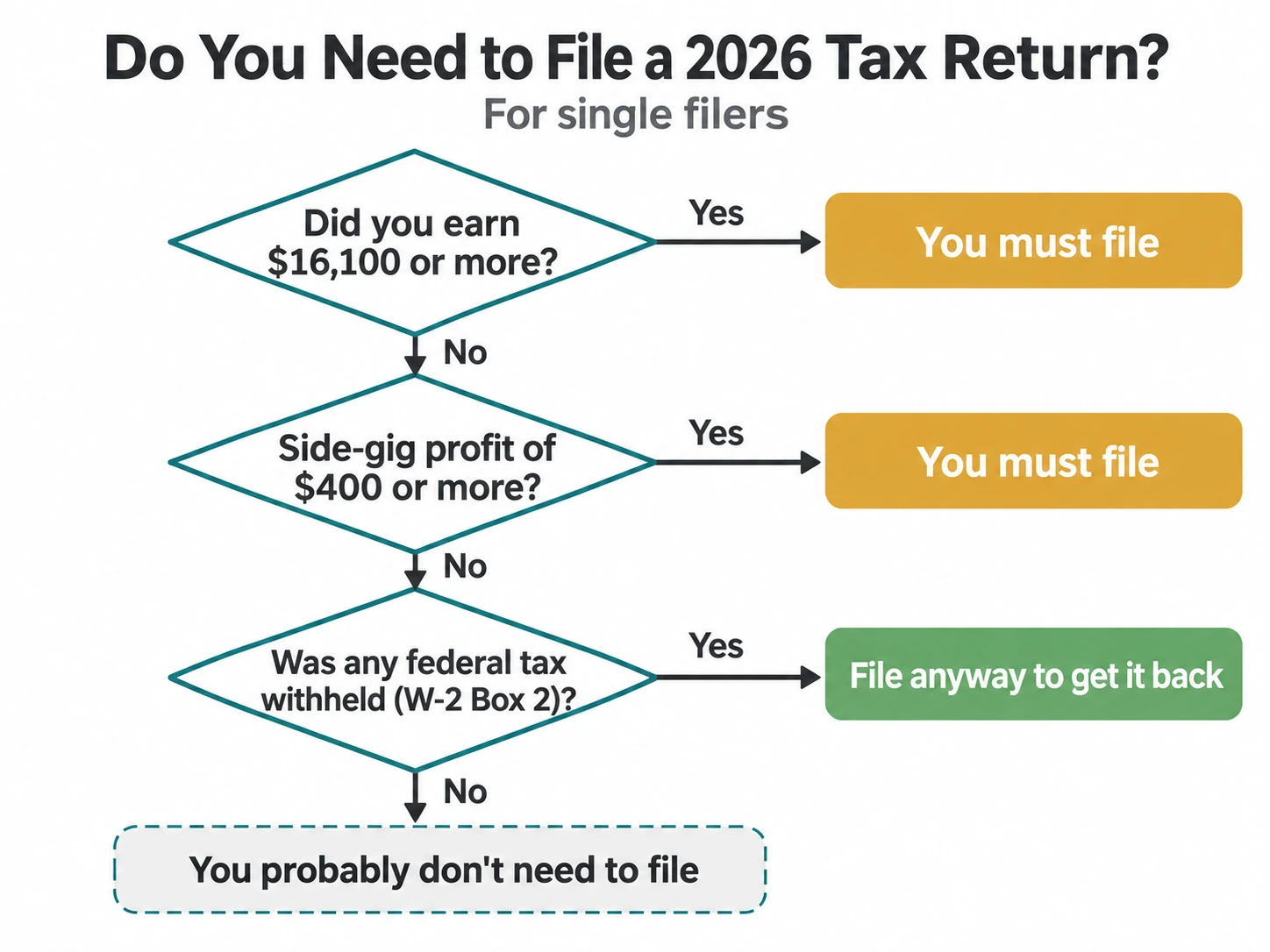
The short answer: if you’re single and earned $16,100 or more in 2026, you have to file. If you earned less but any federal tax came out of your paychecks, you should file anyway. It’s the only way to get that money back. Side-gig profit of $400 or more means you must file, whatever you earned.
You have to file if
- You’re single, nobody can claim you as a dependent, and you earned $16,100 or more in 2026.
- Someone can claim you as a dependent, and your job income was more than $16,100. A dependent is someone another person supports enough to list on their tax return, usually a parent listing a kid. If you also had investment or savings interest, a lower limit can apply ($1,350 of that kind of income). Tax software checks this for you.
- You made $400 or more in profit from self-employment. That means side gigs where you’re your own boss: delivery apps, freelancing, selling your own work.
You should file anyway if
Any federal income tax was taken out of your pay. Look at Box 2 on your W-2. If there’s a number there and you earned under the limit, you probably owe little or nothing, and the IRS won’t send the money back unless you file.
Example: Maya is 19, in college, and her parents claim her. She earned $8,000 at a part-time job, and $300 came out for federal income tax.
- Her standard deduction as a dependent is her job income plus $450, which is $8,450.
- That’s more than she earned, so her taxable income is $0.
- If she files, she gets all $300 back. If she doesn’t, the government keeps it.
What she won’t get back: the Social Security and Medicare tax on her W-2 (Boxes 4 and 6). For normal workers, only the federal income tax in Box 2 comes back.
Skipped a past year? You generally have three years from the original deadline to claim an old refund.
The Parent Question: Can They Still Claim You?
This trips up more first-time filers than anything else. If you and your parents both claim you, the second return filed electronically gets rejected, and someone has to sort it out by mail.
Your parents can usually claim you if all three are true:
- You were under 19 at the end of the year, or under 24 and a full-time student for at least five months.
- You lived with them more than half the year. Time away at college counts as living at home.
- You didn’t pay more than half of your own support: housing, food, school and so on.
Notice what’s missing: how much you earned. You can have a real job and still be your parents’ dependent. A recent grad who started work in June, after five months of school, and lived at home most of the year may still count for 2026.
If they can claim you:
- Check “Someone can claim you as a dependent” on your own return.
- You still file your own return for your W-2. Your parents don’t add your income to theirs.
- Your parents, not you, usually claim any education credits.
Settle it before anyone files. Something like: “Are you claiming me this year? I’m filing my own return for my job, so I’ll check the dependent box if you are.” Two minutes, and nobody’s return gets rejected.
Step 1: Gather Your Documents
Make one folder, on paper or on your phone, with:
- Your Social Security number (SSN).
- Every W-2 from every 2026 job. Employers must send them by February 1, 2027. Two jobs means two W-2s.
- Any 1099 forms. These report income that isn’t a regular paycheck:
- 1099-NEC: freelance or contract work.
- 1099-INT: savings interest (banks send one at $10 or more).
- 1099-K: payment apps or online selling, only above $20,000 and 200 sales.
- Form 1098-T if you were in college, and Form 1098-E if you paid student loan interest.
- Your bank’s routing number and your account number, for the refund. Both are in your banking app.
- Last year’s AGI. AGI stands for “adjusted gross income”: your total income after a few specific subtractions. If you’ve never filed, it’s $0. You’ll use it to sign your return.
Wait until every form has arrived. Filing off your last pay stub is a classic way to get an IRS letter later.
Step 2: Read Your W-2, Box by Box
You’ll type these numbers into your tax software, so it helps to know what they are:
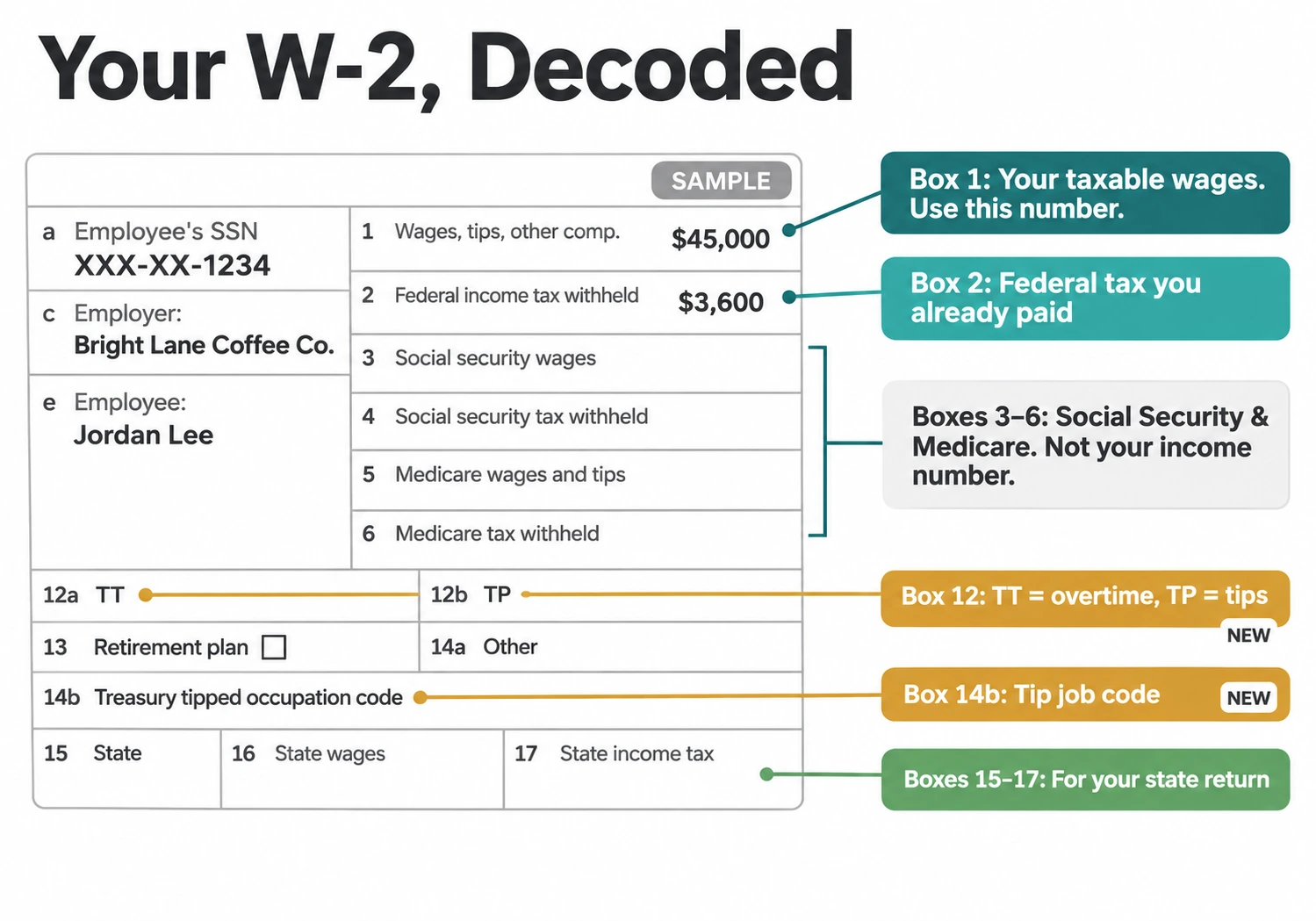
| Box | What it means, in plain words | What to check |
|---|---|---|
| a, e, f | Your SSN, name and address | Must match your Social Security card exactly, or the return gets rejected |
| b, c | Your employer’s ID number and address | Just copy them |
| 1 | Wages that get taxed. The main number on your federal return | Often lower than your salary. Pre-tax 401(k), health insurance and HSA money isn’t included |
| 2 | Federal income tax withheld. What you already prepaid | Decides your refund or balance due |
| 3 and 5 | Wages counted for Social Security and Medicare | Often higher than Box 1. Don’t use these as your income |
| 4 and 6 | Social Security tax (6.2%) and Medicare tax (1.45%) taken out | Not refunded for normal workers |
| 12 | Coded extras | See the codes below |
| 13 | Checkboxes | “Retirement plan” checked means you were in your job’s plan |
| 14a | “Other”: your employer’s notes | Usually just information |
| 14b (new) | Your job’s tip-occupation code | Only matters if you get tips |
| 15–17 | Your state, state wages and state tax withheld | For your state return |
Box 12 codes you might see:
- D: money you put into a regular (pre-tax) 401(k). It’s why Box 1 is lower than your salary.
- AA: money you put into a Roth 401(k). It was already taxed, so it doesn’t lower Box 1.
- W: health savings account (HSA) contributions.
- DD: what your employer paid for your health insurance. Not income, not taxed. It’s just there for your information.
- TT (new): qualified overtime, for the new overtime deduction.
- TP (new): cash tips you reported to your employer, for the tips deduction.
- TA (new, rare): an employer contribution to a “Trump account,” a new type of savings account for children. Most first-jobbers won’t see it.
Quick sanity check: your last pay stub’s year-to-date (“YTD”) taxable wages should roughly match Box 1. My guide to reading a pay stub shows where to find that number.
A Real Example: How the Math Works
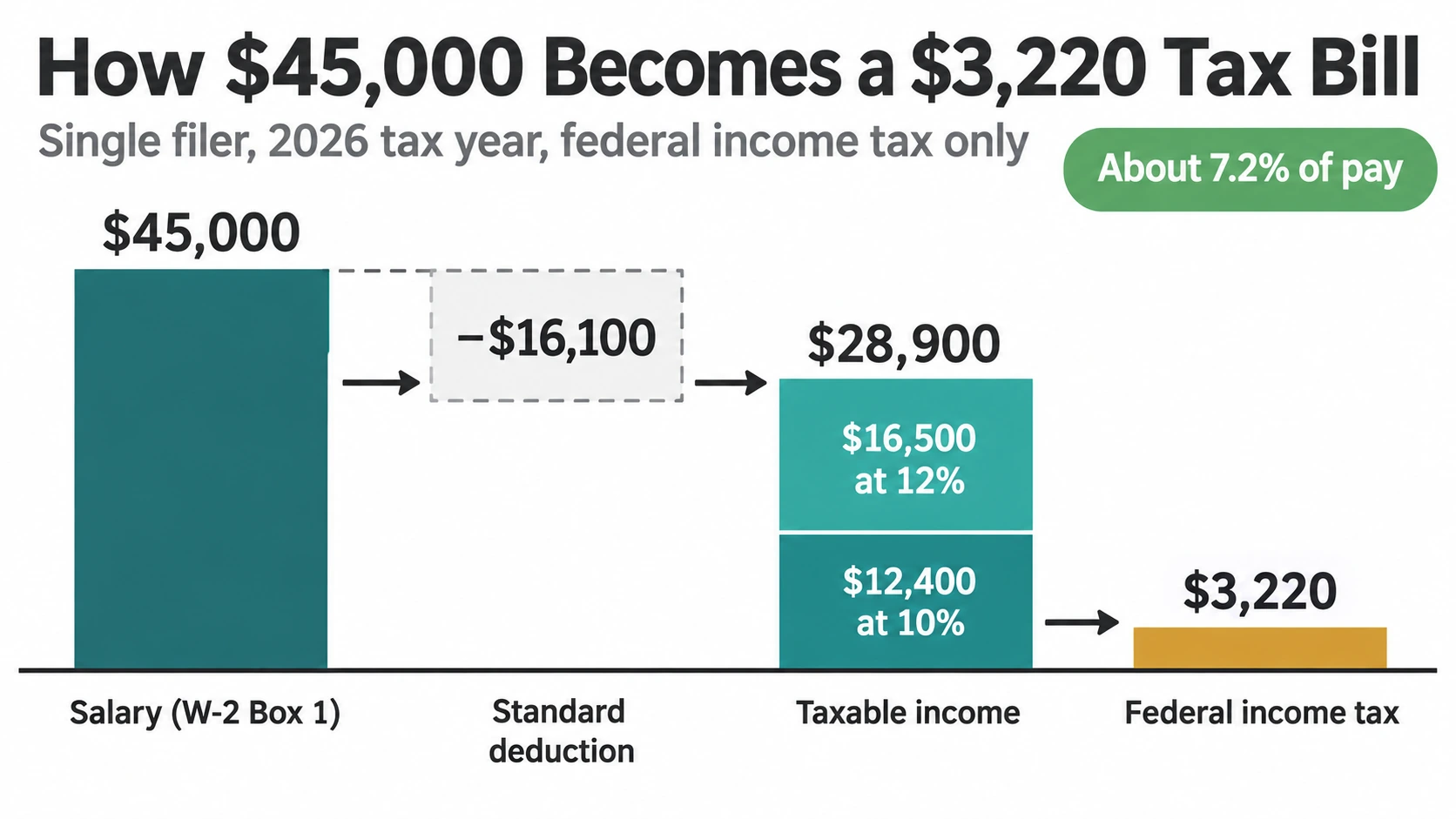
Jordan is 23, single, nobody claims them, and they earned $45,000 at their first job in 2026.
- Start with Box 1: $45,000.
- Subtract the standard deduction: $45,000 − $16,100 = $28,900. This is taxable income: the part that actually gets taxed.
- Apply the tax brackets. Tax brackets mean income is taxed in layers, not all at one rate. For a single person in 2026:
- The first $12,400 is taxed at 10%, which is $1,240.
- The layer from $12,401 to $50,400 is taxed at 12%. Jordan has $16,500 in it, which is $1,980.
- Add it up: $1,240 + $1,980 = $3,220 in federal income tax.
That’s about 7.2% of Jordan’s pay, much less than the “12% bracket” sounds. A higher bracket only applies to the dollars inside it, never your whole income. So the idea that a raise can “push you into a higher bracket” and shrink your take-home pay is a myth.
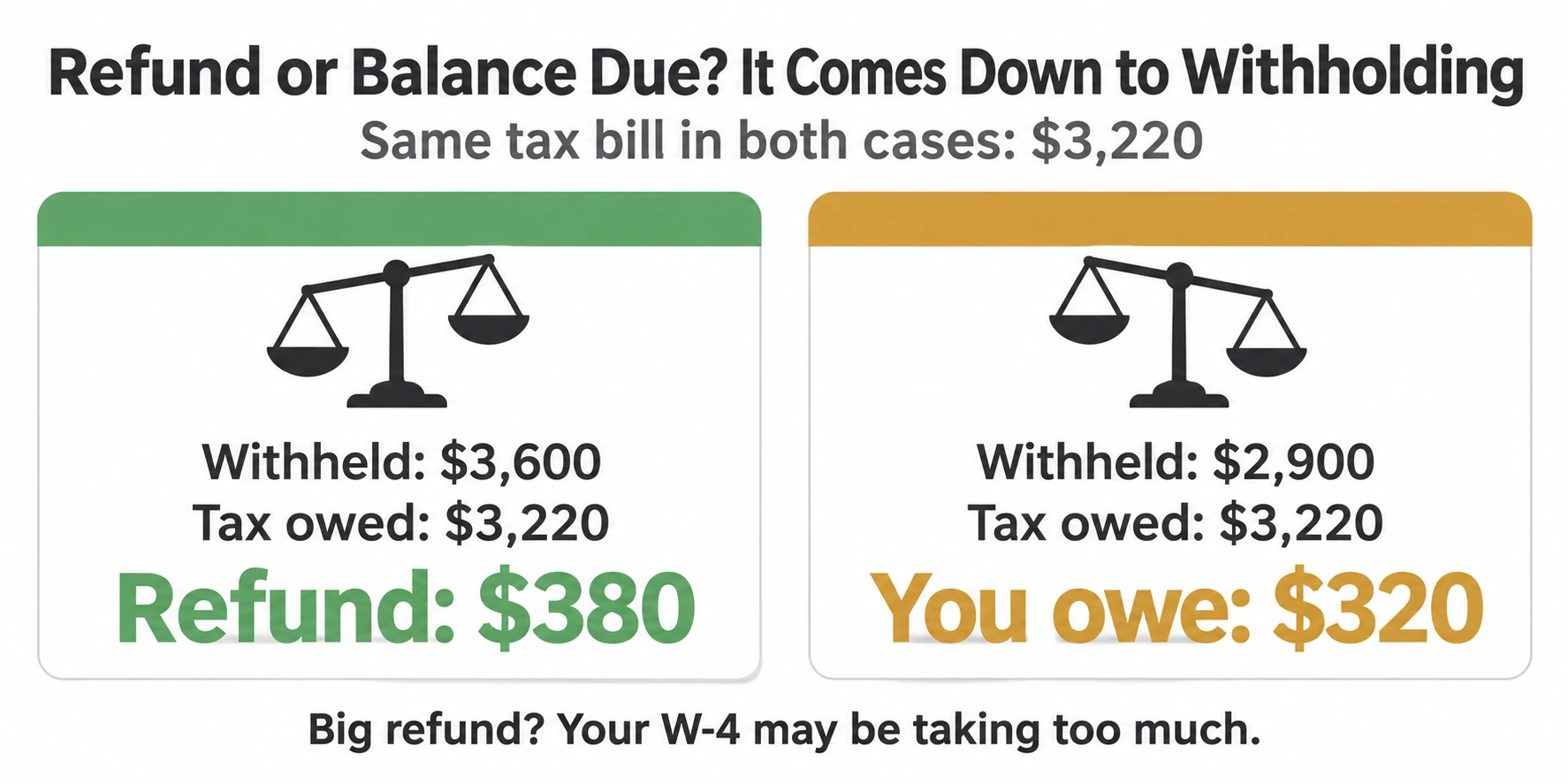
- Compare with Box 2:
- $3,600 withheld → Jordan paid $380 too much → $380 refund.
- $2,900 withheld → Jordan paid $320 too little → owes $320.
What a pre-tax 401(k) changes: if Jordan had put 6% of their pay ($2,700) into a pre-tax 401(k), Box 1 would be $42,300, taxable income $26,200, and tax $2,896. That’s $324 less tax this year, and the $2,700 is still Jordan’s, invested for retirement. Wondering whether pre-tax or Roth suits you better? See Roth 401(k) vs. Traditional 401(k).
Assumptions: single filer, standard deduction, no credits, federal income tax only. Software does this math for you. Now you know what it’s doing.
Step 3: Pick a Free Way to File
If your income is just a W-2, you shouldn’t pay to file. Your real options for the 2027 season:
| Option | What it is | Who it’s for |
|---|---|---|
| IRS Free File (guided) | Brand-name tax software, free through IRS.gov | People under the income limit. $89,000 last season; the IRS posts the new limit in January |
| Free File Fillable Forms | Online IRS forms with no step-by-step help | Anyone, any income. Fine for a simple W-2 return if you don’t mind reading forms |
| VITA (Volunteer Income Tax Assistance) | Free in-person help from IRS-certified volunteers | Generally people earning $69,000 or less (last season’s guideline) |
| Free tiers of commercial apps | The no-cost version of big-name tax software | Simple returns. Watch for upgrades |
| MilTax | Free filing for military families | Service members and families |
Which one? If you’d like to be walked through it and you’re under the limit, use IRS Free File. If you’d rather have a person do it with you, find a VITA site. If you’re comfortable with forms and want zero upselling, use Fillable Forms.
Not an option: IRS Direct File. Some older articles still recommend it, but it didn’t run in 2026 and hasn’t been announced for 2027.
Watch the fine print. “Free” commercial versions sometimes charge for the state return, for side-gig income, or for the new tips and overtime deductions. Free File partners also set their own rules on income, age or state, so check each one’s eligibility page first. According to a Congressional Research Service report, only about 3% of people who qualify for Free File use it.
Step 4: Fill In Your Return
The software asks questions, and your answers fill in Form 1040, the main federal tax form. In order:
- Personal info. Name, SSN and address, exactly as on your Social Security card and W-2.
- Filing status. Almost every first-time filer is Single.
- The dependent question. Answer based on the parent section above.
- Your W-2. Many apps let you snap a photo. Check every number against the paper form, especially Boxes 1, 2, 12 and 15–17.
- Other income. Add any 1099s.
- Deductions. Take the standard deduction. The alternative, itemizing, means listing specific expenses like mortgage interest, and it almost never wins for someone just starting out.
- Credits. A tax credit cuts your tax bill dollar for dollar, which makes it worth more than a deduction (a deduction only lowers the income that gets taxed). Ones that might apply:
- Education credits: if you paid tuition and nobody claims you.
- The Saver’s Credit: if you saved for retirement, earned $40,250 or less as a single filer, aren’t a full-time student, and nobody claims you.
- The Earned Income Tax Credit: mostly for people with kids. Without kids, you generally need to be at least 25.
- Review. Does the refund or balance look roughly like Jordan’s example scaled to your pay?
- Sign electronically. Asked for last year’s AGI? Never filed before? Enter $0. Or create a self-select PIN: any five digits you choose, except all zeros. It works as your signature.
- Submit. Within a day or two you’ll get an email saying the IRS accepted your return. That means it’s in the system, not that it’s been fully processed.
Tips and Overtime: The New Deductions
A new federal law created two deductions for tax years 2025 through 2028. If you work in a restaurant, salon, warehouse or any job with overtime, this matters.
A deduction lowers the income that gets taxed. You claim both of these on a new form, Schedule 1-A, and you get them on top of the standard deduction.
No tax on overtime
- What counts: only the extra part of overtime pay that federal law requires. At time-and-a-half, that’s the “half.” Example: you earn $20 an hour and work 10 overtime hours at $30. You were paid $300 for those hours, but only $100 (10 hours × $10 extra) counts.
- The cap: up to $12,500 a year for a single filer. It shrinks above $150,000 of income, which won’t affect most readers.
- Who usually qualifies: hourly workers legally owed overtime. Most salaried office jobs don’t.
- What changed for 2026: you can only use the amount your employer reports in Box 12, code TT. Last year people could work it out from their pay stubs. This year they can’t. If you worked overtime and there’s no TT amount, ask payroll for a corrected W-2 (a W-2c) before you file.
No tax on tips
- What counts: tips customers chose to give you, including tip-pool shares, in a job on the government’s list of tipped occupations. The list has 70+ jobs, including servers, bartenders, hair stylists and delivery drivers.
- What doesn’t: mandatory service charges and automatic gratuities.
- The cap: up to $25,000 a year, with the same $150,000 income limit.
- On your W-2: tips appear in Box 12, code TP, and your job’s code is in Box 14b.
Both deductions only lower your federal income tax. You still pay Social Security and Medicare on that money, and your state may treat it differently.
Side Gigs and Extra Income
Plenty of us have a W-2 job and a side hustle: deliveries, freelance design, reselling, tutoring, a small online shop.
That income is taxable whether or not you get a form for it. The $2,000 rule only decides whether a company has to send you a 1099-NEC. It doesn’t make the money tax-free.
The $400 rule: side-gig profit (what you earned minus business costs) of $400 or more means you must file and pay self-employment tax. An employer normally splits Social Security and Medicare tax with you. When you work for yourself, you pay both halves: about 15.3% of your profit. The software handles it on Schedule SE.
Keep a simple record of what you earned and spent on gas, supplies and app fees. Business costs lower your profit, and lower profit means less tax.
Step 5: Don’t Forget Your State Return
Most states have their own income tax and their own return. Tax software usually moves you into it after the federal part, sometimes for a fee.
- No state tax on wages: Alaska, Florida, Nevada, New Hampshire, South Dakota, Tennessee, Texas, Washington and Wyoming. Lived and worked in one of these all year? You likely have no state return for your job income.
- Lived in one state and worked in another? You may file two state returns.
- Moved mid-year? You may file a part-year return in each state.
- Deadlines: most states use April 15, but check yours.
The numbers come from Boxes 15–17 of your W-2.
Step 6: Get Your Refund (or Pay What You Owe)
Getting a refund
- Choose direct deposit and type your routing and account numbers carefully. A typo can freeze your refund.
- Timing: usually under 21 days if you file electronically with direct deposit and nothing’s wrong.
- Track it with the IRS “Where’s My Refund?” tool or the IRS2Go app.
- If your bank rejects the deposit, say because the account is closed, the IRS usually freezes the refund instead of mailing a check. You’ll have to respond to get it released.
Owing money
- Pay by April 15, 2027, even if you get an extension to file.
- Use IRS Direct Pay (free, from your bank account) or a card (fees apply).
- Can’t pay it all? File on time anyway. The penalty for not filing is much bigger than the penalty for paying late, and the IRS offers payment plans.
A big refund isn’t a bonus. It means you overpaid all year and gave the government an interest-free loan. If yours was large, adjust your W-4 (see the last section).
Mistakes That Get First Returns Rejected
- You and your parents both claimed you. Settle it first.
- Wrong prior-year AGI. First-timers enter $0.
- Your name or SSN doesn’t match Social Security records.
- You entered Box 3 or 5 as your wages instead of Box 1.
- A typo in your bank numbers, which freezes the refund.
- A missing W-2 or 1099. The IRS gets copies of every form, so it will notice.
- You assumed all overtime is deductible. For 2026, only the TT amount counts.
- You filed before every form arrived.
Your Filing Timeline
- December 2026: confirm your mailing address with HR so the W-2 reaches you.
- Late January 2027: the IRS starts accepting returns. It announces the date in early January.
- By February 1, 2027: your W-2 arrives.
- February–March: file once every form is in. Earlier filers get refunds sooner.
- April 15, 2027: deadline to file and pay. An extension (Form 4868) gives six more months to file, not to pay.
After You File: Three Smart Moves
1. Fix your W-4. The W-4 is the form that tells your employer how much tax to take from each paycheck. A huge refund or a big bill means it’s set wrong. My W-4 guide walks you through it.
2. Protect your Social Security number. Create an IRS online account and request an Identity Protection PIN (IP PIN): a six-digit number required to file a return in your name, so nobody can file a fake one to steal your refund. And the IRS doesn’t text or DM you first about refunds. Those messages are scams.
3. Give your refund a job. For example:
- Start an emergency fund (even $500 helps).
- Open a Roth IRA. The Roth 401(k) vs. Traditional 401(k) guide explains how Roth accounts work.
- Pay down a credit card.
Keep your return and W-2s for at least three years.
Plain-English Tax Glossary
- W-2: the yearly form from your employer showing your pay and the tax taken out.
- Withholding: tax taken out of each paycheck in advance.
- Tax return: the yearly form where you add up income and tax and settle up.
- Refund / balance due: money back if you overpaid; money owed if you underpaid.
- Standard deduction: the tax-free amount almost everyone gets ($16,100 if single in 2026).
- Taxable income: income minus deductions. The part that actually gets taxed.
- Tax bracket: a layer of income taxed at one rate. A higher layer only affects the dollars inside it.
- Effective tax rate: the share of your total income you really paid (about 7.2% for Jordan).
- Dependent: someone another person can list on their return, usually a child or student.
- AGI (adjusted gross income): total income after a few specific subtractions. It’s $0 if you’ve never filed.
- Deduction: lowers the income that gets taxed.
- Credit: lowers your tax bill dollar for dollar.
- 1099: a form reporting income that isn’t a regular paycheck.
- FICA: the Social Security and Medicare taxes on your W-2 (Boxes 4 and 6).
- Self-employment tax: FICA on side-gig profit, where you pay both halves.
- Form 1040: the main federal tax return form.
- Schedule 1-A: the new form for the tips and overtime deductions.
- W-4: the form that sets how much tax comes out of each paycheck.
- IP PIN: a six-digit IRS number that protects you from tax identity theft.
- Extension: extra time to file, not to pay.
FAQ
Do I have to file taxes if I only made a little money at my first job?
If you’re single, earned less than $16,100 in 2026 and had no side-gig profit of $400 or more, usually not. But if any federal income tax came out of your pay (W-2 Box 2), file anyway. It’s the only way to get that money back.
Can my parents still claim me if I have a job?
Often, yes. If you were under 19 (or under 24 and a full-time student), lived with them more than half the year and didn’t pay more than half your own support, they can claim you no matter how much you earned. You still file your own return and check “Someone can claim you as a dependent.”
What do I put for last year’s AGI if I’ve never filed before?
Enter $0. Or create a self-select PIN: any five digits you choose, except all zeros. Either works as your electronic signature.
Is IRS Direct File available in 2027?
No. It didn’t run in the 2026 filing season, and the IRS hasn’t announced it for 2027. Use IRS Free File, Free File Fillable Forms or free in-person help from VITA instead.
Can I still get my refund as a paper check?
In most cases, no. Paper refund checks have been phased out since September 30, 2025. If you file without bank details, the IRS can hold your refund until you provide them or request a check. Direct deposit is fastest.
What do TT and TP mean on my W-2?
Both are new for 2026. TT is your qualified overtime and TP is the cash tips you reported to your employer. They feed the new deductions on Schedule 1-A. For overtime you can only use the TT amount, so if it’s missing, ask payroll for a corrected W-2.
I made money on a delivery app or Venmo but didn’t get a 1099. Do I report it?
Yes. All income is taxable, even without a form. If your side-gig profit was $400 or more, you must file and pay self-employment tax on it.
How long does a tax refund take?
Usually less than 21 days if you file electronically with direct deposit and there are no problems. Track it with the IRS “Where’s My Refund?” tool.
Conclusion
Filing for the first time feels like a test you never studied for. Once you see what’s actually happening, it’s simple. Your employer prepaid your taxes all year, and your return checks the math. For most first-job W-2 workers, the answer is a small refund or a small bill, not a disaster.
The short version of how to file taxes for the first time:
- Wait for every W-2 and 1099. W-2s arrive by February 1, 2027.
- Settle the dependent question with your parents before anyone files.
- Use a genuinely free option: IRS Free File, Fillable Forms or VITA.
- Enter Box 1 as your wages and take the $16,100 standard deduction.
- Sign with $0 as last year’s AGI (first time only) or a self-select PIN.
- Choose direct deposit and file by April 15, 2027, on time even if you can’t pay in full.
Then do what most people skip: use this year’s return to fix your W-4, so next year’s refund or bill is closer to zero and more of your money stays in your paycheck.
Your next step: pull up your last pay stub of the year and note its year-to-date numbers, so you can check your W-2 the day it arrives. New to all of this? The First Job Money Guide covers the rest, from your first paycheck to picking benefits.
This guide is part of Dollar Vista’s First Job Money Guide.
This article is for educational purposes only and isn’t tax, legal or financial advice. Tax rules change. Verify figures at IRS.gov for the current tax year, or ask a CPA, an enrolled agent or a free VITA volunteer about your situation.