Health Insurance Open Enrollment: A First-Timer’s Guide at 22
Introduction
A few weeks into your first real job, HR sends you a link with a subject line like: “Benefits Enrollment — Action Required.”
You click it. You see words like “deductible,” “coinsurance,” “formulary,” and “out-of-pocket maximum.” You stare at three plan options with very different monthly costs. And you have 30 days to pick.
Most 22-year-olds pick the cheapest one, click submit, and hope for the best.
That approach costs the average first-jobber hundreds — sometimes thousands — of extra dollars a year. This guide is here to stop that from happening to you.
Health insurance open enrollment at your first job is one of the most financially important decisions you’ll make this year. The stakes are real: pick the wrong plan and a single ER visit or moderate health scare can wipe out months of savings. Pick the right one and you could actually make money from your benefits package.
This guide is written specifically for 22-year-olds entering the workforce. You have options that older workers don’t — including staying on a parent’s plan, unlocking a powerful Health Savings Account, and locking in disability insurance at its cheapest possible rate. We’ll cover all of it, in plain English, with real numbers.
What Is Open Enrollment — And Why Does It Exist?
Open enrollment is a fixed annual window when you can sign up for, change, or renew your health insurance. Outside of this window, you generally cannot make changes to your coverage.
Why the restriction? Think of it like car insurance after an accident. If insurance companies let anyone sign up the moment they got sick or hurt, only sick people would buy coverage. Healthy people would skip it. Premiums would skyrocket. The whole market would collapse.
Open enrollment creates a fair pool by requiring everyone — healthy and sick — to enroll at the same time. This keeps costs stable for everyone.
There are two separate open enrollment systems you need to know about:
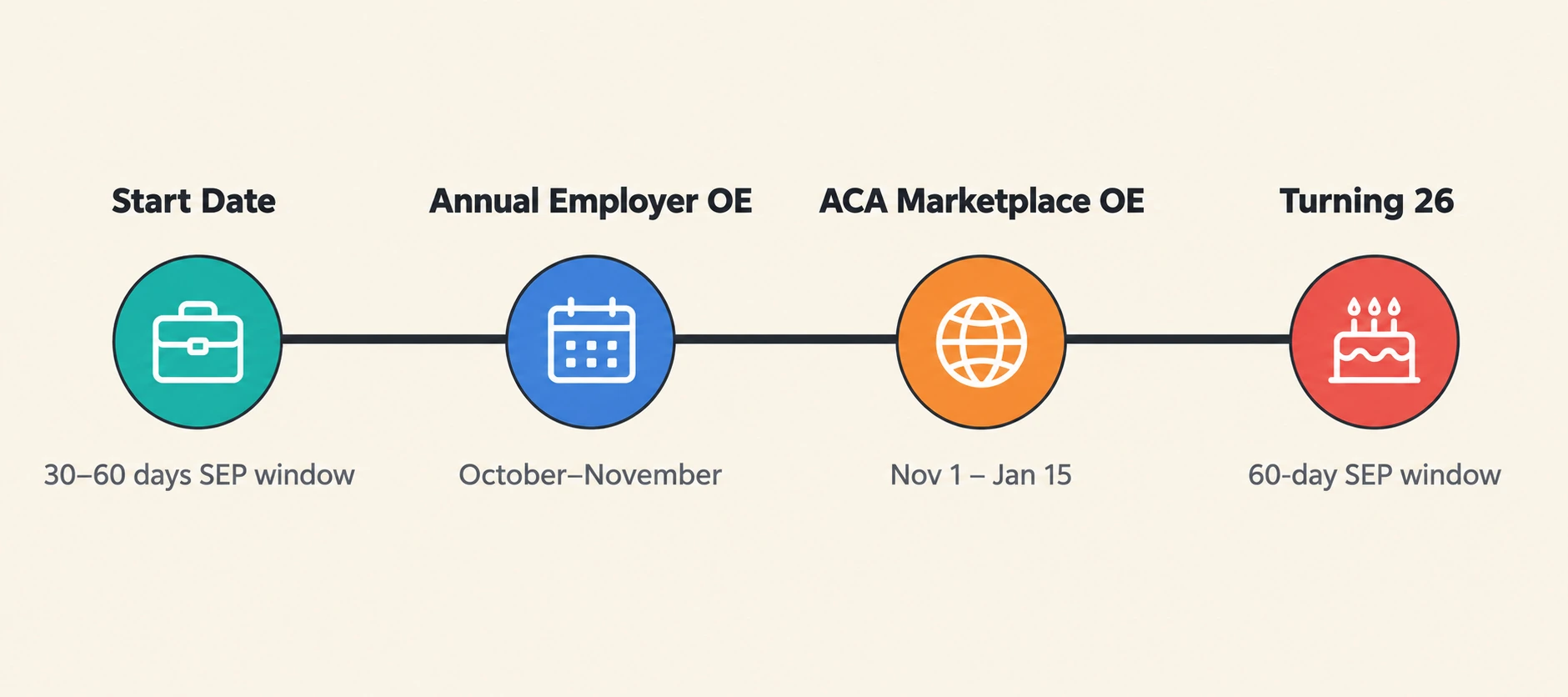
Employer-Sponsored OE: Run by your company’s HR department. The window and dates vary by employer, typically October–November for coverage starting January 1. When you start a new job, you get a separate Special Enrollment Period (SEP) — usually 30 to 60 days from your start date.
ACA Marketplace OE: For people buying individual coverage through HealthCare.gov or state exchanges. The current 2026–2027 window runs from November 1, 2026 to January 15, 2027 for most states. Some states extend further — California, New York, New Jersey, and DC push the deadline to January 31, 2027, and Virginia to January 29, 2027 — while Rhode Island’s window closes earlier, on December 31, 2026. Check your state’s exchange for its exact dates.
As a first-jobber with employer-sponsored benefits, you’ll primarily deal with the employer system. But understanding both matters — especially if you have a coverage gap or your employer’s plan isn’t affordable.
Your Three Enrollment Paths at 22
At 22 with a first job, you face a fork in the road that most older workers have never had to think about. You have three main paths:
Path A — Enroll in your employer’s plan. The most common route. Your employer pays a share of the premium; you pay the rest via paycheck deductions. You get direct access to an HSA if the plan is HDHP-eligible. This is usually the right choice if you’ve moved cities or your parents’ plan has a restrictive network.
Path B — Stay on your parent’s plan. Under the ACA’s age-26 rule, you can remain on a parent’s plan regardless of your employment status, income, or location — until your 26th birthday. This can be cost-effective if the plan is free (or low-cost) to you. But it has critical limitations we’ll cover in detail below.
Path C — Buy a Marketplace plan through HealthCare.gov. If your employer doesn’t offer coverage, or if their plan costs more than 9.96% of your household income (the 2026 affordability threshold), you may qualify for subsidized Marketplace coverage. Less common for first-jobbers but worth knowing.
Most 22-year-olds will decide between Path A and Path B. Understanding how to compare them is one of the most valuable things this guide will walk you through.
Health Insurance Terms You Need to Know
Before choosing a plan, you need to understand what you’re comparing. Here’s every key term — explained like a normal person would.
Premium: The monthly fee you pay to have insurance — whether you use it or not. Like a subscription. Think of it as the “cover charge” to access your benefits.
Deductible: The amount you pay 100% out of pocket before insurance starts covering most services. If your deductible is $1,500, you pay the first $1,500 of covered medical bills yourself each year.
Copay: A flat fee you pay at the time of service — for example, $25 per doctor visit. Some plans apply copays before the deductible; others don’t.
Coinsurance: Your percentage share of costs after you’ve met your deductible. With 20% coinsurance, you pay 20% of each bill; your insurer pays 80%.
Out-of-Pocket Maximum (OOP Max): The most you’ll ever pay in a single plan year. Once you hit this number, insurance covers 100% of in-network covered costs for the rest of the year. This is your catastrophic protection ceiling.
Network: The doctors, hospitals, and clinics that have contracts with your insurer. “In-network” means negotiated discounted rates. “Out-of-network” means full price — or no coverage at all, depending on your plan.
Formulary: Your plan’s list of covered prescription drugs, organized into cost tiers (1–4+). Tier 1 drugs are cheap; Tier 4 specialty drugs can cost $150–$500+ per month out of pocket.
EOB (Explanation of Benefits): A document from your insurer that shows what was billed, what the insurer paid, and what you might owe. It is not a bill. Do not pay it. We’ll cover this in detail later.
Prior Authorization: Pre-approval your insurer requires before certain procedures, medications, or specialist visits are covered. Without it, a claim may be denied. More on this below.
SBC (Summary of Benefits and Coverage): A standardized two-page plan overview that all insurers are legally required to provide. Use it to compare plans side by side.
HSA (Health Savings Account): A tax-advantaged savings account available only to people enrolled in a qualifying High-Deductible Health Plan (HDHP). One of the best financial tools available to a healthy 22-year-old.
SEP (Special Enrollment Period): An off-cycle enrollment window triggered by specific qualifying life events, like starting a new job or turning 26. Gives you a chance to change coverage outside the regular OE window.
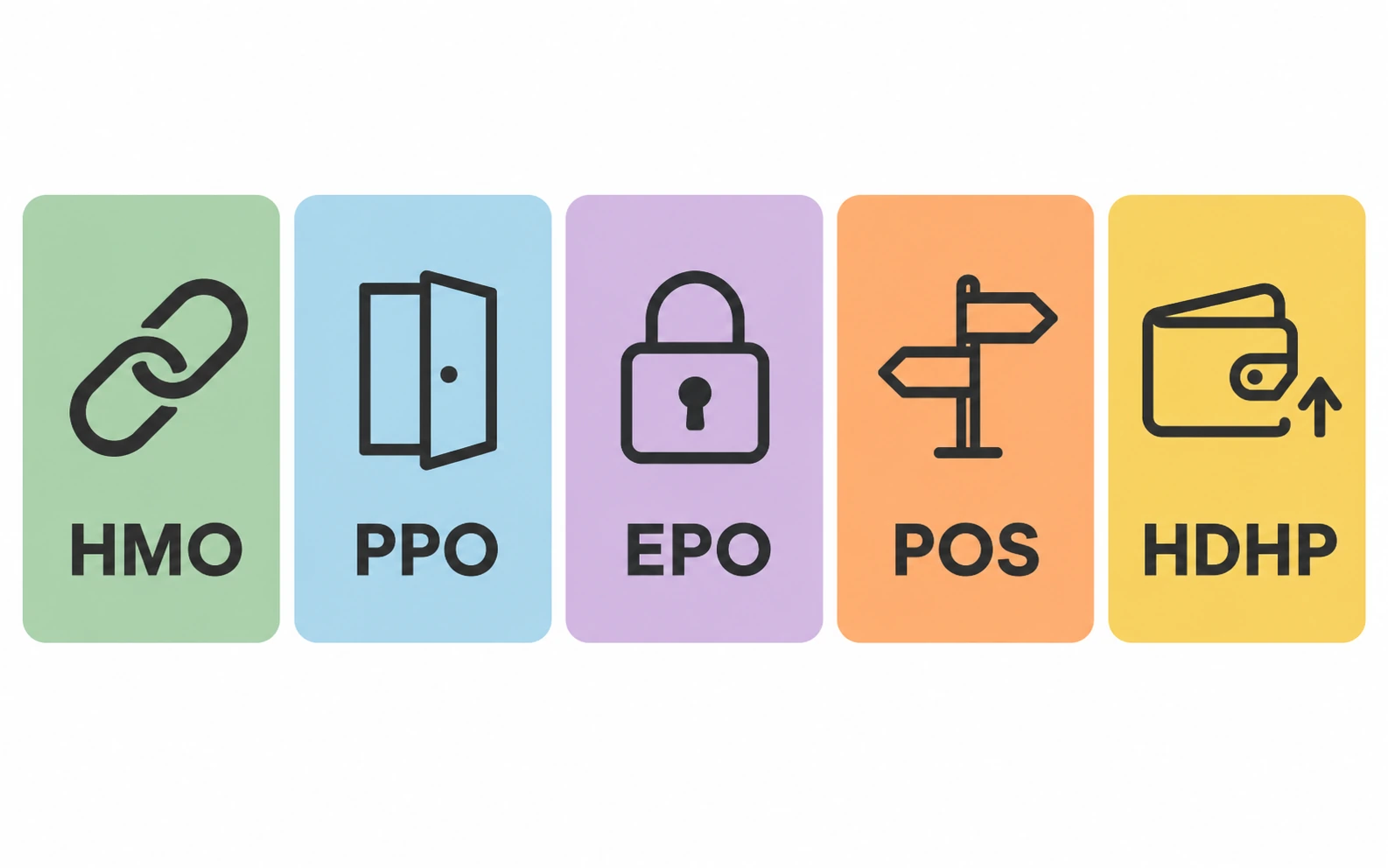
Understanding Your 5 Plan Options
Every employer’s benefits package will offer some combination of these five plan types. Here’s what each one means for you.
HMO (Health Maintenance Organization)
HMOs require you to choose a Primary Care Physician (PCP) who acts as your gatekeeper. You need a referral to see a specialist. Out-of-network care is only covered in emergencies.
Pros: Lower premiums and copays. Predictable, simple cost structure.
Cons: Zero flexibility. If your doctors aren’t in the network, they’re unusable. If you’ve moved cities, a parent’s HMO in another state is nearly useless to you.
Best at 22 when: You want the lowest monthly cost and you can verify your local doctors are in-network.
PPO (Preferred Provider Organization)
PPOs give you freedom. No required PCP, no referrals needed. You can see any specialist directly. Out-of-network care is allowed — it just costs more.
Pros: Maximum flexibility. Good if you have established specialists or want freedom to choose.
Cons: Higher premiums. More complex cost-sharing.
Best at 22 when: You have specific doctors you want to keep, or you travel frequently and need coverage flexibility.
EPO (Exclusive Provider Organization)
An EPO is a middle ground — no PCP required and no referrals, but like an HMO, you get zero out-of-network coverage except in true emergencies.
Pros: No referral hassle. Moderate premiums.
Cons: Strict in-network requirement.
Best at 22 when: You want some flexibility without paying PPO-level premiums, and your preferred providers are in-network.
POS (Point of Service)
A POS plan blends HMO and PPO features. It requires a PCP and referrals like an HMO, but does allow out-of-network care at higher cost.
Pros: Some out-of-network access with structured care management.
Cons: Referral requirement adds friction.
Best at 22 when: You want a bit of everything — uncommon in many employer plans.
HDHP (High-Deductible Health Plan)
An HDHP has a higher minimum deductible ($1,700 for individuals in 2026) and lower premiums. The critical advantage: it’s the only plan type that makes you eligible to open and fund a Health Savings Account (HSA).
Pros: Lower premiums. HSA access with triple tax advantage. Employer may contribute to your HSA.
Cons: You pay more out of pocket before coverage kicks in. Not ideal if you have chronic conditions or expensive prescriptions.
Best at 22 when: You’re generally healthy, rarely need care, and want to build long-term tax-free savings. For most healthy 22-year-olds, this is the strongest financial choice.
Quick Plan Comparison Table
| Plan | PCP Required | Referrals | Out-of-Network | Best Scenario at 22 |
|---|---|---|---|---|
| HMO | Yes | Yes | No (emergency only) | Low cost, local care verified |
| PPO | No | No | Yes (higher cost) | Flexibility, specialist access |
| EPO | No | No | No (emergency only) | Mid-range cost, no referral |
| POS | Yes | Sometimes | Yes (higher cost) | Hybrid needs |
| HDHP | Varies | Varies | Varies | Healthy + HSA savings strategy |
HDHP + HSA: The Best Move Most 22-Year-Olds Miss
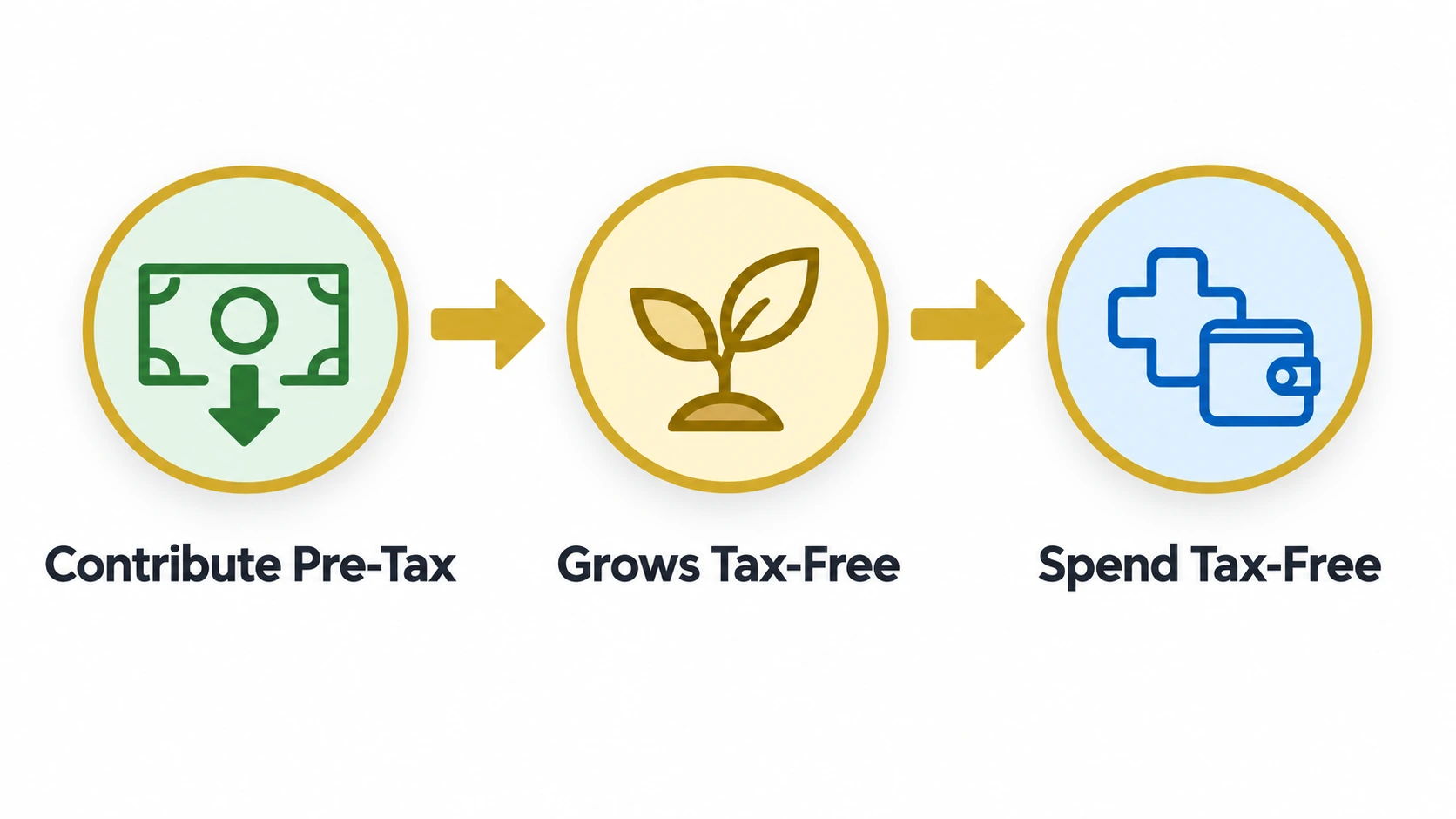
Here’s something no one told you at orientation: pairing an HDHP with a Health Savings Account is likely the single best financial move available to a healthy 22-year-old in their first job.
And nearly everyone skips it.
What Is an HSA?
A Health Savings Account is a tax-advantaged account that can only be opened if you’re enrolled in an HSA-eligible HDHP. You contribute money, and you can use it to pay for qualified medical expenses — tax-free.
But calling it just a “medical spending account” dramatically undersells it.
The Triple Tax Advantage
The HSA gives you three separate tax benefits no other account offers:
- Contributions are pre-tax. Money goes in before federal and state income taxes. At a 22% federal tax bracket, a $4,400 HSA contribution saves you $968 in federal taxes in that year alone.
- Investment growth is tax-free. Once your balance passes a threshold (typically $1,000–$2,000), you can invest it in mutual funds, just like a 401(k). That growth is never taxed.
- Withdrawals for medical expenses are always tax-free. Pull money out to pay any qualified medical expense — dental, vision, doctor visits, prescriptions — and you owe zero tax on it. Ever.
No other account — not your Roth IRA, not your 401(k) — gives you all three of these simultaneously.
The HSA “Super-Power” Strategy
Here’s the advanced play that zero competitors explain:
Pay medical bills out of pocket now. Save receipts. Reimburse yourself from your HSA years — or decades — later.
There is no IRS time limit on HSA reimbursements. If you pay a $200 doctor bill out of pocket today and keep the receipt, you can withdraw $200 tax-free from your HSA in 2045 when your balance has grown through three decades of investment returns.
This turns your HSA into a stealth retirement account. The money compounds tax-free for decades and comes out tax-free. That’s more powerful than a Roth IRA in many scenarios.
After age 65, HSA withdrawals for non-medical purposes are simply taxed as ordinary income — making it function identically to a Traditional IRA. There’s no penalty. You can’t lose.
The Math at Entry Salary
Let’s run the numbers for a healthy 22-year-old earning $55,000:
Year 1 HSA contribution: $4,400
- Federal tax savings at 22% bracket: $968
- $4,400 invested at 7% annual return for 40 years = ~$66,000 tax-free
That’s a $66,000 medical expense fund — from one year’s contributions — that you never paid income tax on, and will never pay income tax on when you use it for qualified expenses.
2025–2026 HSA Limits
| Year | Individual Contribution Limit | Family Limit |
|---|---|---|
| 2025 | $4,300 | $8,550 |
| 2026 | $4,400 | $8,750 |
Source: IRS inflation-adjusted HSA limits. 2026 figures are confirmed (not projections) as of this update.
HSA vs. FSA: Which One?
Many employers offer both. Here’s how they differ:
| Feature | HSA | FSA |
|---|---|---|
| Requires HDHP? | Yes | No |
| Rolls over? | 100%, forever | Up to $680 carryover in 2026 |
| Investable? | Yes | No |
| Portable? | Yes — yours forever | Employer-owned; you lose it if you leave |
| Best for? | Long-term wealth building | Known upcoming expenses |
The verdict: If you qualify for an HSA, prioritize it. An FSA is useful for predictable known costs (glasses, dental work) but is structurally inferior for long-term value.
⚠️ Critical Mistake to Avoid: Enrolling in an HDHP and not opening or funding the HSA. You get all the risk of a high deductible with none of the tax reward. If you choose an HDHP, open and fund the HSA on Day 1.
💡 Ask HR: Does your employer contribute to your HSA? Many do — anywhere from $250 to $1,000 per year as a benefit. That free money dramatically improves the HDHP math in your favor.
Disclaimer: The above is educational content about how HSAs work and does not constitute personalized financial or tax advice. Consult a Certified Financial Planner or tax advisor for guidance specific to your situation.
Parent’s Plan vs. Your Employer’s Plan
One of the most uniquely 22-year-old decisions you’ll make: do you stay on your parents’ health plan or enroll in your own?
The ACA Age-26 Rule
Under the Affordable Care Act, you can stay on a parent’s health plan until your 26th birthday — regardless of your employment status, marital status, tax dependency, income, or geographic location.
That sounds great. And often it is. But there are important nuances to check before you assume it’s the right move.
Side-by-Side Comparison
| Factor | Parent’s Plan | Your Employer’s Plan |
|---|---|---|
| Monthly cost to you | Often $0 (if parent absorbs) | Employee share deducted from paycheck |
| Geographic network | May not cover your city (HMO risk) | Designed for your area |
| HSA eligibility | Only if you’re NOT a tax dependent | Available with HDHP |
| Privacy (EOBs) | Goes to plan holder (your parents) | Goes to you |
| Waiver credit | Ask HR — you may get cash for opting out | N/A |
| Expiration | Your 26th birthday | Ongoing |
The Geographic Network Warning
This is the most important practical risk of staying on a parent’s plan — and almost no one mentions it.
If your parents have an HMO based in Ohio, and you’ve taken a job in Austin, Texas, that plan may provide zero coverage for non-emergency care in Texas. HMOs only cover you within their provider network. Out-of-network care — except in emergencies — isn’t covered at all.
Before you stay on a parent’s HMO, call the insurance company and ask: “Does this plan cover routine and specialist care in [your city]?” If the answer is no, or if you need to find in-network providers in your new city and the list is thin, you’re better off on your employer’s plan.
PPOs on a parent’s plan are generally safer geographically, but still worth verifying.
The Privacy Consideration
When you use a parent’s health plan, your Explanation of Benefits (EOB) goes to the primary account holder — your parent. If you’re seeing a therapist, seeking reproductive healthcare, or visiting any provider you’d prefer to keep private, your visit details will show up on that EOB.
This is a meaningful consideration for mental health and sexual health appointments in particular. If privacy matters to you, your own employer plan — with EOBs going directly to you — is the better choice.
Ask HR About the Waiver Credit
Here’s an exclusive tip that no competitor covers:
Ask HR this exact question: “Do you offer an employee waiver credit if I opt out of coverage?”
Some employers pay employees $50–$200 per month in cash if they waive employer-sponsored coverage because they have other coverage (like a parent’s plan). This money is taxable, but it can meaningfully change the cost math.
If your employer offers a $100/month waiver credit, that’s $1,200 per year that could partially or fully offset what you’d pay on your own plan. Check before you decide.
How to Calculate Which Plan Actually Costs Less
The biggest mistake in plan selection is choosing the plan with the lowest monthly premium. That plan almost never has the lowest total annual cost.
Here’s the formula every 22-year-old should run:
(Monthly Premium × 12) + Estimated Out-of-Pocket Costs = Total Annual Cost
Run this for two scenarios: a healthy year (only preventive care, no major bills) and a moderate year ($2,000–$3,000 in actual medical spending).
Real-Dollar Scenario: 22-Year-Old, $55K Salary
Let’s compare a Bronze HDHP versus a Gold PPO:
| Scenario | HDHP ($150/mo premium, $3,000 deductible) | PPO ($280/mo premium, $500 deductible) |
|---|---|---|
| Healthy year — premiums | $1,800 | $3,360 |
| Healthy year — OOP | $0 | $0 |
| HSA tax savings (22% bracket, $4,400 contribution) | −$968 | N/A |
| Healthy year — NET total | $832 | $3,360 |
| Moderate year — premiums | $1,800 | $3,360 |
| Moderate year — OOP | $2,500 | ~$700 (deductible + copays) |
| HSA tax savings | −$968 | N/A |
| Moderate year — NET total | $3,332 | ~$4,060 |
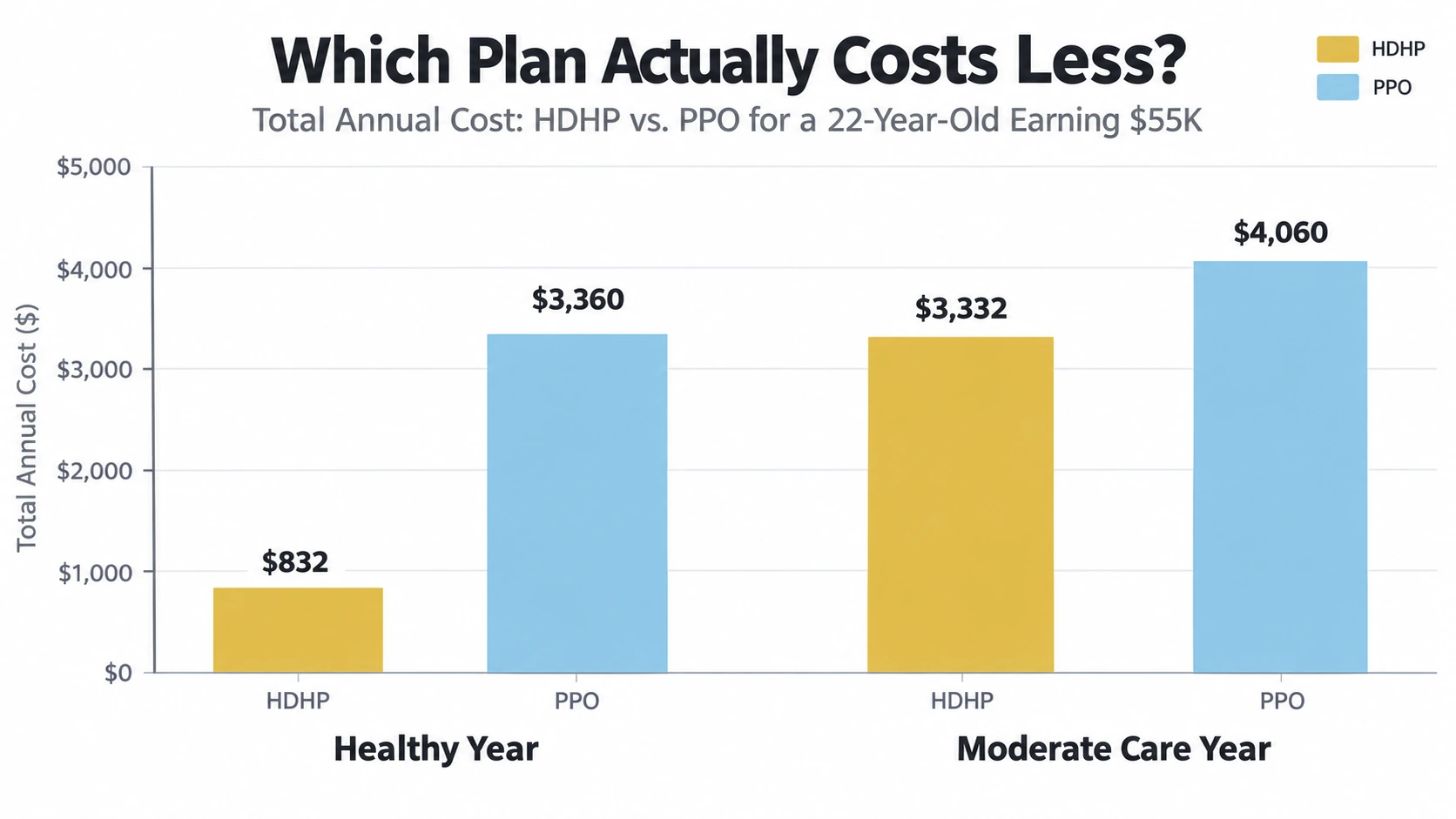
In both scenarios, the HDHP with a funded HSA wins. The HSA tax savings function as a built-in discount that competitors never factor into their plan comparisons.
When the PPO (or Higher-Premium Plan) Makes More Sense
The HDHP math changes if you:
- Have a chronic condition requiring regular specialist visits
- Take brand-name or specialty medications at high formulary tiers
- Expect to need frequent mental health appointments
- Anticipate surgery or a major medical event in the year
Run your own numbers. The goal is honest math, not a one-size-fits-all answer.
Your 7-Step Plan Selection Framework
Use this framework during your actual enrollment window.
Step 1 — Estimate your real healthcare use. Think back: how many times did you see a doctor last year? Do you take any regular prescriptions? Do you have any upcoming planned procedures? Be honest. Most healthy 22-year-olds: 0–2 visits per year.
Step 2 — List all available plans with their full cost structure. For each plan, note: plan type, your monthly premium share, deductible, OOP max, and whether it’s HSA-eligible. This is all in the Summary of Benefits and Coverage (SBC) document.
Step 3 — Verify your doctors are in-network. Before you enroll, go to the insurance company’s provider search tool and confirm your current doctor (and any specialists you use) are in-network. For an HMO or EPO, this is non-negotiable.
Step 4 — Check your prescriptions on each plan’s formulary. If you take any regular medications, search each plan’s drug formulary and find your medication’s tier. Tier 1 = cheap. Tier 4 = potentially $150–$500+/month. This can flip the total cost math dramatically.
Step 5 — Calculate total annual cost for both scenarios. Healthy year + Moderate care year. Use the formula above. Don’t skip the HSA tax savings math if you’re comparing an HDHP.
Step 6 — Factor in employer HSA contributions. If your employer adds money to your HSA, subtract that from your HDHP’s total cost. It’s free money. Add it to the equation.
Step 7 — When in doubt, choose the lower OOP maximum. If two plans come out roughly equal in your math, the lower out-of-pocket maximum protects you from worst-case scenarios. That ceiling matters more than the premium difference in most cases.
Enrollment Timelines: When Every Window Opens and Closes
| Scenario | Window | Key Notes |
|---|---|---|
| New job (employer plan) | 30–60 days from start date | Your SEP. Enroll on Day 1 if possible. Missing it = wait until annual OE. |
| Annual employer OE | Employer-defined (typically Oct–Nov) | Re-enrollment window. Review all options annually. |
| ACA Marketplace OE 2026–27 (current) | Nov 1, 2026 – Jan 15, 2027 | Enroll by Dec 15, 2026 for Jan 1, 2027 coverage. Dec 16, 2026–Jan 15, 2027 enrollment = Feb 1, 2027 start. Most states; CA, NY, NJ, and DC extend to Jan 31, 2027; VA to Jan 29, 2027; RI closes earlier, Dec 31, 2026. |
| ACA OE 2027–28 (next cycle) | Not yet announced | CMS typically confirms dates by mid-to-late summer. Check HealthCare.gov closer to fall 2027. |
| Qualifying life event SEP | 60 days from event | Marriage, birth, loss of coverage, moving to new coverage area, turning 26. |
| Missed OE (no SEP) | Wait until next annual OE | Marketplace bridge plan may be available if employer plan is unaffordable. |
New-job timing matters more than most people realize. Your employer’s enrollment window is typically 30–60 days from your start date. If you start October 1 and miss the November 1 deadline, you could be uninsured until the following October. That’s 10+ months — and one emergency visit during that gap could cost you $10,000 or more without insurance.
Qualifying life events that open a 60-day SEP:
- Starting a new job with benefits
- Turning 26 and losing parent’s coverage
- Getting married or divorced
- Having or adopting a child
- Moving to a new coverage area
- Losing other coverage (involuntarily)
Not qualifying events: Voluntarily dropping coverage, changing your mind, getting a raise. These do not open an SEP.
Supplemental Benefits: What to Elect, What to Skip
Open enrollment covers more than health insurance. Here’s a quick guide to the supplemental benefits you’ll likely see and what to do with each.
| Benefit | Recommendation at 22 | Key Reason |
|---|---|---|
| Dental | Yes (if employer contributes) | 2 free cleanings per year + cavity coverage. ~$20–$40/mo employee cost. Often saves more than it costs. |
| Vision | Yes (if you wear glasses/contacts) | Annual exam + $100–$200 lens/frame allowance for $5–$15/mo. Skip if you have perfect vision. |
| Basic Life Insurance | Accept the free employer coverage | Usually 1–2× salary at no cost. Sufficient at 22 with no dependents. |
| Supplemental Life | Skip for now | Only needed if parents or a partner depend on your income. Not typical at 22. |
| Short-Term Disability (STD) | Yes, if available | Covers 60–90 days of income if you can’t work due to illness or injury. Good safety net for surgeries. |
| Long-Term Disability (LTD) | Strongly yes | More important than most realize. See below. |
| FSA | Useful for known upcoming costs | Use if you have predictable dental, vision, or medical expenses this year. Remember it’s use-it-or-lose-it. |
Why Long-Term Disability Insurance Matters at 22
This is the supplemental benefit most young workers ignore. It’s also the one with the strongest case for action.
Long-term disability insurance replaces 60–70% of your income if a serious illness or injury prevents you from working for an extended period.
Here’s why 22 is the best time to elect it:
- Group LTD rates through your employer are at their lowest lifetime cost when you’re young and healthy.
- Individual LTD policies outside employer groups cost dramatically more.
- According to the Council for Disability Awareness, 1 in 4 workers will experience a disabling condition before retirement.
- A 22-year-old earning $55,000 who works to age 65 has $2.37 million in potential career earnings. LTD protects that entire future income stream.
Tax tip on LTD: If your employer gives you the choice of paying LTD premiums with pre-tax or post-tax dollars, choose post-tax. If you pay pre-tax, any benefits you receive are taxable income. If you pay post-tax, your disability benefits come out tax-free — far more valuable if you ever actually need to file a claim.
Free Preventive Care — and the Billing Caveat Nobody Warns You About
Under the ACA, all compliant health plans must cover the following services at $0 cost to you — regardless of whether you’ve met your deductible.
Services covered for free:
- Annual physical / wellness exam
- Blood pressure, cholesterol, and diabetes screenings
- Depression and mental health screenings
- STI, HIV, Hepatitis B and C screenings
- All ACIP-recommended vaccines (flu, COVID-19, HPV, Tdap, MMR, and others)
- Contraceptive methods and counseling (all FDA-approved methods for women)
- Tobacco cessation counseling
You’ve already paid for these services through your monthly premiums. Not using them is leaving captured value on the table.
The Billing Caveat That Can Cost You Money
Here’s the insider tip most new insurance users don’t know:
If you mention a specific symptom or complaint during a “wellness visit,” the provider may code part of the visit as diagnostic — which is NOT free and IS subject to your deductible.
Example: You go in for your free annual physical. You mention that your knee has been hurting. The doctor examines your knee. That knee examination may now be billed as a diagnostic visit, not a preventive one — and you could receive a surprise bill.
The fix: Schedule separate appointments. Get your free annual physical with zero symptom discussion. If you have a specific concern, book a separate appointment for it.
What Is an EOB — And Why You Should Never Pay It Immediately
After any healthcare visit, you’ll receive a document in the mail (or in your online portal) from your health insurer. It’s called an Explanation of Benefits (EOB).
It is not a bill.
An EOB shows:
- What your provider billed
- The negotiated (discounted) rate your insurer has with that provider
- What your insurer paid
- What portion — if any — you may owe
The critical word is “may owe.” The EOB is informational. It’s telling you what happened in the claim process, not asking you to pay anything.
The actual bill comes separately — directly from your doctor, hospital, or lab, usually 2–6 weeks after your visit.
Common (and costly) mistake: Receiving an EOB and writing a check immediately. This can result in double-paying — once from the EOB (incorrectly) and again when the real provider bill arrives.
What to do: Receive the EOB. Review it for accuracy. Wait for the provider’s actual bill. Compare the two. Then pay the provider’s bill if it matches what you expected.
What Is Prior Authorization?
Prior authorization (also called “prior auth” or “PA”) is when your insurance company requires pre-approval before covering certain medical services, procedures, or prescriptions.
Common triggers for prior authorization:
- MRIs, CT scans, and certain imaging studies
- Elective surgeries and certain outpatient procedures
- Brand-name medications when a generic alternative exists
- Specialist referrals for certain conditions
- Mental health inpatient treatment
What happens without it: Your claim can be denied. An MRI that would have cost you your normal cost-share could instead cost you the full $1,500–$3,000 out of pocket with no insurance contribution.
What to do:
- When a doctor orders a procedure or medication, ask: “Does this require prior authorization from my insurance?”
- If yes, confirm that your doctor’s office has submitted the request.
- Get the authorization number before the procedure happens.
- If authorization is denied, you have the right to appeal.
Always verify before you show up for a procedure. A quick call to your insurer — or a note in your patient portal — can save you thousands.
The 10 Biggest Enrollment Mistakes at 22
- Skipping health insurance entirely. One ER visit without insurance can generate $10,000–$100,000+ in bills. There is no safe version of going uninsured at 22.
- Choosing the plan with the lowest premium. The premium is one number. The total annual cost is the number that actually matters. Always calculate both.
- Enrolling in an HDHP without opening or funding the HSA. This is the most common HDHP mistake. You take on all the deductible risk with none of the tax reward. Open the HSA. Fund it.
- Not verifying your doctors are in-network. On an HMO or EPO, an out-of-network doctor means you pay the full bill. Always confirm before enrolling.
- Missing the new-job enrollment deadline. Your 30–60 day SEP window is firm. Miss it and you’re uninsured until the next annual OE — which could be 6–10 months away.
- Waiving supplemental benefits without evaluating them. Long-term disability and dental insurance are commonly worth electing at 22. Don’t auto-decline everything.
- Not checking your prescriptions on the formulary. A medication that’s $10/month on one plan can be $300/month on another. Always check before you choose.
- Treating the EOB as a bill and paying it. Wait for the actual provider bill. The EOB is informational only.
- Staying on a parent’s HMO without verifying network coverage in your city. Geographic mismatch means near-zero coverage outside emergencies.
- Not using the free preventive care you’ve already paid for. Your annual physical, vaccines, screenings, and mental health check are covered at $0. Use them.
What to Do If You Missed Open Enrollment
First: check whether you actually have a qualifying life event that opens an SEP. Starting a new job is an SEP. Turning 26, losing other coverage, getting married — all of these open a 60-day window. If one of these applies to you, contact HR or HealthCare.gov immediately.
If you genuinely have no SEP:
Option 1 — COBRA. If you recently left a job with benefits, you can continue that coverage under COBRA for up to 18 months. Warning: COBRA is expensive — you pay the full premium your employer was covering, plus a 2% admin fee. But it buys you continuous coverage.
Option 2 — ACA Marketplace. If your employer doesn’t offer coverage (or offers unaffordable coverage), you can enroll in a Marketplace plan during the ACA’s OE window even without an SEP. If your income qualifies, you may receive premium tax credits that make these plans much more affordable.
Option 3 — Medicaid. If your income is at or below 138% of the federal poverty level (about $22,025 for a single adult in 2026), you may qualify for Medicaid — which has no enrollment window. You can apply any time. (States apply this threshold on their own timelines, so confirm the exact figure with your state Medicaid office.)
Option 4 — Wait and stay careful. If you have no good options and the gap will be brief, some people choose to wait. This is a real financial risk. One unexpected ER visit can cost more than a year’s premiums. Avoid this if any affordable option exists.
The bottom line: don’t panic, but don’t ignore it. Contact HR if you’re close to your new-job deadline. Act within your 60-day SEP window if you have a qualifying event.
The Turning 26 Cliff: Plan Now or Pay Later
The ACA age-26 rule is a real benefit. But it has a hard expiration date — your 26th birthday — and the transition requires advance planning.
Here’s what typically happens:
- Coverage ends on your birthday or at the end of your birth month, depending on your parent’s specific plan.
- After losing coverage, you have a 60-day Special Enrollment Period to enroll in your own plan.
- If you miss that 60-day window, you may be uninsured until the next annual OE.
Your 26th Birthday Planning Checklist
30–60 days before your birthday:
- Contact HR at your employer and notify them of your upcoming coverage loss
- Ask HR for the earliest enrollment date available under your employer’s SEP
- Review your employer’s plan options and run the cost comparison framework from Section 7
- Confirm the exact date your parent’s plan terminates (birthday vs. end of month)
- If not employer-covered, open HealthCare.gov and preview plan options for your area
- Set a calendar reminder to submit your enrollment paperwork before your birthday
On or after your birthday:
- Confirm enrollment in new plan is active
- Obtain and save your new insurance card
- Update your pharmacy and regular providers with new insurance information
- If applicable, open an HSA at your new plan provider
Don’t treat the turning-26 transition as a footnote. A coverage gap — even a few days — can be catastrophically expensive if you have an emergency during that window.
2026 Numbers Reference Table
All figures sourced from IRS inflation-adjustment guidance, CMS, and HealthCare.gov. 2026 figures below are confirmed as of this update (October 2026).
| Data Point | 2025 | 2026 |
|---|---|---|
| ACA OOP Maximum (individual) | $9,200 | $10,600 |
| ACA OOP Maximum (family) | $18,400 | $21,200 |
| HDHP Minimum Deductible (individual) | $1,650 | $1,700 |
| HDHP Max OOP (individual) | $8,300 | $8,500 |
| HSA Contribution Limit (individual) | $4,300 | $4,400 |
| HSA Contribution Limit (family) | $8,550 | $8,750 |
| Healthcare FSA Limit | $3,300 | $3,400 |
| FSA Carryover Maximum | $660 | $680 |
| Employer Affordability Threshold (ACA) | 9.02% of household income | 9.96% of household income |
| ACA Marketplace OE | Nov 1, 2025 – Jan 15, 2026 (past cycle) | Nov 1, 2026 – Jan 15, 2027 (current cycle) |
Note: Figures above reflect confirmed IRS and CMS amounts as of this update (October 2026). Always verify at irs.gov and healthcare.gov before making enrollment decisions, in case of later revisions.
Complete Enrollment Checklist
BEFORE Enrollment (Preparation)
- Gather all plan documents (SBC, benefits summary) from HR portal
- List your current doctors and regular prescriptions
- Verify doctor network status on each plan under consideration
- Check formulary tiers for any regular medications
- Decide if you’re enrolling in employer plan or staying on parent’s plan
- If considering parent’s plan: verify geographic network coverage in your city
- Ask HR: Do you offer an employee waiver credit for opting out?
- Calculate total annual cost for 2–3 plan scenarios (healthy year + moderate year)
DURING Enrollment
- Select your health plan before the deadline
- If selecting HDHP: confirm HSA eligibility and open HSA account
- Elect dental coverage (if employer contributes)
- Elect vision coverage (if you wear glasses or contacts)
- Elect short-term disability (if available)
- Elect long-term disability — consider paying premiums post-tax
- Decline supplemental life unless dependents rely on your income
- Screenshot or save your completed election confirmation page
AFTER Enrollment
- Save your insurance cards (digital + physical)
- Log in to your insurer’s member portal and verify coverage is active
- Open and fund your HSA if enrolled in HDHP
- Set up HSA auto-contribution in payroll system
- Schedule your free annual physical (your $0 preventive care)
- Save all medical receipts for potential future HSA reimbursement
- Add turning-26 birthday as a calendar reminder with 60-day pre-action flag
FAQ
When is open enrollment for my first job?
When you start a new job, your enrollment window is a Special Enrollment Period — typically 30 to 60 days from your official start date. This is separate from the annual OE season (typically October–November). Contact HR on Day 1 and ask for your specific enrollment deadline. Missing it means waiting until the next annual OE, which can be 6–10 months away.
What happens if I miss open enrollment at my new job?
If you miss your new-job SEP without a qualifying life event, you generally cannot enroll in employer coverage until the next annual OE. Depending on when you started, that gap can be 6–10 months. Options during the gap include COBRA (if applicable), a Marketplace plan (if your employer’s offer is unaffordable), or Medicaid (if income-eligible). Contact HR immediately if you think you’re near the deadline — some employers have flexibility.
Should I stay on my parents’ insurance or get my own?
Compare four things: (1) Total cost to you on each plan, (2) Whether the parent plan’s network covers your city, (3) HSA access — which you only get with your own HDHP, and (4) Privacy — your EOBs go to the plan holder on a parent’s plan. If the parent plan is free or nearly free and covers your geographic area, it can be the right choice. But verify the network and ask HR about a waiver credit before deciding.
What is an HSA and should I open one at 22?
A Health Savings Account is a triple-tax-advantaged savings account only available with a qualifying HDHP. You contribute pre-tax dollars, investments grow tax-free, and withdrawals for medical expenses are always tax-free. For a healthy 22-year-old, it’s often the best single financial move available in a first job. The 2026 individual contribution limit is $4,400. Open it the same day you enroll in your HDHP — don’t wait.
What is the difference between a deductible and an out-of-pocket maximum?
A deductible is what you pay before most insurance coverage kicks in. An out-of-pocket maximum is the most you will ever pay in a single plan year — after which your insurance covers 100% of covered in-network costs. Example: $2,000 deductible, $7,000 OOP max. You pay the first $2,000 fully. After that, you pay your coinsurance share (say, 20%) until you hit $7,000. After $7,000, insurance covers everything.
Can I stay on my parents’ insurance after starting a new job?
Yes. Under the ACA, you can remain on a parent’s plan until your 26th birthday regardless of your employment status or income. However, verify that the plan’s provider network covers your geographic area. An HMO in one state may provide near-zero coverage in a different state except for true emergencies.
Is it better to choose a plan with a lower monthly premium?
Not necessarily. The premium is only one component of total annual cost. Add the premium × 12 to your expected out-of-pocket costs (deductible, copays, coinsurance). A plan with a lower premium often has a much higher deductible — which can cost you more in a moderate care year. Always run the full annual cost calculation before choosing.
What should I do when I turn 26?
Start planning 30–60 days before your birthday. Contact HR about your employer’s Special Enrollment Period for this qualifying life event. Confirm the exact date your parent’s plan terminates (birthday vs. end of birth month). Submit your employer plan enrollment before the deadline to avoid any gap in coverage. You have a 60-day SEP window after losing your parent’s plan — use it promptly.
Conclusion
Your first benefits enrollment season doesn’t have to feel like guessing at a test you never studied for.
The concepts behind health insurance open enrollment are genuinely learnable. Premiums, deductibles, and out-of-pocket maximums follow a clear logic. The HDHP + HSA combination has a math advantage that most new employees never discover. And the specific choices available to you at 22 — the age-26 option, the waiver credit, the disability insurance window — won’t be available to you forever.
Here’s what to take away:
- Run the total annual cost calculation, not just the premium comparison.
- If you’re healthy, model the HDHP + HSA path seriously. The triple tax advantage is real.
- If you’re staying on a parent’s plan, verify the geographic network before assuming it covers you.
- Don’t treat the turning-26 cliff as a future problem. Start planning at 25.
- Use your free preventive care — it’s already paid for.
- Ask HR about the waiver credit. It’s an exclusive, actionable question that could pay you cash.
If you have more questions than this guide answered, or if your situation is complex — chronic conditions, expensive medications, a specific specialist you rely on — talk to a licensed insurance broker or your HR benefits team. Most HR departments are happy to walk you through your options.
And one final reminder: enroll on Day 1. The window is shorter than it feels.
This article is for educational purposes only and does not constitute medical, legal, or financial advice. Consult your employer’s HR/benefits team, a licensed insurance broker, or a Certified Financial Planner for guidance specific to your situation. Dollar figures and dates referenced are based on confirmed 2026 IRS and CMS published limits as of this update.
Have a question about your first enrollment decision? Leave a comment below — we read every one.
This guide is one piece of our complete First Job Money Guide — covering everything from reading your first pay stub to picking employee benefits.
If your plan turns out to be HSA-eligible, the next decision is HSA vs FSA: Which Should You Choose at Your First Job? — worth deciding before your enrollment window closes.