
HSA vs FSA: Which Should You Choose at Your First Job?
About 43% of eligible employees skip both accounts entirely. They glance at the benefits enrollment form, see two similar-looking acronyms, panic, and just move on. A few months later they’re paying full price for an urgent care visit that should have cost them nothing.
If you’ve just landed your first real job and you’re staring at an open enrollment form with “HSA” and “FSA” on it — this article is for you.
Both accounts let you set aside pre-tax money for medical expenses. But they work very differently, they’re not always interchangeable, and picking the wrong one (or skipping both) can cost you real money.
In this guide, you’ll get a plain-language breakdown of what each account actually does, a side-by-side comparison with current 2026 IRS limits, real dollar math to show you the savings difference, and a simple framework to figure out which one fits your situation.
We’ll also cover something almost no other guide mentions: the 2026 law changes from the One Big Beautiful Bill (OBBBA 2025) that expanded HSA access in ways that directly affect new employees on marketplace or ACA plans.
By the end, you’ll know exactly what to pick — and why.
What Is an HSA?
An HSA (Health Savings Account) is a tax-advantaged account you own and control. You put pre-tax money in, it grows tax-free, and you withdraw it tax-free for qualified medical expenses. That’s three separate tax advantages — which is why people in the financial independence community call it the most powerful tax-advantaged account in the U.S. tax code.
Here’s what makes it unique:
- You own it. It stays with you when you change jobs, get laid off, or retire.
- It rolls over. Unused money never expires. Ever. It just keeps accumulating.
- You can invest it. Once your balance hits a certain threshold (varies by provider), you can invest in index funds or other options inside the account and let it grow.
- It turns into an IRA at 65. After age 65, you can withdraw HSA funds for any reason — not just medical — and pay regular income tax on it, just like a Traditional IRA. No penalty.
2026 Contribution Limits (current):
- Individual coverage: $4,400
- Family coverage: $8,750
- Catch-up (age 55+): +$1,000
(For reference, 2025 limits were $4,300 individual / $8,550 family.)
The catch: You can only open and contribute to an HSA if you’re enrolled in a qualifying High-Deductible Health Plan (HDHP). More on that in a moment.
What Is an FSA?
An FSA (Flexible Spending Account) is an employer-sponsored benefit that lets you set aside pre-tax dollars for medical expenses. It saves you money on taxes — but it works very differently from an HSA.
Key things to know:
- The employer owns it. It doesn’t travel with you. When you leave the job, unused FSA money stays with your employer (in most cases).
- Use it or lose it. FSA funds generally expire at the end of the plan year. Your employer may offer a grace period (up to 2.5 months) or a carryover allowance, but not both, and not all employers offer either.
- Day 1 full access. This is FSA’s biggest practical advantage. Your entire annual election is available to you from January 1 — even if you haven’t contributed that much yet. It’s essentially an interest-free advance from your employer.
- No investment option. FSA funds sit in a non-interest-bearing account. They don’t grow.
2026 Contribution Limits (current):
- Health FSA: $3,400
- Dependent Care FSA: $7,500
- Maximum carryover: $680
(For reference, 2025 limits were $3,300 health FSA / $5,000 dependent care FSA / $660 carryover.)
You don’t need an HDHP to have a general-purpose FSA. Most employer health plans — PPO, HMO, and others — are FSA-compatible.
HSA vs FSA: Side-by-Side Comparison
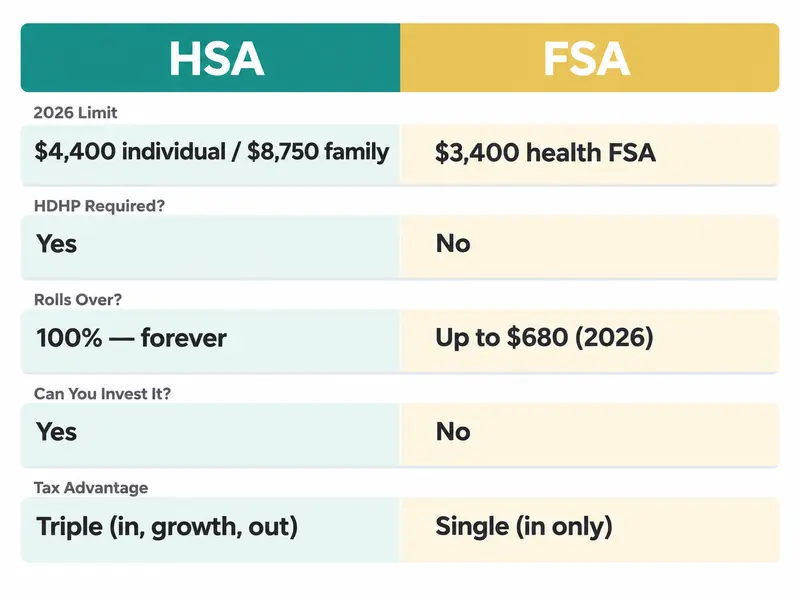
| Feature | HSA | FSA |
|---|---|---|
| Who owns the account? | You | Your employer |
| HDHP required? | Yes | No |
| 2026 Contribution Limit (current) | $4,400 (individual) / $8,750 (family) | $3,400 (health) / $7,500 (dependent care) |
| 2025 Contribution Limit (for reference) | $4,300 / $8,550 | $3,300 / $5,000 |
| Rollover rule | 100% rolls over forever | Expires at year-end (up to $680 carryover in 2026) |
| Portability | Fully portable — stays with you | Lost when you leave the employer |
| Investment option | Yes — can invest in funds | No |
| Day 1 access to full election? | No — only what you’ve contributed | Yes — full annual election available immediately |
| Can you have both? | HSA + Limited Purpose FSA only | Yes, but not with an HSA (except LPFSA) |
| Tax advantage | Triple (contribution + growth + withdrawal) | Single (pre-tax contribution only) |
| Employer contributions? | Common — many employers contribute | Rare — only ~4% of employers contribute |
| After age 65 | Any use allowed (taxed as income; no penalty) | N/A — FSA is use-it-or-lose-it |
The #1 Deciding Factor: Do You Have an HDHP?
Before you spend any time comparing features, answer this one question: does your employer offer a High-Deductible Health Plan, and are you enrolled in it?
If the answer is no — you can stop reading about HSAs. You’re not eligible. A general-purpose FSA is your only pre-tax option (outside of a dependent care FSA).
If yes — you’re HSA-eligible, which opens the door to the more powerful account.
What counts as an HDHP in 2026 (current)?
| Minimum Deductible | Maximum Out-of-Pocket | |
|---|---|---|
| Individual | $1,700 | $8,500 |
| Family | $3,400 | $17,000 |
(For reference, 2025 thresholds were $1,650 / $8,300 individual and $3,300 / $16,600 family.)
HDHPs typically have lower monthly premiums than PPO or HMO plans. The tradeoff is a higher deductible — meaning you pay more out of pocket before insurance kicks in. For healthy young people who don’t anticipate many medical expenses, this is often a net positive.
The HDHP + HSA combo is a frequently misunderstood strategy. Some people look at the high deductible and run the other way. But when you factor in the lower premiums plus the HSA tax savings plus employer HSA contributions (which many companies offer), the math often favors the HDHP even for people with moderate medical needs.
Real Dollar Tax Savings: What the Math Actually Looks Like
Here’s something most benefits guides skip — the actual dollar difference.
Let’s say you earn $60,000/year and you’re in the 22% federal tax bracket.
| Scenario | Pre-Tax Contribution | Annual Tax Savings |
|---|---|---|
| Nothing | $0 | $0 |
| FSA (max $3,400) | $3,400 | ~$1,178 |
| HSA (max $4,400) | $4,400 | ~$1,525 |
At maximum contributions, the HSA saves you about $347 more per year than the FSA — just from the higher contribution limit.
That’s not a massive difference on its own. But here’s where it changes:
- The FSA tax savings is your entire benefit. Once you spend the money, it’s gone.
- The HSA tax savings is just the starting benefit. The money then grows tax-free and comes out tax-free for medical expenses.
This brings us to the most important section in this article.
The HSA as a Retirement Account: The “Stealth IRA” Strategy
Most people treat their HSA like a spending account. They put money in, pay for doctor visits, and drain it every year. That’s a legitimate use — but it misses the biggest opportunity.
Here’s the strategy people in the financial independence community call the “stealth IRA” approach:
- Contribute the maximum to your HSA every year.
- Pay medical expenses out of pocket (using your regular paycheck) whenever you can afford to.
- Save your receipts. There’s no time limit on reimbursement — you can submit a receipt from 2026 to reimburse yourself in 2040.
- Let the HSA funds grow invested in index funds (or whatever your provider offers).
- In retirement, use the accumulated balance — reimbursing yourself for decades of saved receipts or paying future medical costs — all tax-free.
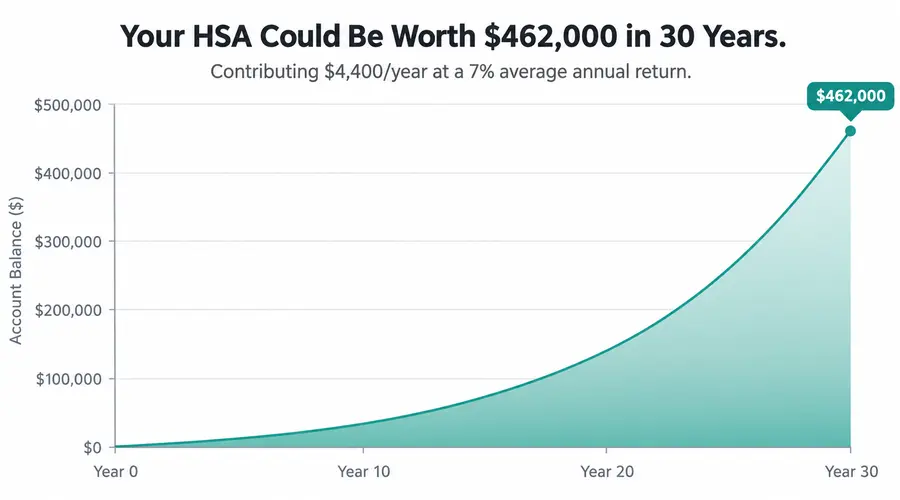
The math: If you contribute $4,400/year (the 2026 individual HSA limit) and earn a 7% average annual return, after 30 years you’d have approximately $462,000 in tax-free wealth.
For context: Fidelity’s latest retiree health care cost estimate puts the number a 65-year-old individual needs for healthcare in retirement at about $185,500. Milliman’s 2026 Retiree Health Cost Index puts a healthy 65-year-old couple’s savings target at around $418,000 (traditional Medicare with a Medigap supplement). Your maxed-out HSA can cover that entirely — with money left over.
The priority order that financial advisors recommend for young workers:
- Contribute to 401(k) up to the employer match (free money first)
- Max out your HSA
- Max out your Roth IRA
- Return to your 401(k)
Most young workers have never heard that HSA comes before Roth IRA in this order. But with its triple tax advantage — pre-tax contribution, tax-free growth, and tax-free medical withdrawals — the HSA technically beats the Roth IRA’s double advantage for healthcare spending.
When FSA Actually Makes More Sense
The HSA wins on paper for long-term wealth building. But FSA genuinely is the right choice for some people. Here’s when:
1. You’re not enrolled in an HDHP. This is the most common reason. If your employer’s only health plan is a PPO or HMO, you can’t open an HSA. FSA is your option.
2. You have predictable, significant medical costs coming up. Braces, surgery, regular therapy, prescription medications, planned procedures — if you know you’ll spend your full election, FSA’s Day 1 access makes it a practical, interest-free advance from your employer.
3. You’re worried about cash flow. If you can’t afford to pay a $300 dental bill out of pocket and wait months to reimburse yourself, FSA’s upfront access is more practical for your situation right now.
4. You value simplicity. FSA requires no investment decisions, no receipt-tracking strategy, and no worry about HDHP eligibility. Put money in. Spend on medical. Done.
5. Your employer contributes to your FSA. About 4% of employers contribute to FSAs. If yours does, that’s free money you shouldn’t walk away from.
One thing many people don’t know: if you leave your job mid-year after spending more FSA funds than you’ve contributed, you don’t owe the money back. Your employer takes that loss. This makes FSA quietly useful for people who might be changing jobs within the year — as long as they’re mindful about it.
The Combination You’ve Never Heard Of: LPFSA + HSA
Here’s the one thing almost no other first-job benefits guide covers — and it solves the most common objection to HSA adoption.
The objection sounds like this: “I need an FSA because I have to pay for glasses and dental work every year. I can’t give that up for an HSA.”
The answer: You don’t have to give it up. You can have both.
A Limited Purpose FSA (LPFSA) is a special version of the FSA that covers dental and vision expenses only. It can coexist with an HSA because it doesn’t overlap with the HSA’s coverage area.
So if you’re enrolled in an HDHP and eligible for an HSA, and you also have recurring dental and vision costs, you can:
- Open an HSA for all other medical expenses (and for investing long-term)
- Open an LPFSA for dental and vision specifically
The LPFSA has the same 2026 contribution limit as a regular health FSA: $3,400 (up from $3,300 in 2025).
This strategy lets you capture the HSA’s long-term advantages while still pre-funding predictable dental and vision costs with pre-tax dollars. Not all employers offer LPFSA as an option — check your benefits portal or ask HR.
Which Type of First-Jobber Are You? Persona Recommendations
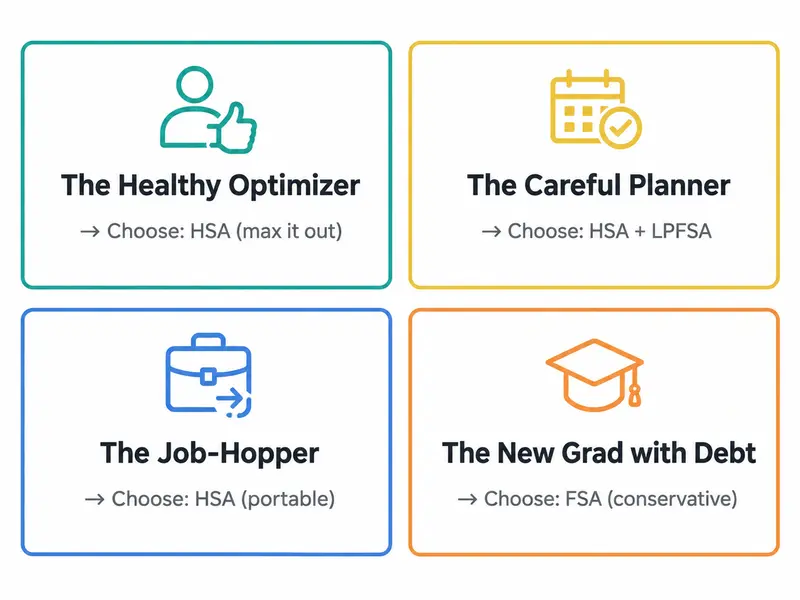
Every benefits guide gives you abstract rules. Here’s a more practical lens.
The Healthy Optimizer
Young, rarely sees a doctor, wants to build wealth
→ Choose: HSA (max contribution)
You’re in the ideal position for HSA. Low medical costs mean you can pay out of pocket, let the HSA compound for decades, and build a six-figure tax-free account. Focus on enrolling in the HDHP to unlock eligibility.
The Careful Planner
Has annual prescriptions, regular therapy, or planned dental work
→ Choose: FSA or LPFSA + HSA combination
If you’re on an HDHP, check if your employer offers LPFSA for dental/vision and open an HSA for everything else. If you’re not on an HDHP, a carefully budgeted FSA (contribute only what you’ll realistically spend) works well.
FSA Election Formula: Add up your known recurring costs + your deductible + a small buffer. Don’t over-elect. If you’re unsure, elect slightly less rather than more.
The Job-Hopper
Plans to change employers within 1–2 years
→ Choose: HSA (if HDHP-eligible)
The portability advantage of the HSA is critical for you. An FSA balance at your old employer disappears when you leave. Your HSA goes with you — contributions, invested balance, and all. This is one of the most underappreciated HSA advantages for Gen Z workers who expect to change jobs frequently.
The New Grad with Debt
Tight on cash, wants simplicity, unsure about medical costs
→ Choose: FSA (conservatively elected)
If cash flow is tight and you can’t absorb a high deductible right now, an FSA gives you Day 1 access and tax savings without the complexity of HDHP enrollment or investment decisions. Start small — $500–$1,000 — to get comfortable with the mechanics.
The One with an ACA/Marketplace Plan (New for 2026)*
Self-employed, gig worker, or buying insurance on the marketplace
→ Choose: HSA (starting 2026)
This is new. Under the OBBBA, bronze-level and catastrophic ACA marketplace plans are now treated as HSA-compatible starting in 2026 — even if they don’t meet the standard HDHP minimum deductible or maximum out-of-pocket thresholds. If this is you, you can now open and contribute to an HSA for the first time.
See the next section for more on these changes.
What’s New in 2026: OBBBA Law Updates
The One Big Beautiful Bill (OBBBA 2025), signed into law in July 2025, made three significant changes to HSA rules that take effect in 2026. These are not covered in most competitor articles.
Change 1: Telehealth Before Deductible — Now Permanent
Before OBBBA, a COVID-era rule allowed HDHP plans to cover telehealth services before you met your deductible (which was necessary for HSA eligibility). That rule had been expiring and renewing on a temporary basis for years. OBBBA made it permanent.
This means: if your HDHP covers telehealth visits before the deductible, that’s no longer a red flag for HSA eligibility.
Change 2: Bronze and Catastrophic ACA Plans Now HSA-Compatible
Starting in 2026, bronze-level and catastrophic health plans purchased on the ACA marketplace are treated as HSA-compatible — even if they don’t meet the standard HDHP minimum deductible or maximum out-of-pocket thresholds. (Off-exchange versions of the same plans, and plans bought through an ICHRA, qualify too.)
This expands HSA access to an entirely new group of workers: freelancers, gig workers, self-employed individuals, and anyone buying insurance independently rather than through an employer.
Change 3: Direct Primary Care (DPC) Arrangements Now Eligible
Direct Primary Care arrangements — where you pay a flat monthly fee directly to a primary care physician for unlimited access — are now HSA-qualified expenses in 2026, up to $150/month for individual coverage or $300/month for family coverage. Having a DPC membership also no longer blocks you from contributing to an HSA in the first place.
This is relevant for workers who use DPC as a lower-cost alternative to traditional insurance for primary care. Previously, DPC fees were a gray area that made some people nervous about HSA eligibility.
All three changes expand who can benefit from an HSA and remove previous barriers. If you were ever told you weren’t eligible — it may be worth re-checking in 2026.
Common Mistakes to Avoid
HSA Mistakes
1. Treating it like a spending account, not a savings account. The biggest wealth-building mistake. Pay medical costs out of pocket when you can. Let the HSA compound.
2. Not investing the balance. Most people leave HSA funds in a cash account earning near-zero interest. Once your balance clears the minimum threshold (usually $1,000–$2,000), move money into your provider’s investment options.
3. Forgetting to save receipts. There’s no time limit on reimbursement. Keep a digital folder of all your medical receipts. Future-you will thank present-you.
4. Contributing while no longer on an HDHP. If you change jobs or switch plans mid-year and lose HDHP coverage, you must stop contributing. You can still spend existing HSA funds, but new contributions are not allowed.
5. Using it for non-qualified expenses before age 65. You’ll pay income tax plus a 20% penalty. After 65, the penalty disappears and it functions like a Traditional IRA for non-medical use.
FSA Mistakes
1. Over-electing. The most common FSA mistake. If you elect $2,500 and only spend $1,800, you lose $700 (minus any employer carryover allowance). Be conservative unless your costs are highly predictable.
2. Forgetting to spend by the deadline. Set a calendar reminder in November to check your FSA balance. Your employer’s plan year end, grace period, and carryover rules should be clearly communicated in your benefits documents.
3. Not knowing your plan’s carryover or grace period rules. Some employers offer a 2.5-month grace period. Some allow a carryover of up to $680 (2026). Some offer neither. Know which one applies to you before January.
4. Assuming you can keep it when you change jobs. You generally cannot. If you’re planning to job-hop, FSA is particularly risky if you have a large unused balance.
5. Not using it for eligible expenses you’re already buying. Many over-the-counter medications, sunscreen, menstrual products, and first-aid supplies are FSA-eligible. Use the account for things you’d buy anyway. IRS Publication 502 has the complete list.
How to Decide: A Simple Framework
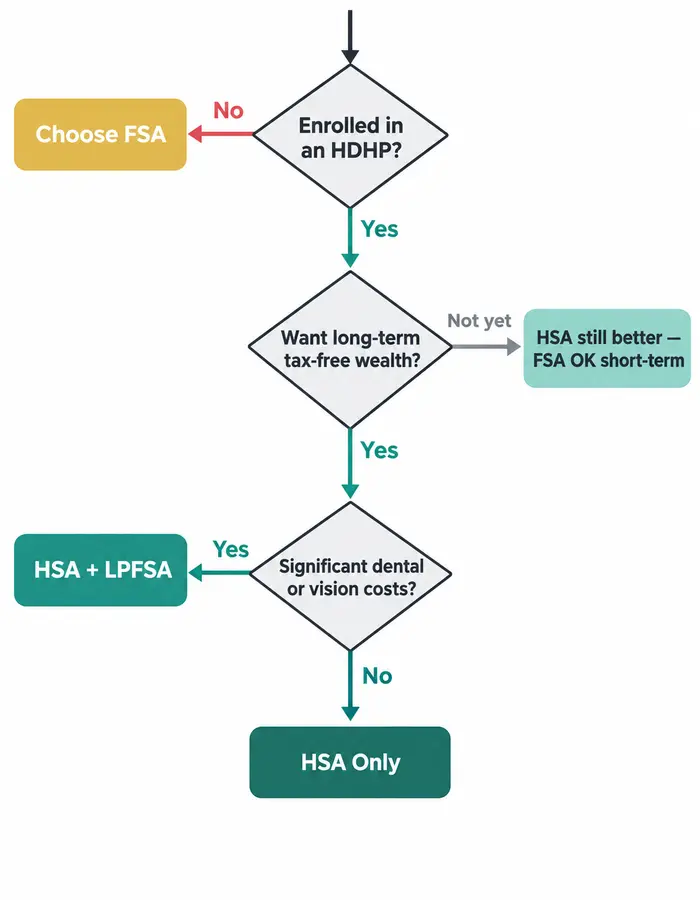
Answer these questions in order:
Step 1: Are you enrolled in an HDHP?
- No → You’re limited to FSA (or Dependent Care FSA). Skip to Step 4.
- Yes → Continue to Step 2.
Step 2: Do you want to build long-term tax-free wealth?
- Yes → Choose HSA. Max it out if you can.
- Not yet — just want to save on taxes now → HSA is still better, but FSA is acceptable short-term.
Step 3: Do you have significant dental or vision costs?
- Yes → Ask HR if they offer a Limited Purpose FSA. If yes, open both LPFSA (for dental/vision) and HSA.
- No → HSA only is fine.
Step 4 (FSA path): Do you have predictable medical expenses?
- Yes → Elect conservatively: total expected costs minus any employer carryover.
- No → Elect a small amount ($500–$750) as a buffer. Don’t over-elect.
Step 5: Is your employer contributing?
- HSA: If your employer contributes to your HSA, that’s free money — make sure you’re enrolled.
- FSA: Only ~4% of employers contribute to FSAs. Check your benefits summary.
FAQ
Can I have both an HSA and an FSA?
Not a standard health FSA and an HSA at the same time — they conflict. But you can have an HSA paired with a Limited Purpose FSA (dental and vision only). You can also have a Dependent Care FSA alongside an HSA, since it covers childcare rather than medical expenses.
What happens to my FSA if I leave my job?
Generally, unused FSA funds are forfeited when you leave your employer. You may be able to spend down the balance during a post-employment grace period, or continue the account through COBRA — but COBRA continuation of an FSA is uncommon and expensive. If you’re planning to change jobs, be careful not to over-elect.
What happens to my HSA if I leave my job?
Nothing — it stays yours. The account and all its funds are 100% portable. You can keep contributing as long as you maintain HDHP coverage at your new job, or simply stop contributing and let the existing balance continue to grow and be available for future medical expenses.
Can I use my HSA for non-medical expenses?
Before age 65: you can, but it’s a bad idea. You’ll owe income tax on the withdrawal plus a 20% penalty. After age 65: you can use HSA funds for anything — you’ll just pay regular income tax, like a Traditional IRA. No penalty.
What is the Limited Purpose FSA (LPFSA)?
An LPFSA is a special FSA restricted to dental and vision expenses only. Its value is that it can be paired with an HSA — since it doesn’t overlap with the HSA’s coverage area. The 2026 contribution limit is the same as a regular FSA: $3,400 (it was $3,300 in 2025). Not all employers offer it, so check your benefits portal.
Should I prioritize HSA or Roth IRA?
For HDHP-eligible workers, the recommended order is: 401(k) match → HSA (max) → Roth IRA → more 401(k). The HSA’s triple tax advantage technically makes it more powerful than the Roth IRA’s double advantage — specifically for funds that will eventually be used for healthcare (which is almost certain in retirement).
What changed about HSAs in 2026?
Three significant changes from the OBBBA 2025 law:
- Telehealth before the deductible is now permanently allowed without affecting HSA eligibility.
- Bronze and catastrophic ACA marketplace plans are now treated as HSA-compatible even without meeting standard HDHP thresholds.
- Direct Primary Care (DPC) arrangement fees are now qualified HSA expenses, up to $150/month individual or $300/month family.
These changes expand who can open an HSA in 2026.
How much should I contribute to my FSA?
Only elect what you expect to actually spend. A conservative approach: add up known recurring costs (prescriptions, contacts, planned procedures) and add a small buffer — maybe $200–$300 for unexpected items. Don’t elect the maximum unless you’re confident you’ll spend it all. The use-it-or-lose-it risk is real.
Final Thoughts
HSA or FSA — neither is a bad choice. Both let you pay for medical expenses with pre-tax dollars, and both are better than using nothing.
But if you’re asking which one to prioritize long-term, the answer for most HDHP-eligible workers is clear: max out your HSA first.
The HSA vs FSA decision at your first job isn’t just about this year’s doctor visits. It’s about whether you want a simple annual spending tool or a wealth-building account that compounds tax-free for decades. The $462,000 figure isn’t a fantasy — it’s compound interest working on money that’s never taxed.
That said, know your situation. If you’re not on an HDHP, FSA is your path — and it’s a genuinely useful one, especially with Day 1 access and predictable medical costs. If you have dental and vision expenses but also want HSA access, ask HR about LPFSA combination.
Most importantly: participate in one of them. The 43% of eligible workers who skip both accounts are leaving real tax savings on the table every single year.
Have an HSA or FSA question not covered here? Drop it in the comments below.
This guide is one piece of our complete First Job Money Guide — covering everything from your first paycheck withholding to picking employee benefits.
Still deciding between plans in the first place? Health Insurance Open Enrollment: A First-Timer’s Guide at 22 walks through HDHP vs. PPO before you get here.
When open enrollment opens, you have the information you need. Use it.