
What to Do with Your First Big Paycheck: A 7-Step Money Checklist
Introduction
You opened your banking app. The number is bigger than you’ve ever seen in your account. Your first real paycheck just hit — and now comes the moment that most people don’t prepare for.
What you do in the next 30 days matters more than almost any other financial decision you’ll make. Research on financial behavior consistently shows that the habits you form around your first significant income become your default template for the rest of your working life. This moment is what behavioral economists call a financial anchor — a reference point your brain uses to set spending and saving expectations going forward.
Here’s the problem: most people feel the excitement, upgrade a few things, and wake up a month later wondering where half the money went.
You don’t have to be one of them.
This guide walks you through a clear, seven-step checklist built specifically for new and early-career earners. You’ll learn how to decode your pay stub, build a budget that actually holds up, start your emergency fund, capture free retirement money, tackle debt intelligently, and set up a system that works automatically — even on your laziest months.
And yes, there’s room to celebrate. Just the right amount.
This checklist is one piece of our complete First Job Money Guide — covering everything from reading your first pay stub to picking employee benefits.
Haven’t decided on your 401(k) elections yet? 401(k) Enrollment at Your First Job breaks down exactly what to pick.
Why Your First Paycheck Is Different
Your first real paycheck isn’t just money. It’s a psychological marker.
Financial psychologists call it a financial anchor — the number your brain quietly uses to calibrate every future spending and saving decision. Set the anchor at “spend most of it and save a little,” and that pattern tends to repeat, even as income grows. Set it at “save first, spend what’s left,” and you’ve built something powerful from day one.
Communities where young earners discuss money share the same piece of wisdom, independently, from dozens of people: pay yourself first, no exceptions. It’s not just motivational language. It’s behavioral economics. Savings that happen automatically, before you see the money in your checking account, are savings that actually happen.
The other thing worth knowing: your paycheck probably looks different than you expected. A $75,000 salary doesn’t mean $6,250 hits your account each month. After federal and state taxes, Social Security, Medicare, health insurance, and retirement contributions, that same salary often means closer to $4,122 take-home. That gap is the first lesson.
Let’s work through it step by step.
Step 1: Understand Your Net Pay (The Real Number That Matters)
The #1 Mistake New Earners Make: Budgeting from gross salary instead of take-home pay.
If your offer letter says $75,000, your first instinct might be to divide by 12 and plan around $6,250 per month. But that’s not your money — not yet. Taxes, insurance, and retirement contributions come out first.
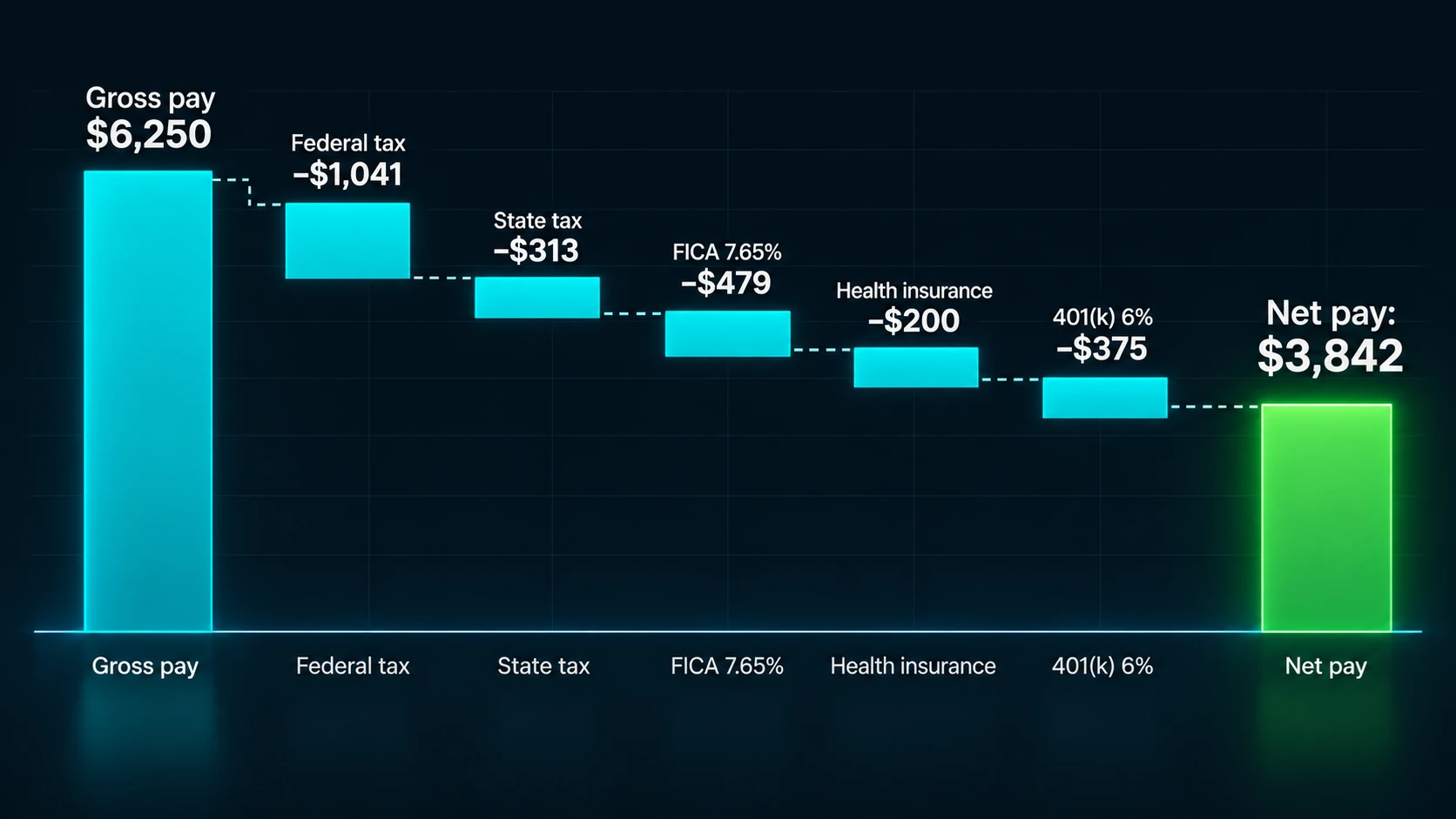
The $75K Salary Reality Check
| Line Item | Monthly Amount |
|---|---|
| Gross Monthly Salary | $6,250 |
| Federal Income Tax (~22%) | −$1,041 |
| State Income Tax (~5%) | −$313 |
| Social Security (6.2%) | −$388 |
| Medicare (1.45%) | −$91 |
| Health Insurance Premium | −$200 |
| 401(k) Contribution (6%) | −$375 |
| Net (Take-Home) Pay | ~$3,842 |
The exact numbers vary by state, employer benefits, and W-4 elections. But in many cases, you take home around 60–66 cents of every gross dollar.
Budget only from your net pay. Always.
How to Read Your Pay Stub
Pull your first pay stub from your employer’s HR portal and locate:
- Gross Pay — the top-line number, before any deductions
- Deduction breakdown — federal/state taxes, FICA (Social Security + Medicare), health premiums, 401(k) contributions
- Net Pay — the last line; this is your actual take-home and your only budgeting number
Action: Run your withholding through the IRS W-4 Estimator at irs.gov/W4App. If you’re over- or under-withholding, adjust your W-4 with HR now.
Note for no-income-tax states: Residents of Texas, Florida, Nevada, Washington, and the other 6 states with no state income tax will have meaningfully higher take-home pay than the example above.
Step 2: Build a Budget Using the 50/30/20 Rule
Once you know your real take-home, give every dollar a job.
The most beginner-friendly framework is the 50/30/20 rule, popularized by Senator Elizabeth Warren in All Your Worth (2005). It divides your net income into three buckets:
| Category | Percentage | What It Covers |
|---|---|---|
| Needs | 50% | Rent, utilities, groceries, minimum debt payments, insurance, transportation |
| Wants | 30% | Dining out, streaming, entertainment, gym, hobbies |
| Savings/Debt | 20% | Emergency fund, retirement accounts, extra debt payments |
Real Dollar Example ($4,000/month net)
- Needs (50%): $2,000
- Wants (30%): $1,200
- Savings (20%): $800
Category Benchmarks
- Housing: at or below 30% of gross income
- Car (payment + insurance): no more than 15% of net income
- Groceries: $300–$500/month for a single person
- Dining out: aim to stay under $200–$300/month
- Subscriptions (total): cap at $100/month; audit quarterly
What If 50% Doesn’t Cover My Needs?
In high-cost cities like New York or San Francisco, rent alone may consume 50% of net income. Adjust the ratios — but keep savings in the budget no matter what. Even 10% is better than 0%.
For debt-heavy situations: Consider zero-based budgeting (every dollar gets a specific assigned job until you reach $0 unassigned). More detailed, more effective for aggressive debt payoff.
Budgeting App Recommendations
| App | Cost | Best For |
|---|---|---|
| YNAB | $15/month | Behavior change, zero-based method |
| PocketGuard | Free tier | Simplicity, “safe-to-spend” view |
| Empower | Free | Multiple accounts + investment tracking |
| Copilot | $14/month | AI-powered, iOS users |
| Monarch Money | $15/month | Couples, shared finances |
Step 3: Start Your Emergency Fund
Before investing a single dollar in the stock market, you need a financial cushion.
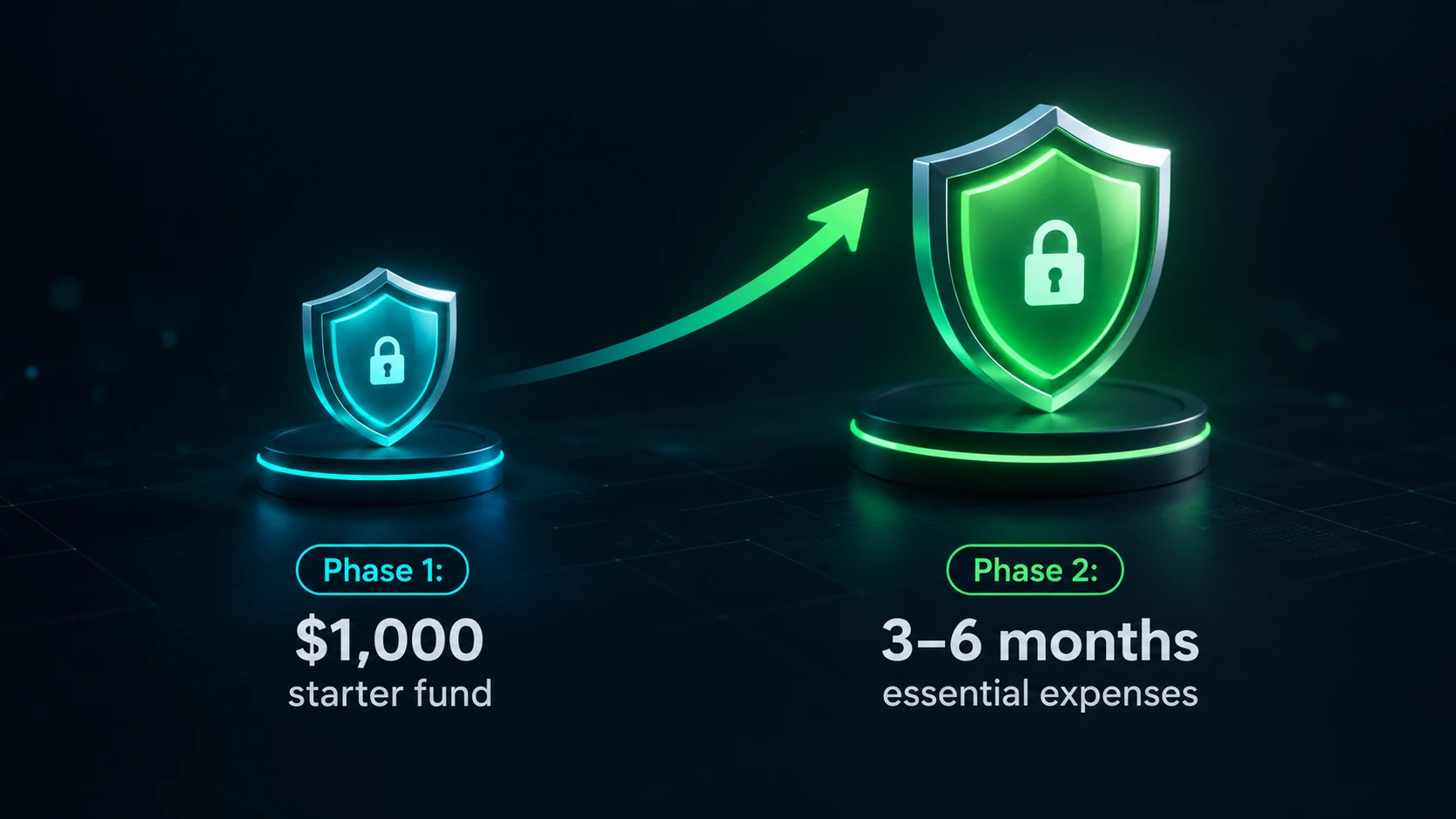
An emergency fund is a dedicated pool of liquid savings for one purpose: covering unexpected expenses without going into debt or liquidating investments.
According to Bankrate’s 2026 Annual Emergency Savings Report, 24% of Americans have no emergency fund, and per the Federal Reserve’s most recent SHED survey, 37% can’t cover a $400 unexpected expense without borrowing. Don’t be in that group.
The Two-Phase Approach
Phase 1 — The Starter Fund ($1,000)
This covers the most common financial shocks: a car repair, an ER copay, a broken phone. $1,000 handles the majority of single unexpected expenses that would otherwise land on a credit card at 22% interest.
Phase 2 — Full Emergency Fund (3–6 Months of Essential Expenses)
Once you hit $1,000, keep building. Target 3–6 months of essential monthly expenses — rent, food, utilities, insurance, and minimum loan payments. Not total spending; essential spending.
| Situation | Recommended Coverage |
|---|---|
| Stable job, dual income | 3 months |
| Single income, variable expenses | 4–5 months |
| Freelancer / self-employed / commission-based | 6+ months |
Where to Keep It
High-Yield Savings Account (HYSA) — not your checking account, not the stock market.
In 2026, top HYSAs are offering roughly 4–4.5% APY vs. the 0.37% national average at traditional banks. These accounts are FDIC-insured and accessible within 1–2 business days.
Best HYSA providers: Ally Bank, Marcus by Goldman Sachs, SoFi Bank, American Express HYSA
Keep it separate from checking so it’s not accidentally spent, and away from the market so it’s not down 20% when you actually need it.
Step 4: Capture Your Full 401(k) Match
If your employer offers a 401(k) match and you’re not contributing enough to capture it fully, you are leaving part of your salary on the table.
How the Match Works
A common structure: the employer matches 50% of your contribution, up to 6% of salary.
Example — $60,000 salary:
- You contribute 6% → $3,600/year
- Employer adds 50% → $1,800/year, free
- Total annual retirement contribution: $5,400
That $1,800/year in missed match, invested at 7% average annual return over 30 years, compounds to roughly $170,000 in lost retirement wealth if skipped.
This is the highest guaranteed return available to you anywhere. A 50–100% instant return on your contribution. Nothing in the market matches it.
2026 Contribution Limits
- Employee contribution limit: $24,500/year
- Catch-up contribution (age 50+): $8,000/year (bringing your total to $32,500/year); ages 60–63 get an enhanced catch-up of $11,250/year (total $35,750/year)
Always contribute at minimum up to the full employer match before allocating money elsewhere.
No 401(k) at Your Job?
- Open a Traditional IRA or Roth IRA (see Step 5)
- Self-employed or freelancing: a SEP IRA allows contributions up to $72,000 or 25% of net self-employment income in 2026
Check the Vesting Schedule
Employer match contributions vest over time per your plan’s schedule — they only become fully yours after 1–3+ years. Always check before leaving a job so you don’t walk away from unvested funds.
Step 5: Open and Fund a Roth IRA
After capturing your full employer match, the Roth IRA is the next most powerful tool for early-career earners.
What Is a Roth IRA?
A Roth IRA is a retirement account funded with after-tax dollars. The money grows completely tax-free. Withdrawals in retirement are tax-free. You pay taxes now, at your current (likely lower) rate, and never again.
This is exactly why it’s ideal for new earners. You’re probably in a lower tax bracket right now than you’ll be in 20–30 years. Lock in lower taxes today.
The Compounding Case for Starting Now
- Earner A contributes $7,500/year starting at age 22, for 10 years, then stops.
- Earner B contributes $7,500/year starting at age 32 and never stops.
At 7% average annual growth, Earner A ends up with more money at age 65. Ten years of time is worth more than decades of contributions that start late.
2026 Roth IRA Limits
| Detail | Amount |
|---|---|
| Annual contribution limit (under 50) | $7,500 |
| Annual contribution limit (age 50+) | $8,600 |
| Income limit — single, full contribution | Up to $153,000 |
| Income limit — single, partial contribution | $153,000–$168,000 |
How to Open a Roth IRA
- Choose a brokerage: Fidelity (best for beginners), Vanguard (low-cost), Schwab (all-around solid), or Betterment (automated robo-advisor)
- Complete the online application (about 10 minutes)
- Fund the account via bank transfer
- Invest in a Target Date Fund (e.g., Vanguard Target Retirement 2065) — auto-adjusts risk as you age, ideal for beginners
- Set up automatic monthly contributions
- Review once a year; otherwise leave it alone
Early withdrawal note: You can withdraw contributions (not earnings) at any time, penalty-free. Only earnings face a 10% penalty if taken before age 59½ — making the Roth IRA more flexible than most people realize.
Step 6: Choose a Debt Payoff Strategy
If you carry debt — student loans, credit cards, a car payment — it needs a real plan, not just good intentions.
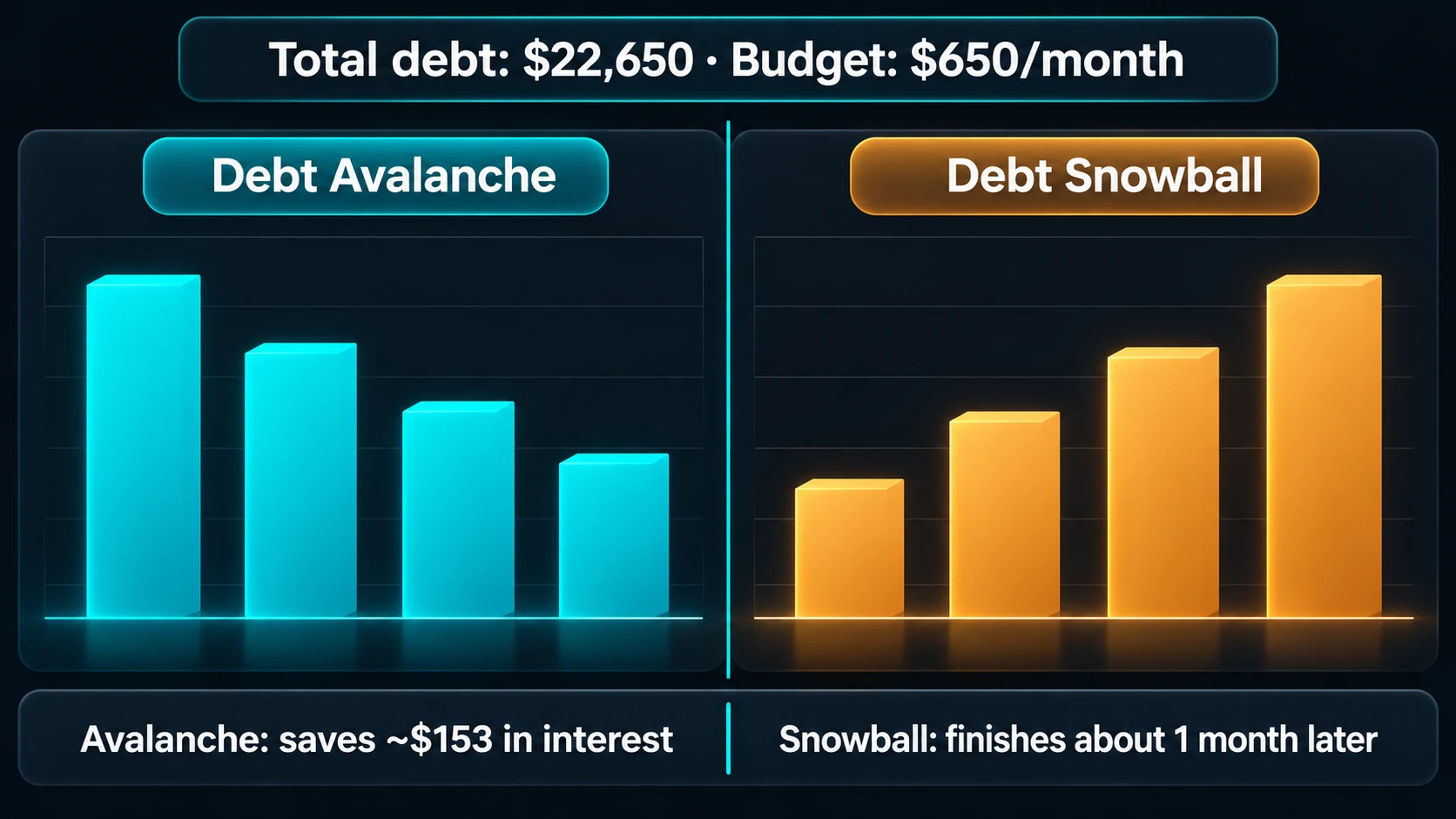
Two proven methods exist. The right one depends partly on math, partly on psychology.
Method 1: Debt Avalanche (Mathematically Optimal)
Pay minimums on all debts. Every extra dollar goes to the highest-interest debt first.
This saves the most money in total interest over time.
Method 2: Debt Snowball (Psychologically Powerful)
Pay minimums on all debts. Every extra dollar goes to the smallest balance first.
This generates faster wins, which builds momentum and keeps people on track when progress feels slow.
The Data
A CNBC Select analysis of a four-debt, $22,650 total balance scenario with a $650/month debt budget found:
- Avalanche saved approximately $153 more in interest
- Snowball took roughly one extra month to complete
The difference is modest. Pick the method you will actually stick with — the best strategy is the one you follow consistently.
Debt Priority by Interest Rate
| Debt Type | Typical Rate | Priority |
|---|---|---|
| Credit Cards | 20–29% | Pay first (after 401k match) |
| Personal Loans | 10–20% | High priority |
| Auto Loans | 6–9% | Medium priority |
| Private Student Loans | 5–12% | Medium priority |
| Federal Student Loans | 4–7% | Lower priority |
| Mortgage | 5–7% | Lowest |
Save vs. Pay Decision Order
- Capture 401(k) match
- Build $1,000 emergency fund
- Pay off high-interest debt (above 7%)
- Build full 3–6 month emergency fund
- Invest in Roth IRA
- Pay off remaining moderate/low-interest debt
Step 7: Automate Everything and Celebrate Intentionally
Willpower is finite. Automation is not.
The most effective thing you can do after steps 1–6 is remove active decision-making from your savings system. When transfers happen automatically before you see the money in checking, you adapt to spending what remains — not what you wish you’d saved.
How to Set Up Automation
Split Direct Deposit: Ask HR to split your paycheck: 90% to checking, 10% (or your HYSA savings target) directly to savings. Money that never appears in checking is money that never gets accidentally spent.
What to Put on Autopilot:
- 401(k) contributions — already handled via payroll; confirm your contribution rate
- HYSA transfer — trigger the day after payday
- Roth IRA contribution — monthly, on payday
- All bill payments — autopay on or before due dates
- Credit card — autopay set to full statement balance, not minimum
- Extra debt payment — monthly, fixed amount
Once running, your financial progress happens in the background. Check in monthly to confirm everything processed; adjust quarterly.
Celebrate Intentionally (Without Lifestyle Creep)
Pre-plan 2–5% of your net pay as guilt-free spending to mark the milestone. This is deliberate and capped — not lifestyle creep. A dinner, something you’ve waited to buy, an experience. Put a number on it and enjoy it fully.
Lifestyle creep is the real threat: quietly upgrading your entire living standard the moment income rises, locking in new fixed expenses before savings habits form. Every time you get a raise, increase automated savings by at least 50% of the raise before adjusting lifestyle spending. Wealth and lifestyle can grow together — just not at the same speed.
Master Savings Priority Ladder
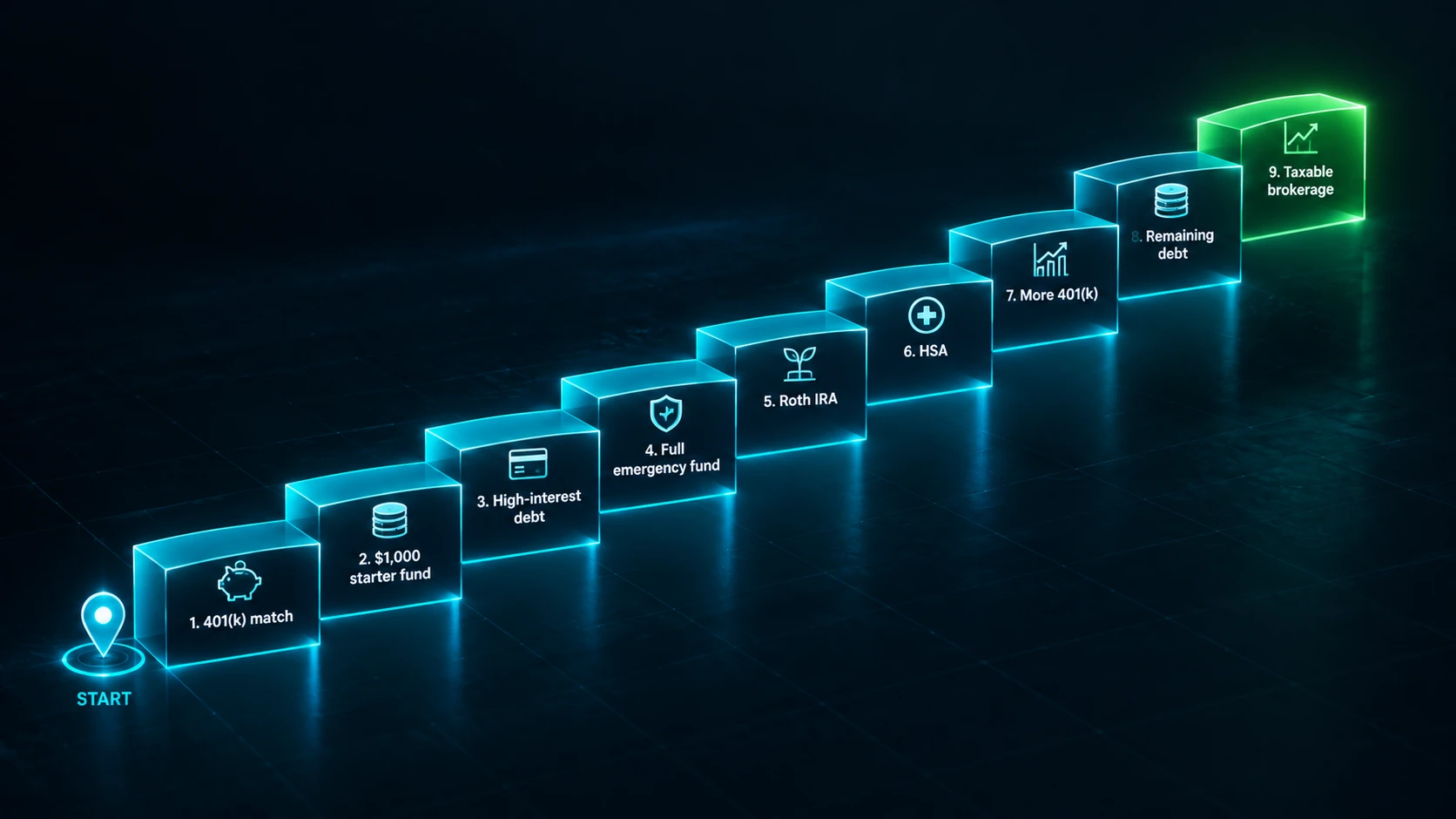
Not sure where to put extra money? Work down this ladder from the top. Start at Rung 1 and don’t move to the next until the current one is complete.
| Rung | Priority | Action |
|---|---|---|
| 1 | First | Contribute to 401(k) up to full employer match |
| 2 | Second | Build $1,000 starter emergency fund (HYSA) |
| 3 | Third | Pay off high-interest debt (>7%) aggressively |
| 4 | Fourth | Build full 3–6 month emergency fund (HYSA) |
| 5 | Fifth | Max out Roth IRA ($7,500/year in 2026) |
| 6 | Sixth | Contribute to HSA if you have a high-deductible health plan (triple tax advantage) |
| 7 | Seventh | Increase 401(k) contributions beyond the match |
| 8 | Eighth | Pay off remaining low-interest debt |
| 9 | Ninth | Open a taxable brokerage account for additional investing |
This ladder removes decision fatigue. You always know exactly where the next dollar goes.
7 Common Mistakes to Avoid
| Mistake | Why It Hurts | What to Do Instead |
|---|---|---|
| Budgeting from gross pay | You plan with $6,250/month when you actually receive $3,842 | Budget only from net (take-home) pay |
| Skipping the 401(k) match | Costs ~$170K in retirement wealth over 30 years | Contribute at least enough to get the full match |
| Investing before building emergency fund | You sell investments at a loss during emergencies | Hit $1,000 starter fund before any investing |
| Immediate lifestyle inflation | Locks in new fixed expenses before habits form | Automate savings first; celebrate a small, capped amount |
| Paying only credit card minimums | 22% interest compounds fast on unpaid balances | Set autopay to full statement balance every month |
| Waiting to start retirement savings | “I’ll save more when I earn more” costs decades of compounding | Start small now; increase contributions with every raise |
| Mental budgeting only | Studies show mental budgeting underestimates spending by 15–40% | Use a written budget or app every single month |
Your 30-Day Action Plan (Week by Week)
Week 1: Understand and Set Up
- Pull your pay stub; locate your net pay number
- Run your W-4 through the IRS Withholding Estimator (irs.gov/W4App)
- Open a High-Yield Savings Account if you don’t have one
- Enroll in (or verify) your 401(k) at the correct contribution rate to capture full match
Week 2: Budget and Emergency Fund
- Apply the 50/30/20 rule to your actual net pay
- Write a budget in an app or spreadsheet
- Transfer first $200–$500 toward your $1,000 emergency fund
- Audit subscriptions — cancel anything unused in the last 30 days
Week 3: Invest and Debt Plan
- Open a Roth IRA at Fidelity, Vanguard, or Schwab
- List all debts with interest rates and current balances
- Choose avalanche or snowball; write down your payoff order
- Set up autopay on all recurring bills
Week 4: Automate and Review
- Set up split direct deposit with HR (or a manual auto-transfer to HYSA)
- Automate your monthly Roth IRA contribution
- Set credit card autopay to full statement balance
- Schedule a monthly budget review — 30 minutes, same day each month
- Celebrate intentionally — you’ve built something real this month
Bonus: Building Credit from Scratch
Starting your first job without much credit history? This is the right time to build it cleanly.
Understanding Your FICO Score
| Factor | Weight |
|---|---|
| Payment History | 35% |
| Credit Utilization | 30% |
| Length of Credit History | 15% |
| Credit Mix | 10% |
| New Inquiries | 10% |
Getting Started
- Get a starter credit card: Discover it® Student or Capital One Platinum are solid options
- Use it for one monthly recurring bill (streaming, phone)
- Pay the full balance every month via autopay — no exceptions
- Keep utilization below 30% of your credit limit (ideally below 10%)
- Check your free credit report at annualcreditreport.com — all three bureaus, weekly access available
Rent reporting: Services like Rental Kharma or Experian RentBureau can add your on-time rent payments to your credit file — an easy credit-building move most people overlook entirely.
🧑🎓 Teen / Young Earner Sidebar
Got your first paycheck from a part-time job or internship? The steps are smaller but the habits are identical.
- Save 30% automatically. Even $50–$100 per paycheck builds the habit.
- Set a starter emergency fund goal of $500–$1,000. This covers most unexpected teen expenses.
- Ask a parent or guardian about a custodial savings or investment account — especially a custodial Roth IRA if you have earned income.
- Take a photo of your first pay stub. You’ll want that memory later.
- Resist the urge to upgrade everything immediately. The habits you set now compound exactly like the money does.
Conclusion
Your first big paycheck is more than a deposit. It’s the beginning of a pattern.
You don’t need to be perfect. You don’t need to do all seven steps this week. What matters is that you start — with your real net pay, a simple budget, a growing emergency fund, and at least enough 401(k) contribution to capture what your employer is offering you for free.
The most consistent finding across financial research and behavioral economics is straightforward: earners who save first, automatically, consistently — build wealth. Not the highest earners. Not the best stock-pickers. The ones who set a system and let it run.
You now have the checklist. You have the numbers. You have the framework.
Go build the financial life you want — one automated transfer at a time.
What is the difference between gross pay and net pay?
Gross pay is your total earnings before any deductions. Net pay — your actual take-home — is what hits your bank account after federal and state taxes, Social Security (6.2%), Medicare (1.45%), health insurance premiums, and retirement contributions are removed. A $75,000 annual salary often results in approximately $3,842–$4,122 in monthly take-home depending on state and benefits. Budget only from net pay.
How much should I save from my first paycheck?
A solid starting target is 20% of net pay using the 50/30/20 rule. Before anything else, contribute enough to your 401(k) to get the full employer match — that’s a guaranteed 50–100% return. Then direct savings toward your $1,000 starter emergency fund, then a Roth IRA. Even 10% saved consistently beats waiting until you earn more.
What is a High-Yield Savings Account and should I use one?
A High-Yield Savings Account is a standard FDIC-insured savings account earning significantly more than a traditional bank. In 2026, the best HYSAs offer roughly 4–4.5% APY vs. the 0.37% national average. It’s the ideal home for your emergency fund — safe, accessible within 1–2 business days, and actually growing. Top providers include Ally, Marcus by Goldman Sachs, SoFi, and American Express.
Should I pay off debt or invest first?
Follow this order: First, contribute to your 401(k) up to the full employer match. Second, build a $1,000 emergency fund. Third, aggressively pay off high-interest debt above 7% (especially credit cards at 20–29%). Fourth, build your full emergency fund. Then invest in a Roth IRA. Paying off a 22% credit card is mathematically a guaranteed 22% return — nothing in the stock market matches that risk-free.
What is the 401(k) match and why does it matter so much?
The 401(k) match is free money your employer adds to your retirement when you contribute. A common structure: 50% match up to 6% of salary. On a $60,000 salary, contributing 6% ($3,600) earns you $1,800 from your employer at no extra cost. That $1,800/year compounded at 7% over 30 years equals roughly $170,000 in lost retirement wealth if skipped. It’s the highest guaranteed return available to you.
What is lifestyle creep and how do I avoid it?
Lifestyle creep is gradually upgrading your spending habits every time income increases — until there’s nothing left to save despite earning significantly more. The antidote is automation: every time income grows, increase automated savings by at least 50% of the raise before adjusting lifestyle spending. This way wealth and lifestyle grow together, just not at the same rate.
What should teenagers do with their first paycheck?
The principles are the same, scaled down. Save at least 30% automatically — even $50 per paycheck builds the habit. Set a starter emergency fund goal of $500–$1,000. If you have earned income, ask a parent about opening a custodial Roth IRA — contributions made in your teens compound for 40+ years. Use the remaining money for needs and reasonable wants. Take a photo of your first pay stub. You’ll want that memory.