
401(k) Enrollment at Your First Job: What to Actually Pick (And What to Avoid)
You just got hired. Congratulations. Then HR sent you a packet about your 401(k) and suddenly you’re staring at terms like “Traditional vs. Roth,” “vesting schedule,” and “expense ratio” — and none of it makes sense.
Here’s the first thing you need to know: your 401(k) contributions are always 100% yours. The government doesn’t own them. Your employer doesn’t hold them hostage. They’re yours from the moment you contribute, sitting in your own account at a financial institution like Fidelity or Vanguard.
The decisions you make during 401(k) enrollment at your first job can mean the difference between a comfortable retirement and scrambling in your 60s. Not because the choices are complicated — they’re actually pretty simple once someone explains them clearly — but because compound interest runs for 30 to 40 years. A small mistake at 23 costs far more than the same mistake at 50.
This guide covers everything you need to make good decisions on day one: how much to contribute, whether to pick Roth or Traditional, which funds to choose, how vesting works, and the mistakes that quietly cost people tens of thousands of dollars. All in plain English, with real numbers.
What Is a 401(k)? — Plain English Version
A 401(k) is a retirement savings account tied to your employer. You put in a percentage of your paycheck, and that money gets invested in mutual funds. Over time, it grows. When you retire — and can access it penalty-free at age 59½ — you withdraw it.
The “tax-advantaged” part means you either:
- Pay taxes now but never again on growth (Roth), or
- Skip taxes now and pay them at retirement (Traditional)
Both are better deals than a regular brokerage account, where you pay taxes on gains every year.
Your employer may also add money to your account when you contribute — this is called employer matching. It’s the most valuable benefit most companies offer, and most people don’t take full advantage of it.
Is this your money? Yes. Completely. The government taxes it (either now or later), but it does not take it, own it, or control it. Your account is held at a financial institution like Fidelity, Vanguard, or Empower. They’re just the administrator. The money is yours.
When can you access it? Age 59½ — not 60, as many people think. Take money out before then (with limited exceptions) and you pay a 10% penalty plus income taxes. On a $10,000 withdrawal in the 22% tax bracket, you’d walk away with about $6,800.
How Much Should You Contribute? — The Three-Tier Framework
This is the most important decision you’ll make. Here’s a clear three-tier framework:
Tier 1 — The Absolute Minimum: Get the Full Employer Match
If your employer offers a match (e.g., “100% of your first 6%”), you must contribute at least that amount. Anything less means you’re declining part of your salary. A 100% match is a 100% guaranteed instant return. There is no investment in any market that reliably delivers that.
Tier 2 — The Target: 10–15% of Your Salary
Most financial experts recommend saving 10–15% of your gross salary for retirement, including your employer’s contribution. If your employer matches 5%, you personally need to contribute 5–10% to hit the target.
Tier 3 — The Maximum: $24,500 in 2026
If you can afford it, maxing out your 401(k) each year dramatically accelerates your retirement timeline.
What Does Contributing Actually Cost Your Paycheck?
Most people overestimate the pain of contributing because they forget about tax savings. Here’s what 6% actually costs:
| Annual Salary | 6% Contribution | Tax Savings (22% bracket) | Actual Paycheck Reduction |
|---|---|---|---|
| $50,000 | $3,000/yr ($125/paycheck) | ~$660/yr | ~$95/paycheck |
| $75,000 | $4,500/yr ($188/paycheck) | ~$990/yr | ~$135/paycheck |
| $100,000 | $6,000/yr ($250/paycheck) | ~$1,320/yr | ~$177/paycheck |
Contributing 6% on a $75,000 salary doesn’t reduce your paycheck by $188. It reduces it by about $135. The tax savings absorb the rest.
The SECURE 2.0 Auto-Enrollment Warning
Under the SECURE 2.0 Act, new 401(k) plans established after December 29, 2022 must automatically enroll eligible employees at a minimum of 3%. Auto-escalation (increasing your rate by 1% per year) is also required.
The problem: 3% will not fund your retirement. At $60,000 salary, contributing 3% for 30 years at a 7% return produces roughly $180,000. That falls far short of what’s needed to replace 70–80% of your pre-retirement income.
You can change your contribution rate anytime through your HR portal. But if you stay at the auto-enrolled 3%, treat it as a floor to raise immediately — not a recommendation.
Roth vs. Traditional 401(k) — How to Decide
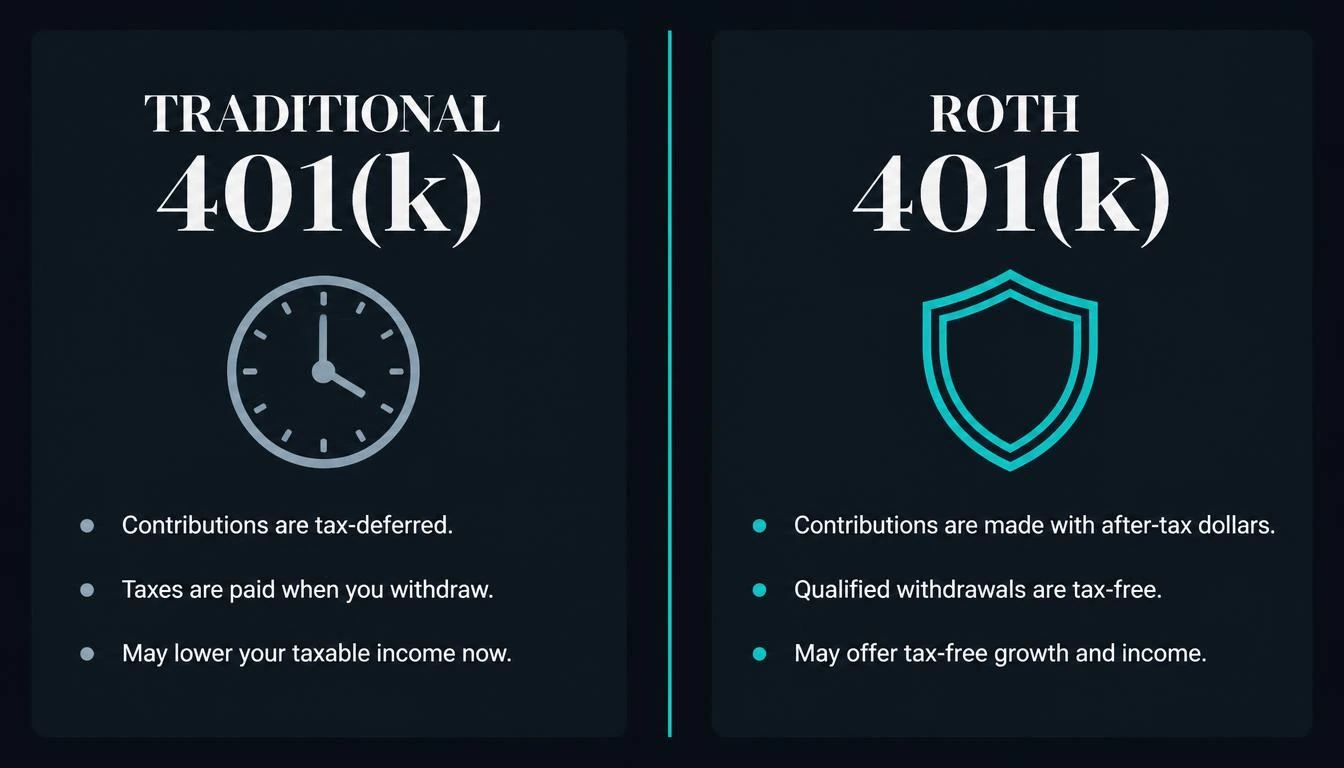
Both options let you save in the same account, invest in the same funds, and receive the same employer match. The only difference is when you pay taxes.
| Traditional 401(k) | Roth 401(k) | |
|---|---|---|
| Contributions | Pre-tax (reduces taxable income now) | After-tax (no immediate tax break) |
| Withdrawals in retirement | Taxed as ordinary income | 100% tax-free |
| Required Minimum Distributions | Yes — starting at age 73 | No — eliminated by SECURE 2.0 |
| Income limit | None | None (unlike Roth IRA) |
| Best for | Higher earners expecting lower tax rates in retirement | Lower earners expecting same or higher tax rates later |
The Decision Rule (Simplified):
- 10–12% tax bracket: Choose Roth. Pay a small tax now; avoid taxes on 30+ years of growth.
- 22%+ tax bracket: Consider splitting 50/50, or leaning Traditional.
- Not sure: Default to Roth, or split evenly.
Want the full math, including the cases where Traditional actually wins? Roth 401(k) vs. Traditional 401(k): The Gen Z Breakdown runs the 40-year numbers at three different retirement tax rates.
The Hidden Roth Advantage Most People Miss
SECURE 2.0 eliminated Required Minimum Distributions (RMDs) for Roth 401(k) accounts starting in 2024. With a Traditional 401(k), the IRS forces you to start withdrawing money at age 73 whether you need it or not — and you pay income tax on every dollar. With a Roth 401(k), you never have to touch it if you don’t need it. Let it compound as long as you want.
For someone in their 20s with 50 years of runway, that flexibility is worth a lot.
Note: Your employer’s matching contributions typically go into a Traditional account, even if you elect Roth. SECURE 2.0 now permits plans to let you elect Roth treatment for employer matching and nonelective contributions too, but it’s optional for employers to offer — most plans still default employer money to Traditional. Either way, it’s still free money.
How to Pick Your Investments
Most people overthink this. You have two solid options.
Option A: Target-Date Index Fund (Best Default)
A target-date fund (TDF) is a single fund that automatically adjusts its stock-to-bond ratio over time. You pick the fund closest to your expected retirement year — for example, “Vanguard Target Retirement 2060” if you plan to retire around 2060. That’s it. When you’re young, the fund holds mostly stocks. As you get closer to retirement, it shifts toward bonds. You don’t have to manage anything.
What to look for:
- Choose a low-cost index TDF, not an actively managed one
- Fidelity has two TDF lines: always pick “Freedom INDEX” funds, not plain “Freedom” funds
- Best options by expense ratio: Vanguard (~0.08%), Fidelity Freedom Index (~0.12%), Schwab Index (~0.13%)
- Avoid any TDF with an expense ratio above 0.50%
“To” vs. “Through” Funds — This Matters
“To” funds stop adjusting their allocation at your retirement year and become conservative. “Through” funds continue shifting for 10–20 years past your target date. For most people who will live 20–30 years into retirement, “through” funds typically provide better long-term growth. Check which type your plan offers before selecting.
Option B: Three-Fund Index Portfolio
If you’re comfortable doing slightly more work, a three-fund portfolio gives excellent diversification at minimum cost:
- U.S. Total Stock Market Index Fund — broad domestic exposure
- International Index Fund — global diversification
- U.S. Bond Market Index Fund — stability
A sample allocation for someone in their 20s: 70% U.S. stocks, 20% international, 10% bonds. Rebalance once a year.
What to Avoid
| Fund Type | Why to Avoid |
|---|---|
| Actively managed funds (ER > 0.75%) | More expensive AND typically underperform index funds over 15+ years |
| Your company’s own stock (> 5–10%) | Enron employees lost both their jobs AND their retirement savings when the stock collapsed |
| Stable value / money market as long-term | $50,000 at 3% for 40 years = $163K. At 7% = $749K. The “safe” choice costs $586,000 |
| Sector funds | Concentrated bets with no diversification benefit |
| Load funds | Sales fees that exist to compensate the broker, not to improve your returns |
The Fee Problem: Expense Ratios in Real Dollars
An expense ratio is the annual fee a fund charges, automatically deducted from your returns. You never see a bill — the money just quietly disappears.
This sounds minor. It is not.
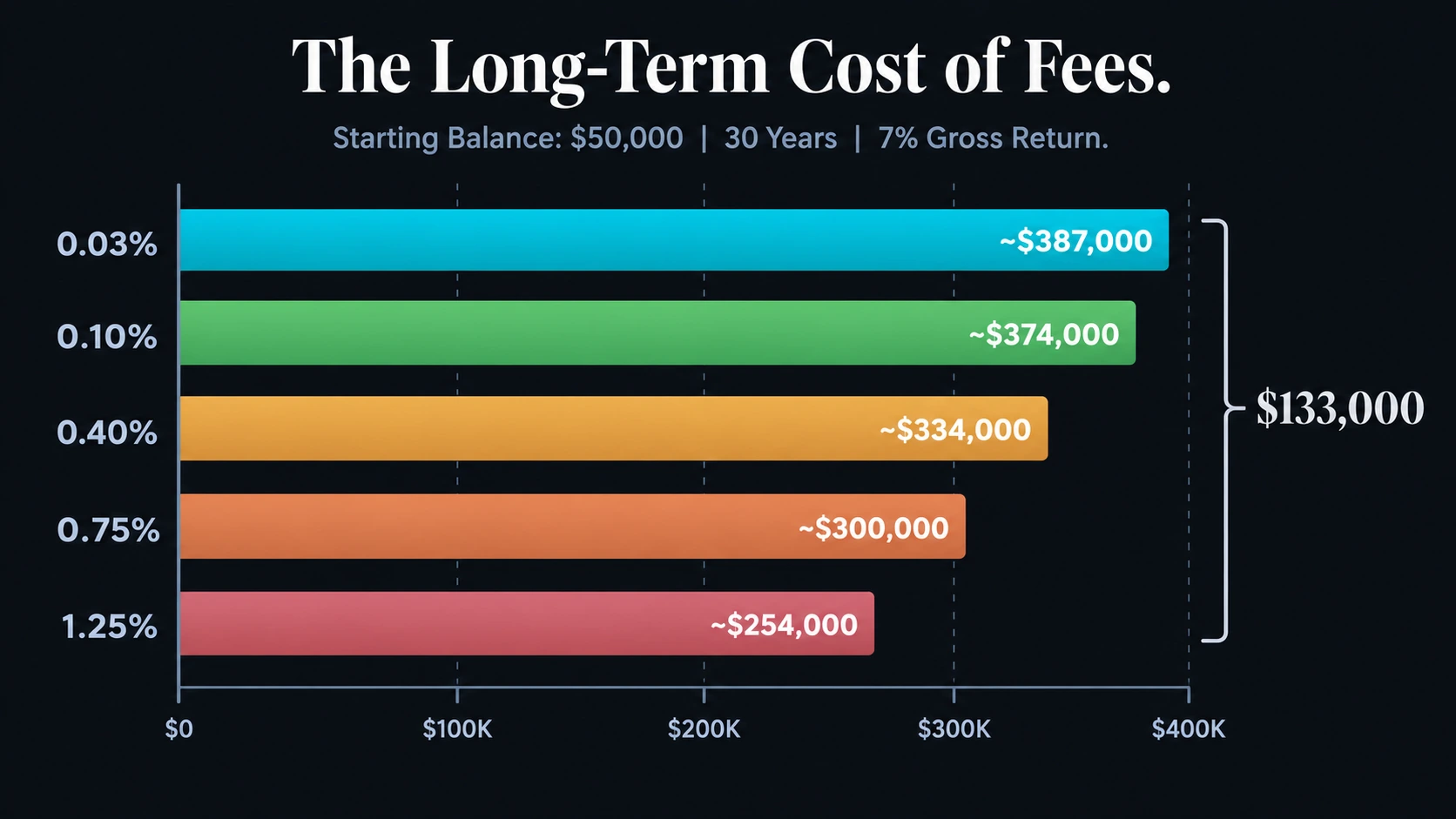
Dollar Impact Over 30 Years — $50,000 Starting Balance, 7% Gross Return:
| Expense Ratio | Fund Example | 30-Year Ending Balance |
|---|---|---|
| 0.03% | Fidelity FXAIX | ~$387,000 |
| 0.10% | Vanguard TDF Index | ~$374,000 |
| 0.40% | Industry Average TDF | ~$334,000 |
| 0.75% | Active Fund | ~$300,000 |
| 1.25% | High-Cost Active | ~$254,000 |
The difference between 0.03% and 1.25%: roughly $133,000 — on the same starting balance, same time period, same market returns.
Fee benchmark:
- Excellent: Under 0.05%
- Good: 0.05%–0.15%
- Acceptable: 0.15%–0.75%
- Avoid: Above 0.75%
Check the expense ratio of every fund before you select it. Your HR portal shows this in the fund details. If it doesn’t, look up the fund on Morningstar.com.
Vesting Schedules — Don’t Leave Money on the Table
Your own contributions are always 100% yours immediately. No waiting period, no conditions. If you leave your job the day after enrolling, you take your contributions with you.
Employer contributions are different. They belong to you on a vesting schedule — a timeline your employer sets for when their match becomes permanently yours.
Three Types of Vesting:
- Immediate Vesting: Employer match is yours from day one. Required for Safe Harbor and SIMPLE plans.
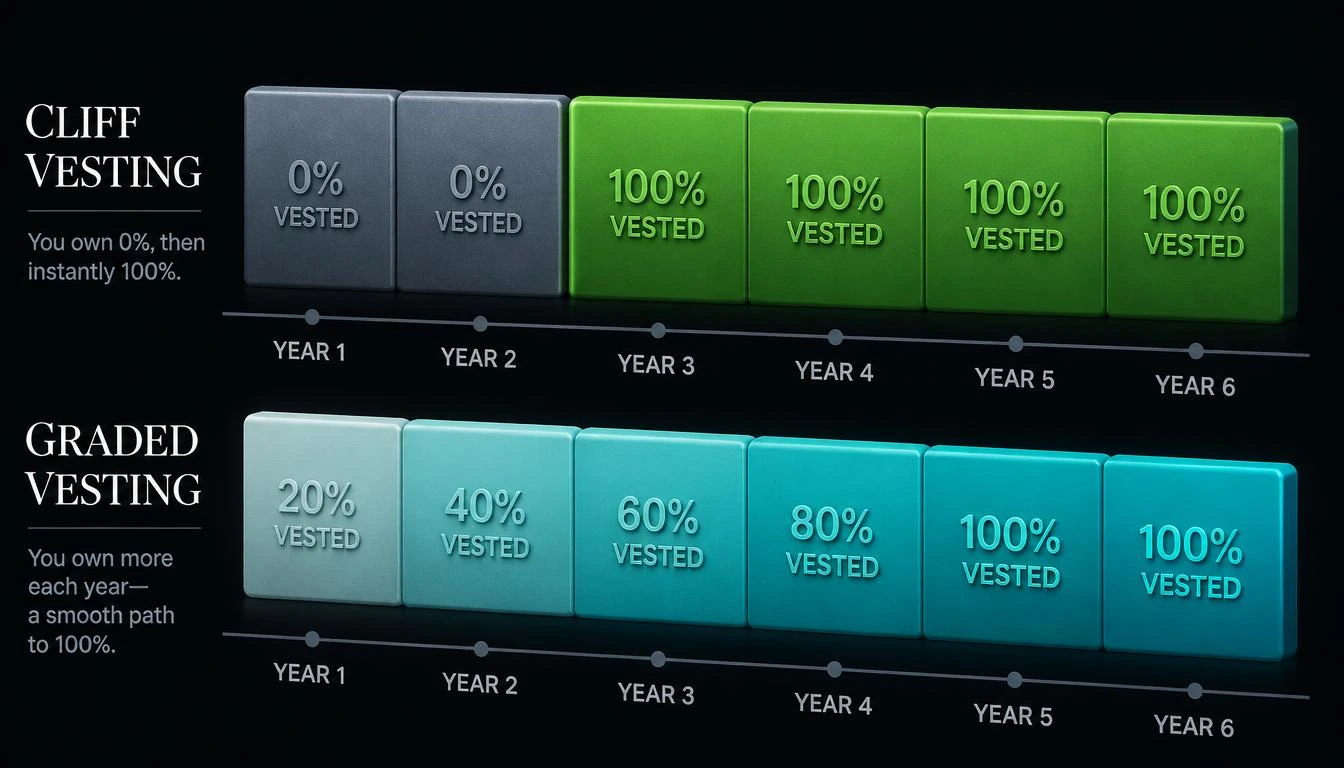
- Cliff Vesting: You own 0% of the match until a set date, then 100% instantly. Maximum 3 years by law.
- Graded Vesting: Gradual ownership over time — typically 20% per year. Maximum 6-year schedule by law.
Example (Cliff Vesting, 3 Years):
You’ve been at a company 2 years and 10 months. Your 401(k) has $30,000 of your contributions and $12,000 in employer match. With cliff vesting, if you leave today, you keep $30,000 and forfeit $12,000. Wait 2 more months? You keep all $42,000.
The Statistics Are Alarming
A Vanguard study found that 30% of job separations involve forfeiture of some employer match. A Yale Law Journal Forum study found that more than 1.87 million participants forfeited unvested employer contributions in 2022 alone, totaling over $1.5 billion in forfeited retirement funds that year.
Before accepting any job offer, calculate the dollar value of unvested employer match you’d be leaving behind. That money is part of your compensation.
How to find your vesting schedule: Request your Summary Plan Description (SPD) from HR. Modern HR portals (Workday, Fidelity NetBenefits, Vanguard) also show your current vested percentage in real time.
What happens to forfeited money? It goes back into a forfeiture account the employer uses to offset future contributions or plan expenses. Your loss becomes the plan’s gain.
The Step Most People Skip: Naming Your Beneficiary
When you enroll, you’ll be asked to name a beneficiary — the person who receives your 401(k) balance if you die. Most people skip this or leave it blank. That’s a serious mistake.
Here’s why it matters:
- If you leave it blank, your account goes through probate — a slow, expensive, public court process
- Your beneficiary designation overrides your will. If you named your ex-spouse five years ago and never updated it, they receive your retirement savings regardless of your divorce or your will
- After marriage, divorce, the birth of a child, or the death of a prior beneficiary, update this immediately
The right setup:
- Name a primary beneficiary (who gets the account)
- Name a contingent beneficiary (backup if the primary predeceases you)
- Keep it updated after every major life event
This takes about two minutes in your HR portal. Don’t skip it.
What to Do When You Leave Your Job
When you change jobs, your 401(k) doesn’t disappear. You have four options:
Option 1: Roll Over to Your New Employer’s 401(k)
Best if the new plan has good low-cost fund options. Keeps everything consolidated. Maintains loan access if the plan allows it.
Option 2: Roll Over to an IRA
Often the best long-term choice. More investment options, potentially lower fees, more control. A Roth rollover from Roth 401(k) to Roth IRA eliminates future RMDs entirely.
Option 3: Leave It With Your Former Employer
Acceptable short-term. Problematic long-term — accounts can get forgotten, fees may increase, and you can’t contribute to it anymore. An estimated $1.65 trillion (per the Government Accountability Office) sits in forgotten 401(k) accounts.
Option 4: Cash It Out
Never do this. On a $10,000 withdrawal in the 22% bracket, you receive about $6,800 after the 10% penalty and income tax. You lose $3,200 instantly — plus decades of future compounding.
The Critical Direct Rollover Rule
When rolling over, always request a direct rollover: funds transfer directly from your old plan to your new account without passing through your hands.
If a check is made out to you instead (an indirect rollover), your former plan withholds 20% for taxes automatically. You then have 60 days to deposit 100% of the original amount — including the 20% withheld, which must come from your own pocket. Miss the deadline? The full amount is treated as a taxable distribution with the 10% penalty.
Always say: “I want a direct rollover to [new account].” Get it in writing.
What If Your Employer Has No 401(k)?
Some employers — particularly startups and small businesses — don’t offer a 401(k). Here’s what to do:
Step 1: Open a Roth IRA
Roth IRA contribution limit in 2026: $7,500 (or $8,600 if you’re 50+, which includes the $1,100 catch-up). This is your primary tax-advantaged savings tool if no 401(k) is available. Income limits apply — for 2026, the phase-out runs from $153,000 to $168,000 MAGI for single filers and $242,000 to $252,000 for married filing jointly (check IRS.gov for current thresholds each year).
Step 2: Calculate Whether the Higher Salary Compensates
Consider this real-world scenario: $65,000 salary with a 5% employer match vs. $92,000 salary with no 401(k). The $92,000 job pays $27,000 more annually. The 5% match on $65,000 is $3,250/year — real money, but far less than the $27,000 salary gap. In this case, the higher salary likely wins, especially if you invest the difference in a Roth IRA.
Step 3: Self-Employed Options
If you’re freelance or self-employed, a Solo 401(k) lets you contribute as both employer and employee — up to $72,000 in 2026.
Step 4: Evaluate the Company’s Plans
If a small employer says they’re “working on getting a 401(k) set up,” treat this with skepticism until it’s actually in place.
Top 10 Enrollment Mistakes to Avoid
- 1. Not enrolling at all
Every year you delay is a year of compounding you’ll never get back. Enroll on day one. - 2. Staying at the 3% auto-enrollment default
3% is a floor, not a recommendation. Increase it immediately. - 3. Not contributing enough to get the full employer match
If your employer matches 100% of the first 6% and you only contribute 3%, you’re declining 3% of your salary every pay period. - 4. Leaving contributions in the default money market or stable value fund
After enrolling, log in and confirm your money is invested in the funds you selected. Some plans default new contributions to a money market fund that earns almost nothing. - 5. Picking high-fee actively managed funds
80–90% of actively managed funds underperform their index benchmarks over 15+ years — and you pay more for that underperformance. - 6. Over-concentrating in your employer’s stock
Enron’s employees held 60% of their retirement savings in Enron stock. When the company collapsed, they lost both their jobs and their retirement accounts simultaneously. Cap employer stock at 5–10% maximum. - 7. Ignoring your vesting schedule when changing jobs
Calculate the exact dollar amount of unvested match before accepting any job offer. - 8. Cashing out when leaving a job
A $20,000 cash-out in your 20s could cost $150,000+ in lost compound growth by retirement. - 9. Forgetting to name or update your beneficiary
Your beneficiary designation overrides your will. Keep it current. - 10. Panic-selling during market downturns
Your 401(k) is a 30–40 year investment. Market drops are normal. Selling when markets are down locks in losses permanently. Stay the course.
Day-One Enrollment Checklist
Before Enrolling:
- Find your employer’s HR portal (Workday, ADP, Fidelity NetBenefits, Vanguard, etc.)
- Confirm the employer match formula (ask HR if not in your offer letter)
- Check your vesting schedule (request the Summary Plan Description from HR)
- Decide: Roth, Traditional, or split?
- Decide: Target-date fund or three-fund index portfolio?
During Enrollment:
- Set contribution rate at minimum = full employer match threshold
- Select Traditional, Roth, or split percentage
- Choose investments — check expense ratios before confirming
- Name a primary AND contingent beneficiary
- Enable auto-escalation (usually 1%/year) if available
After Enrollment:
- Check your first pay stub — verify contributions were deducted correctly
- Log in to confirm contributions are invested in your chosen funds (not sitting in cash)
- Store your login credentials securely
- Set a calendar reminder for an annual review
2025 and 2026 Reference Numbers
| Item | 2025 | 2026 |
|---|---|---|
| Employee Contribution Limit | $23,500 | $24,500 |
| Total Limit (Employee + Employer) | $70,000 | $72,000 |
| Catch-Up Contribution (Age 50+) | $7,500 | $8,000 |
| Super Catch-Up (Ages 60–63) | $11,250 | $11,250 |
| Roth IRA Limit | $7,000 | $7,500 |
| Roth IRA Catch-Up (Age 50+) | $1,000 | $1,100 |
| Penalty-Free Withdrawal Age | 59½ | 59½ |
| RMD Starting Age | 73 | 73 |
2026 figures confirmed against IRS-announced cost-of-living adjustments as of this update. Always verify at IRS.gov before publishing, since figures are reissued annually.
Disclaimer: This article is for educational purposes only and does not constitute tax, legal, or financial advice. Consult a Certified Financial Planner (CFP) or CPA for personalized guidance.
FAQ
How much should I contribute to my 401(k) at my first job?
At minimum, contribute enough to capture 100% of your employer match — this is free money that’s part of your total compensation. From there, work toward 10–15% of your salary total including the employer match. The 2026 employee contribution limit is $24,500. Even if you can’t max it out, contributing more than the auto-enrolled 3% makes a significant difference over decades.
Should I choose Roth or Traditional 401(k) at my first job?
For most first-job earners in the 10–12% tax bracket, Roth is usually the better choice. You pay a small tax on contributions now but get decades of tax-free growth and tax-free withdrawals in retirement. Roth 401(k) accounts also have no Required Minimum Distributions under SECURE 2.0. If you’re in the 22%+ bracket, consider a 50/50 split or leaning Traditional.
What is employer matching and how does it work?
Employer matching is money your company adds to your 401(k) when you contribute. A common formula: “100% of the first 6% of your salary.” If you earn $60,000 and contribute 6% ($3,600), your employer adds another $3,600 — free. To receive the full match, you must contribute at least the threshold percentage. Employer match is subject to a vesting schedule.
What is vesting, and can I lose my employer match if I leave?
Vesting is the schedule by which your employer’s matching contributions become permanently yours. Your own contributions are 100% yours from day one — always. Employer contributions may vest over time via cliff vesting (max 3 years by law) or graded vesting (max 6 years by law). A Vanguard study found 30% of job separations involve some forfeiture of employer match. Always check your vesting schedule before accepting a new job offer.
What should I invest in for my 401(k) as a beginner?
For most beginners, a low-cost target-date index fund is the best default. Pick the fund year closest to your expected retirement year. Look for Vanguard Freedom Index, Fidelity Freedom INDEX, or Schwab Index funds with expense ratios below 0.15%. Avoid any fund with an expense ratio above 0.75%.
What happens to my 401(k) if I leave my job?
You have four options: roll it to your new employer’s plan, roll it to an IRA, leave it with the former employer, or cash it out. Never cash out — on a $10,000 withdrawal in the 22% bracket, you receive only about $6,800 after the 10% penalty and income taxes. Always use a direct rollover when transferring.
Is my 401(k) my money, or does the government own it?
It’s completely your money. The government taxes it — Traditional accounts at withdrawal, Roth accounts on contributions — but does not own or hold it. Your account is at a financial institution (Fidelity, Vanguard, Empower, etc.) that acts as the administrator. The balance is yours.
What are the 401(k) contribution limits for 2026?
Employee contribution limit: $24,500. Total limit including employer contributions: $72,000. Catch-up contribution for age 50+: $8,000. Super catch-up for ages 60–63: $11,250 under SECURE 2.0. These are confirmed against IRS.gov — verify annually.
Conclusion
Starting a new job is overwhelming. The 401(k) enrollment packet doesn’t help. But here’s the truth: you don’t need to get everything perfect on day one. You just need to avoid a few critical mistakes.
Enroll. Contribute at least enough to get your full employer match. Pick a low-cost target-date index fund if you’re unsure what else to choose. Select Roth if you’re in a low tax bracket. Name a beneficiary before you close the portal.
Those five steps, done in your first week, protect you from the most common and costly errors. You can fine-tune the rest later — increase your contribution rate, review your fund selections, adjust your Roth/Traditional split as your income changes. None of it is permanent.
The most important thing is to start. The second most important thing is to not leave free money on the table.
Your 401(k) contributions are always yours. The sooner they start compounding, the harder they work for you.
This guide is one piece of our complete First Job Money Guide — covering everything from reading your first pay stub to picking employee benefits.
Not sure how a 401(k) contribution fits your budget yet? What to Do with Your First Big Paycheck: A 7-Step Money Checklist covers where it fits in the order of operations.