
Roth 401(k) vs. Traditional 401(k): The Gen Z Breakdown
Ninety-five percent of Gen Z IRA contributions go to Roth accounts. That stat from Fidelity’s Q3 2025 data isn’t a coincidence. It’s the financially engaged generation quietly sending a signal: when it comes to Roth 401(k) vs. Traditional 401(k), they’ve done the math — and they’re picking Roth.
But here’s the problem. Most Gen Z workers enrolled in a 401(k) for the first time never made that choice consciously. Their plan auto-enrolled them, and the default was most likely Traditional. Fidelity’s same Q3 2025 report shows the gap: only about 1 in 5 Gen Z 401(k) participants (20%) contributes to a Roth 401(k).
You’re entering — or are already in — the most important window of your financial life. Your tax bracket right now is likely the lowest it will ever be. You have decades of compounding ahead. And the government just rewrote some of the retirement rules in your favor.
This guide breaks it all down. No tax whitepaper jargon. Just the actual difference between these two accounts, real dollar scenarios based on typical Gen Z salary ranges, and a clear framework for figuring out which one fits your situation.
We’ll cover:
- The single structural difference that determines everything
- Why your plan’s default may not be the account you’d actually pick
- What the SECURE 2.0 Act changed — including a provision almost nobody talks about
- Honest cases where Traditional actually wins
- A decision framework you can apply to your own paycheck today
Let’s start with the only thing that actually separates these two accounts.
The One Difference That Changes Everything
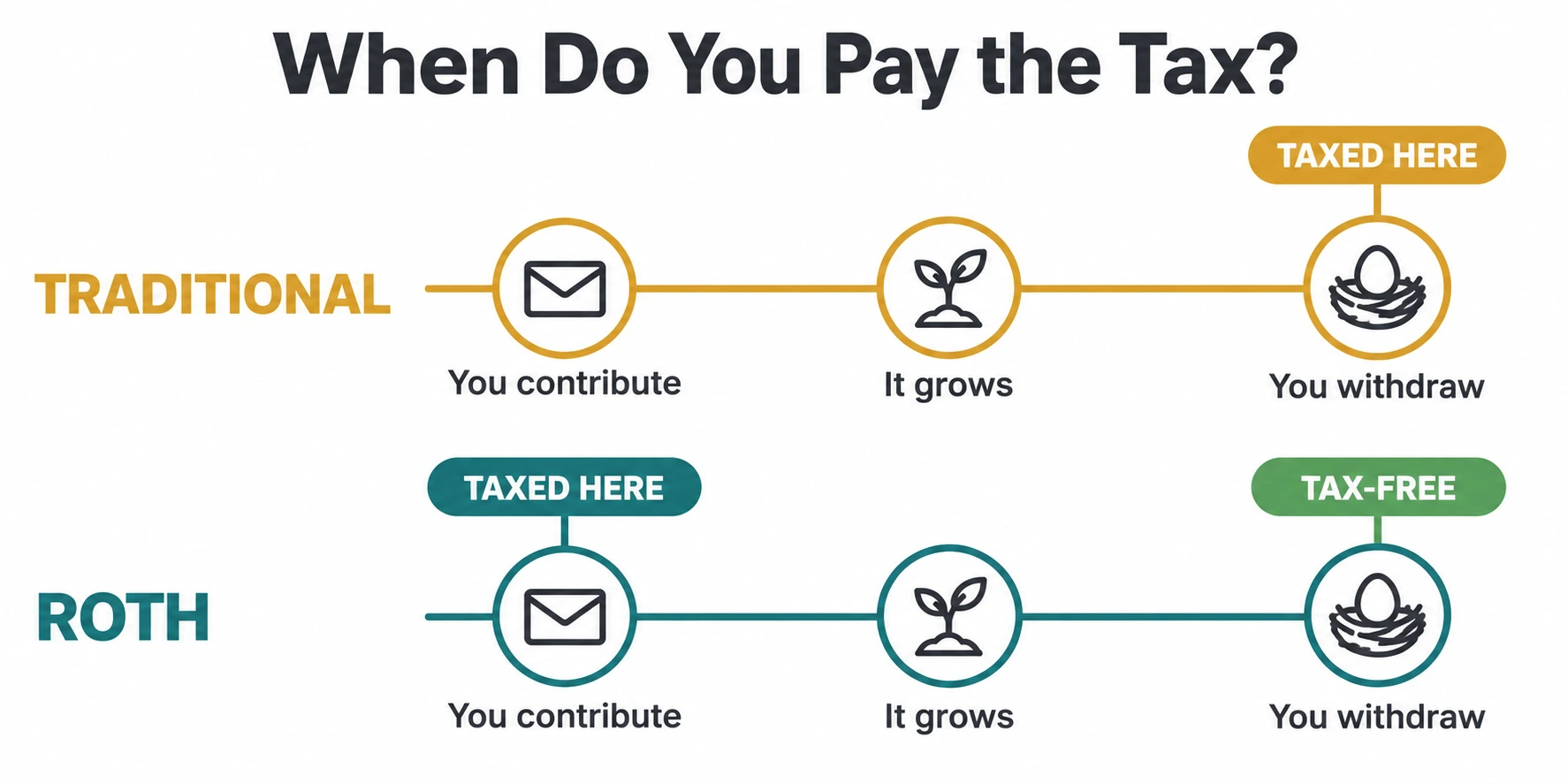
Strip away all the confusion and both accounts are the same product with one variable flipped: when the IRS takes its cut.
Traditional 401(k):
- You contribute pre-tax dollars (your paycheck goes down less because you haven’t paid income tax yet)
- Your money grows tax-deferred inside the account
- When you withdraw in retirement, every dollar is taxed as ordinary income
- Required Minimum Distributions (RMDs) begin at age 73
Roth 401(k):
- You contribute after-tax dollars (your paycheck takes a bigger hit now)
- Your money grows completely tax-free
- Qualified withdrawals in retirement are 100% tax-free
- No RMDs during your lifetime (as of 2024, thanks to SECURE 2.0)
The entire decision comes down to one question: Is your tax rate higher right now, or will it be higher in retirement?
If you’re 22 and earning $48,000, your taxable income after the 2026 standard deduction ($16,100) is about $31,900 — squarely in the 12% federal bracket. With Roth, you pay that 12% on your contributions today and never pay tax on that money again — not when it grows, not when you withdraw it in retirement. With Traditional, you skip the 12% now and pay tax on every dollar you withdraw later, at whatever rate applies then.
So the honest version of the rule is: Roth wins if your tax rate on withdrawals later is higher than your rate today. At 12%, there’s very little room for your rate to go lower — and a lot of room for it to go higher as your career grows. That’s why Roth is usually the better default bet in your 20s. It’s a bet, not a guarantee — the math section below shows exactly how big (and how small) the edge really is.
What Your Paycheck Actually Looks Like With Each Account
Here’s a concrete illustration. Assume you earn $55,000 a year and contribute $5,500 annually (10% of salary) into your 401(k). After the $16,100 standard deduction, that’s about $38,900 of taxable income — the 12% bracket for 2026.
| Traditional 401(k) | Roth 401(k) | |
|---|---|---|
| Gross monthly income | $4,583 | $4,583 |
| 401(k) contribution | $458 pre-tax | $458 after-tax |
| Taxable income reduced? | Yes — by $458 | No |
| Federal income tax on that $458 (12% bracket) | $0 now (taxed when withdrawn) | ~$55 now |
| Difference in monthly take-home | — | ~$55 less (federal; state tax may add a little) |
The Roth paycheck is about $55 smaller per month in this example. Social Security and Medicare (FICA) taxes are identical either way, so the whole gap is federal income tax. That $55 is the price of never paying tax on that money — or anything it grows into — again.
If cash flow is very tight, that $55 gap matters — and we’ll address that honestly in the “When Traditional Wins” section. But if you can absorb it, Roth is usually the stronger long-term default at this bracket. Want to see exactly where these deductions show up? Here’s how to read every line of your pay stub.
Real Dollar Math: What the Numbers Actually Say
Let’s use actual numbers. This is the section most articles skip. They shouldn’t.
Scenario A: 22-Year-Old, $48,000 Salary, 12% Federal Bracket
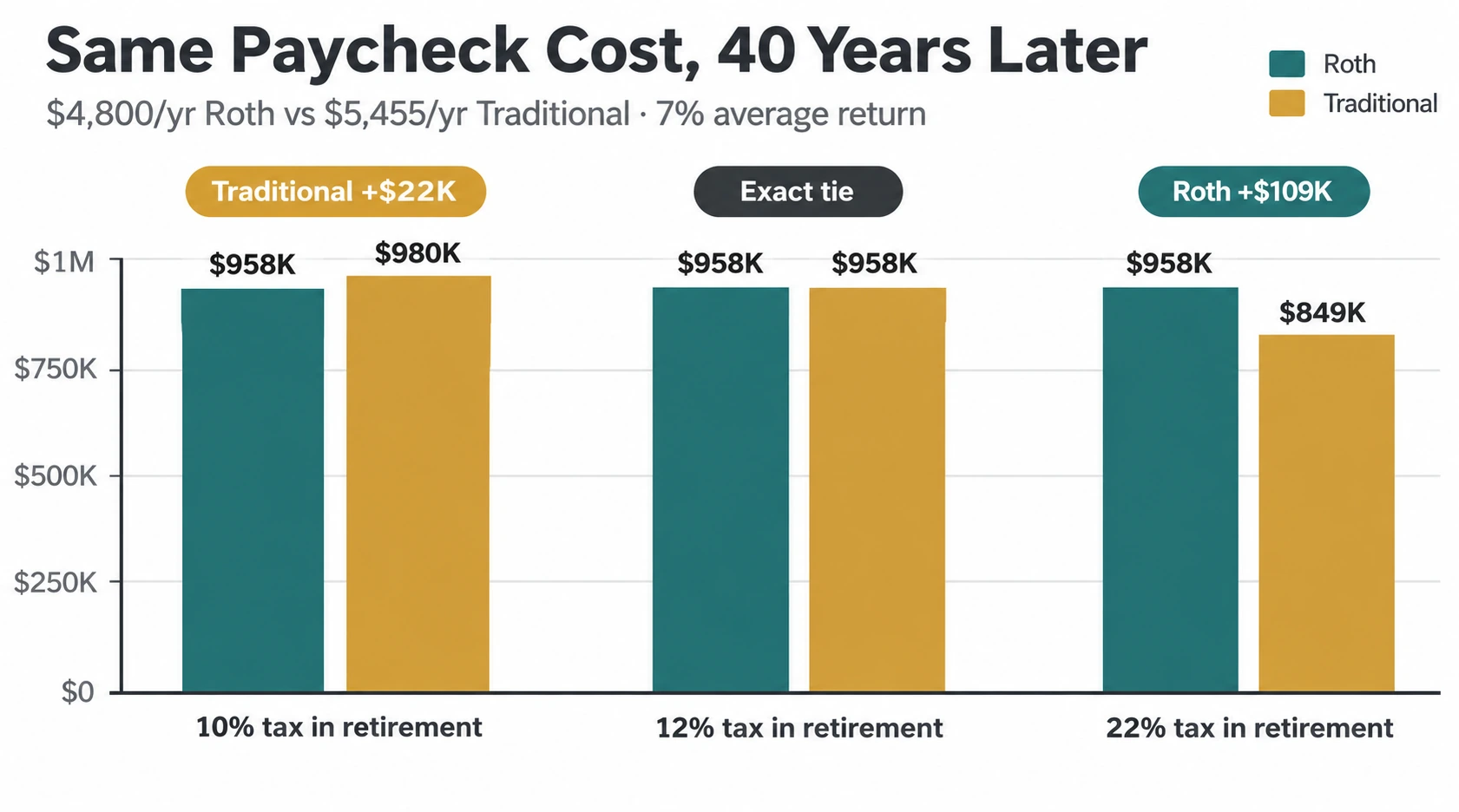
Assumptions: you put 10% of salary — $4,800 a year — into a Roth 401(k) for 40 years at a 7% average annual return. For a fair comparison, the Traditional saver contributes the amount that costs the same take-home pay: $5,455 a year, because the 12% tax break makes each pre-tax dollar cheaper. Same paycheck hit, two different accounts.
| Roth 401(k) | Traditional 401(k) | |
|---|---|---|
| Yearly contribution (same take-home cost) | $4,800 after-tax | $5,455 pre-tax |
| Balance at 62 | ~$958,000 | ~$1,089,000 (taxable) |
| Spendable if your retirement tax rate is 10% | ~$958,000 | ~$980,000 (Traditional +$22,000) |
| Spendable if your retirement tax rate is 12% | ~$958,000 | ~$958,000 (exact tie) |
| Spendable if your retirement tax rate is 22% | ~$958,000 (Roth +$109,000) | ~$849,000 |
Read that table slowly, because it’s the part most “always go Roth” content gets wrong. If your tax rate in retirement equals your rate today, the two accounts end up exactly even. Roth only wins if your rate later is higher — and Traditional wins if it’s lower. Your rate later depends on how much you withdraw: under 2026 rules, a single retiree pulling $60,000 a year from a Traditional account would owe roughly $5,000 in federal income tax, an effective rate near 8%. That’s why online claims of a “$200,000+ Roth advantage” — which usually assume a flat 22% tax on every retirement dollar — overstate the case.
So why do we still lean Roth at 12%? Three reasons. Your income is likely to rise over a 40-year career, so later Traditional contributions would only have saved you tax at higher rates you’re not paying yet. Roth money has no required withdrawals and doesn’t push up your taxable income in retirement. And nobody knows what tax rates look like in the 2060s — holding Roth money is cheap insurance at today’s 12%. The edge is real, but it’s measured in tens of thousands of dollars, not hundreds of thousands. The bigger win is contributing at all and capturing your full employer match.
Scenario B: 28-Year-Old, $75,000 Salary, 22% Federal Bracket
At 22%, the calculus is still generally favorable for Roth — especially if your career trajectory points toward higher income. If your income later climbs into the 24% bracket (it starts at $105,700 of taxable income in 2026), paying 22% today will look smart in hindsight. Locking in 22% today on Roth contributions looks smart in hindsight.
Scenario C: 31-Year-Old, $130,000 Salary, 24% Federal Bracket
At 24%, the gap narrows. Roth is still reasonable if you expect continued income growth, but a split strategy (contributing to both Traditional and Roth) starts to make sense. We cover this in the Split Strategy section below.
The key point from these scenarios: early-career Gen Z workers at typical entry salaries are where Roth is the safest default — the lower your bracket today, the less you give up by paying tax now.
2026 and 2027 Contribution Limits (Full Table)
The IRS sets contribution limits every year. The 2027 numbers were announced on November 12, 2026 (IRS Notice 2026-66), so here’s what applies now and what applies from January 1:
| Limit / Rule | 2026 | 2027 |
|---|---|---|
| Employee Contribution Limit | $24,500 | $25,500 |
| Catch-Up (ages 50–59 and 64+) | +$8,000 → $32,500 total | +$8,500 → $34,000 total |
| Super Catch-Up (ages 60–63) | +$11,250 → $35,750 total | +$11,750 → $37,250 total |
| Total (employee + employer combined) | $72,000 | $75,000 |
| Catch-ups must be Roth if prior-year FICA wages exceeded | $150,000 | $155,000 |
| Roth IRA Limit (under 50) | $7,500 | $7,500 |
| Roth IRA Catch-Up (50+) | +$1,100 | +$1,100 |
| Roth IRA Income Phase-Out (Single) | $153,000–$168,000 | $158,000–$173,000 |
| Roth IRA Income Phase-Out (MFJ) | $242,000–$252,000 | $250,000–$260,000 |
| Roth 401(k) RMDs | NONE (since 2024, SECURE 2.0) | NONE |
| Traditional 401(k) RMD Age | 73 | 73 (rising to 75 in 2033) |
One key note: Roth 401(k) has no income limit. High earners who are phased out of a Roth IRA can still contribute the full $24,500 in 2026 ($25,500 in 2027) to a Roth 401(k). This is a significant difference from the Roth IRA rules.
SECURE 2.0 Act: The Law That Changed the Game
Signed in December 2022, the SECURE 2.0 Act is the most significant retirement legislation in over a decade. Most of the provisions affecting Gen Z workers have phased in between 2023 and 2026. Here’s what you need to know:
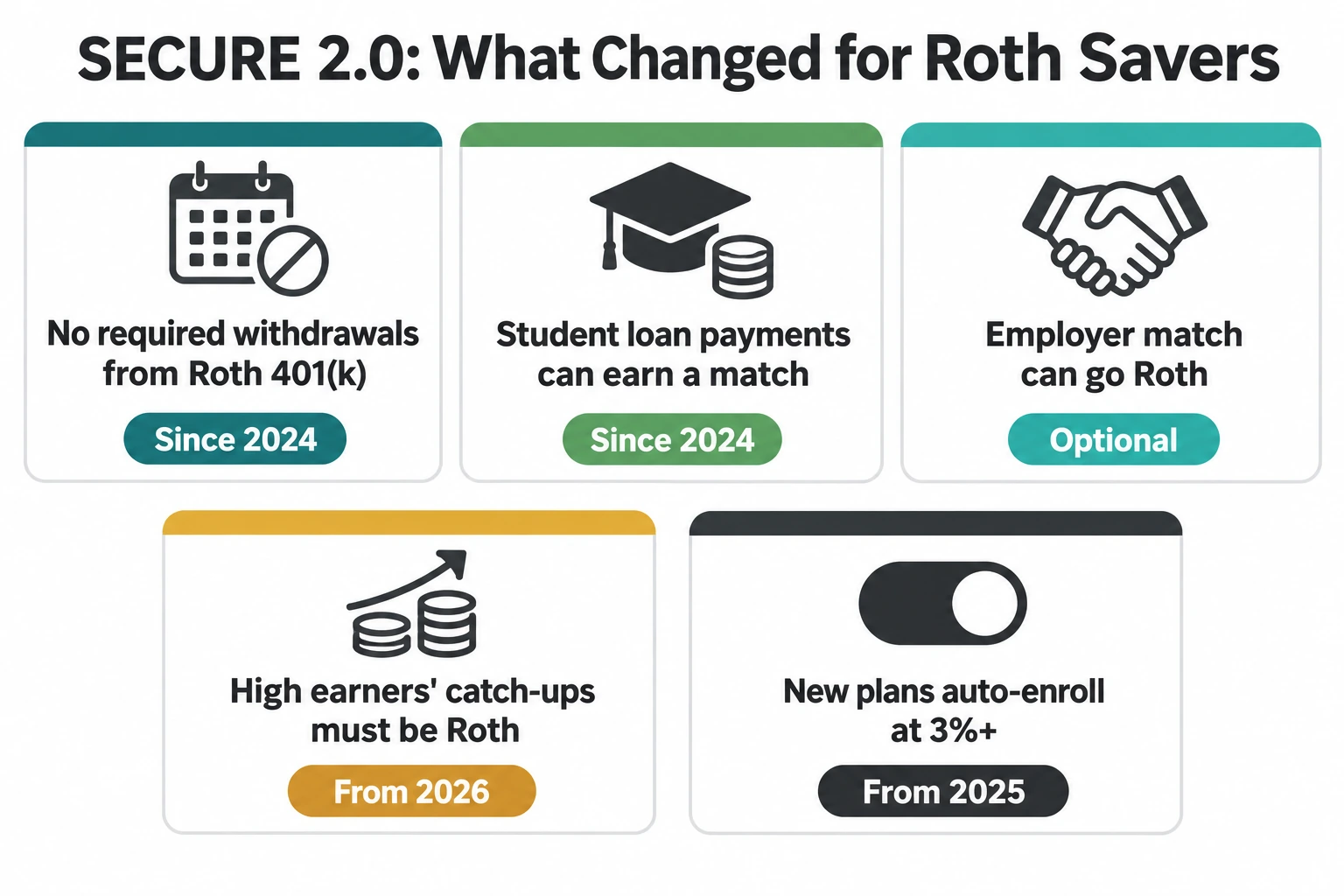
RMD Elimination for Roth 401(k) (Effective 2024)
Before SECURE 2.0, Roth 401(k) accounts were subject to Required Minimum Distributions starting at age 73 — the same rules as a Traditional 401(k). That was a structural flaw. It forced you to withdraw money from a tax-free account even if you didn’t need it.
That’s now gone. As of 2024, Roth 401(k) accounts have no RMDs during the owner’s lifetime. Your account can compound indefinitely. You can pass the entire balance to your heirs tax-free. This fundamentally changes the case for Roth as both a retirement AND estate planning vehicle.
Student Loan Match (Effective 2024) — The One Nobody Talks About
This is the SECURE 2.0 provision that almost no Gen Z worker knows exists.
Gen Z borrowers report paying about $526 a month on student loans — nearly double the $284 average across all borrowers in the same June 2025 Empower poll. Many young workers feel forced to choose: pay down debt or save for retirement. SECURE 2.0 introduced a provision that lets employers match your student loan payments with a 401(k) contribution.
Here’s what that means practically: if you’re paying $400/month toward your student loans and your employer has enabled this provision, they can credit that as if it were a 401(k) contribution and match it. You build retirement savings while paying off debt.
Action item: Email your HR department or check your benefits portal and ask: “Does our 401(k) plan offer the SECURE 2.0 qualified student loan payment match?” This is free money most Gen Z workers are leaving on the table.
Employer Roth Match (Optional, Plan-Specific)
Employers can now opt to send their matching contributions directly to your Roth 401(k) account rather than the default Traditional side. This is still being rolled out — not every plan offers it. One important detail: employer Roth contributions count as taxable income in the year they land in your account. They’re reported on a Form 1099-R (not your W-2), so watch for that form at tax time.
Mandatory Roth Catch-Up (Starting 2026)
Starting in 2026, if you earned more than $150,000 in FICA wages from your employer in the prior year, any catch-up contributions you make (age 50+) must go to Roth. The threshold rises to $155,000 for 2027. This won’t touch you for decades, but it signals a clear legislative direction: Congress is pushing retirement savings toward Roth.
Auto-Enrollment (New Plans Post-2022)
If your employer’s 401(k) plan was created after December 29, 2022, it generally must auto-enroll eligible employees (for plan years starting in 2025 or later) at 3%–10% of pay, rising 1% a year until it reaches at least 10%. Older plans are grandfathered, and businesses with 10 or fewer employees or under three years old are exempt — so check your own plan. And — this is critical — the default contribution type is usually Traditional (pre-tax). More on this in the next section.
The Auto-Enrollment Trap Most Gen Z Workers Fall Into
This is the single most important practical warning in this article.
When you start a new job, your employer likely auto-enrolls you in the 401(k) plan. The default contribution rate is typically 3–6% of your salary. The default account type is usually Traditional (pre-tax).
If you’ve never logged into your HR benefits portal and explicitly chosen Roth, there’s a good chance you’ve been contributing to a Traditional 401(k) this entire time — without realizing it.
⚠️ Check your default RIGHT NOW. Log into your company’s HR portal or benefits platform (Fidelity, Vanguard, Empower, ADP, etc.). Look at your 401(k) contribution election. If it says “pre-tax” or “traditional,” that is the default. You can change it to Roth — usually in under 5 minutes.
Changing your election going forward doesn’t affect money already contributed (that stays as Traditional). But every contribution going forward will go to Roth once you make the switch.
New to your plan altogether? Our 401(k) enrollment guide for your first job walks through the whole sign-up — capturing the match, picking a contribution rate and choosing funds.
Roth 401(k) vs. Roth IRA: You Need to Understand Both
Both accounts are “Roth” — meaning after-tax contributions and tax-free growth. But they work differently, and the best strategy for most Gen Z workers involves using both.
| Feature | Roth 401(k) | Roth IRA |
|---|---|---|
| 2026 Contribution Limit | $24,500 | $7,500 |
| Income Limit | None | Phases out at $153K–$168K (single) |
| Employer Match | Yes | No |
| Early Withdrawal (before 59½) | Pro-rata: every withdrawal is part contributions, part taxable earnings | Contributions come out first — anytime, tax- and penalty-free |
| Investment Options | Limited to your plan’s fund menu | Unlimited — any ETF, stock, fund |
| 5-Year Rule Clock | Per-plan (starts with first contribution to THIS employer’s plan) | Universal — one clock for all Roth IRAs |
| RMDs | None (SECURE 2.0, 2024) | Never had RMDs |
The 5-year rule clock difference is one of the most misunderstood nuances. Your Roth 401(k) clock starts when you make your first contribution to your current employer’s plan. If you roll that Roth 401(k) into a Roth IRA later, the IRA’s universal clock governs — and if you opened a Roth IRA years earlier, you may already have the 5-year requirement satisfied.
Best practice for Gen Z: Open a Roth IRA immediately, even with just $50. This starts your universal 5-year clock. Then follow this savings priority order:
- Roth 401(k) up to the employer match — always capture free money first
- Max out Roth IRA ($7,500 in 2026) — for flexibility and broader investment options
- Max out Roth 401(k) — increase contributions up to the $24,500 limit
- Taxable brokerage account — for any additional savings beyond tax-advantaged limits
Advanced: Backdoor Roth IRA
If your income exceeds $168,000 (single) or $252,000 (married), you can’t contribute directly to a Roth IRA. But you can use the Backdoor Roth: contribute to a non-deductible Traditional IRA, then convert it to Roth. There’s no income limit on conversions.
Warning: If you have pre-existing pre-tax IRA balances, the pro-rata rule applies and the conversion becomes taxable on a proportional basis. Clear pre-tax IRA balances before executing.
Advanced: Mega Backdoor Roth
If your 401(k) plan allows after-tax contributions beyond the standard employee limit AND in-plan Roth conversions (check with your plan administrator), you can potentially get up to $72,000 in 2026 ($75,000 in 2027) into Roth-equivalent accounts — a cap that includes your own and your employer’s contributions. This strategy is primarily useful for high-earning Gen Z workers in tech or finance.
When Traditional 401(k) Actually Wins
Most Gen Z financial content is Roth-first, Roth-always. That’s largely correct — but it’s not the full picture. There are real situations where Traditional is the better choice.
1. You’re in the 32% bracket or higher
If you’re earning roughly $218,000+ in salary as a single filer (taxable income above $201,775 in 2026), your marginal rate is 32%. If you reasonably expect your retirement income to be lower (say, 22–24% bracket), deferring taxes now and paying less later is mathematically sound.
2. Very tight cash flow
Traditional contributions reduce your taxable income today, which means a smaller paycheck reduction. If choosing between Traditional with a meaningful contribution or Roth with a contribution so small it barely matters — Traditional wins. Getting money into the account at all beats optimizing the account type.
3. High state income tax — planning to retire to a no-tax state
If you currently live in California (13.3% top state rate) and plan to retire in Texas or Florida (0% state income tax), your Traditional contributions reduce both federal AND state taxable income now. At retirement, you only owe federal. The combined rate differential can be 10–13%. This is a legitimate planning strategy.
4. Planned Roth conversion strategy in early retirement
Some advanced planners intentionally use Traditional accounts during high-income years, then retire early (before Social Security and RMDs kick in), creating a low-income window where they convert Traditional funds to Roth at a lower rate. This is sometimes called a Roth Conversion Ladder — popular in the FIRE (Financial Independence, Retire Early) community.
5. TCJA Rates Are Now Permanent (Mostly)
For several years, a major argument for Roth was that the Tax Cuts and Jobs Act rates would expire after 2025, causing rates to rise. The One Big Beautiful Bill Act (OBBBA), signed in July 2025, made those rates permanent. The “rates are going up soon” urgency is no longer the strongest argument for Roth. Career income growth and the elimination of Roth 401(k) RMDs remain the compelling arguments.
The Split Strategy: Tax Diversification Explained
You don’t have to pick one. You can contribute to both Traditional and Roth 401(k) simultaneously — any split — as long as the combined total stays within the annual limit ($24,500 in 2026).
Financial planners call this tax diversification. The idea is similar to diversifying an investment portfolio: since no one knows exactly what future tax rates will be or how large your retirement income will be, holding both pre-tax and after-tax retirement assets gives you flexibility.
How it works in retirement (bracket filling):
Imagine you retire with $600,000 in a Traditional 401(k) and $600,000 in a Roth 401(k), and you need $90,000 a year. Using 2026 tax rules for illustration (single filer, $16,100 standard deduction):
- Pull $66,500 from Traditional — after the standard deduction, that’s $50,400 of taxable income, the very top of the 12% bracket
- Pull the remaining $23,500 from Roth — completely tax-free
- Result: about $5,800 in federal tax. Pulling all $90,000 from Traditional would cost about $10,970 — the mix saves roughly $5,170 a year
Over 20–30 years in retirement, this kind of bracket management can save tens of thousands of dollars in total taxes.
Example splits under the $24,500 (2026) limit:
| Strategy | Traditional | Roth |
|---|---|---|
| All Roth | $0 | $24,500 |
| 75% Roth / 25% Traditional | $6,125 | $18,375 |
| 50/50 Split | $12,250 | $12,250 |
| All Traditional | $24,500 | $0 |
When to use the split: If you’re in the 22% bracket and uncertain about your trajectory, a 70% Roth / 30% Traditional split is a reasonable hedge. If you’re firmly in the 12% bracket, go 100% Roth.
Gig Income, Side Hustles, and Your 401(k)
This section is for the many Gen Z workers with income on the side — 43% of 18-to-29-year-olds reported having a side hustle in LendingTree’s March 2026 survey.
How gig income affects your tax bracket:
1099 income (freelance, gig, contract) is taxable and adds to your total income. If your W-2 salary is $45,000 and your side hustle adds $15,000, the combined $60,000 still lands in the 12% bracket after the standard deduction — but income above roughly $66,500 (single filer, 2026) starts hitting 22%, which narrows the Roth edge slightly. Self-employment income also carries its own self-employment tax, which is the same whichever account you choose.
Solo 401(k) for self-employment income:
If you’re self-employed or earn significant freelance income, you can open a Solo 401(k) (also called an Individual 401(k)). This allows you to contribute as both the “employee” and the “employer”:
- Employee contribution: up to $24,500 (2026), $25,500 (2027)
- Employer contribution: up to 25% of compensation — for sole proprietors that works out to roughly 20% of net self-employment earnings
- Combined limit: $72,000 (2026), $75,000 (2027)
And yes — Solo 401(k)s can be Roth.
Part-time worker eligibility (SECURE 2.0 change):
SECURE 2.0 reduced the long-term part-time worker eligibility threshold from 3 years to 2 years of 500+ hours annually. If you’ve been working part-time or gig hours, you may now qualify for your employer’s 401(k) sooner than under previous rules.
Your Gen Z Decision Framework
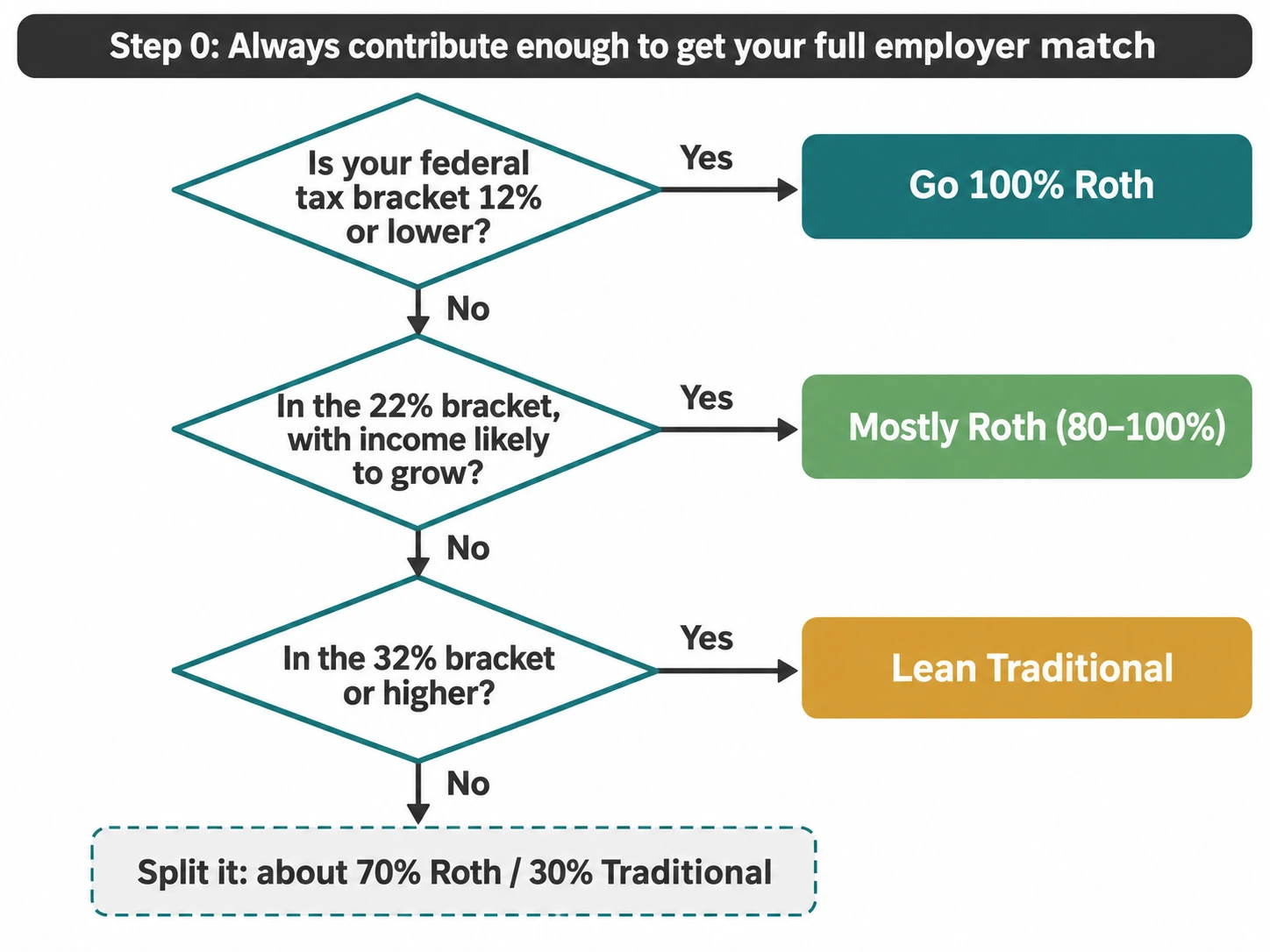
Use this table to find your recommended starting point:
| Your Situation | Recommended Approach |
|---|---|
| 10%–12% federal bracket | Go 100% Roth 401(k) |
| 22% bracket, income likely to grow | Go 80–100% Roth 401(k) |
| 22% bracket, income plateaued | Consider 70% Roth / 30% Traditional split |
| 24% bracket | Split strategy or lean Traditional; evaluate career trajectory |
| 32%+ bracket | Traditional likely wins; consult a CFP |
| Very tight cash flow | Traditional first to capture match; add Roth when budget allows |
| High-tax state, retiring to no-tax state | Traditional contributions may be optimal |
| Student loan debt, employer offers SECURE 2.0 match | Ask HR immediately; this changes your priority order |
| Have both W-2 and gig income | Calculate combined bracket; consider Solo 401(k) for gig income |
| Uncertain / first job | Split 70% Roth / 30% Traditional as a default hedge |
Quick rule of thumb: If you’re in the 12% or 22% bracket and don’t have an unusual financial situation, Roth 401(k) is almost certainly the right default choice. The only question is whether to go 100% Roth or use a split.
Common Mistakes to Avoid
1. Accepting the auto-enrollment default
Usually Traditional. Check your HR portal and change it if you want Roth. Do this today.
2. Thinking it’s all-or-nothing
You can split contributions between Traditional and Roth in any ratio. The all-or-nothing framing is incorrect.
3. Cashing out when you change jobs
This is especially common for Roth. The logic is: “I already paid tax on this, so it’s basically mine.” But cashing out triggers a 10% early withdrawal penalty on earnings AND loses decades of compounding. Always roll it over.
4. Ignoring state income taxes
State income taxes change the math significantly. A 22% federal + 9% state rate today vs. 22% federal only in a no-income-tax retirement state is a 9-point differential worth calculating.
5. Not opening a Roth IRA alongside your Roth 401(k)
The Roth IRA’s universal 5-year clock, unlimited investment options, and penalty-free contribution withdrawal flexibility make it a complementary tool — not a substitute. Open one now, even with $50, to start the clock.
6. Paralysis — not contributing while debating account type
The worst outcome is contributing nothing while trying to pick the “perfect” account. Both accounts beat a savings account by a wide margin. Start contributing, then optimize.
FAQ
Is a Roth 401(k) better for Gen Z?
Usually, for workers in the 10% or 12% bracket — but it’s a bet, not a guarantee. Paying tax at a low rate now beats paying a higher rate later; if your retirement tax rate ends up lower than today’s, Traditional would have come out ahead. For most people early in their careers, income and tax rates rise over time, which is why Roth is the stronger default. Fidelity’s Q3 2025 data shows Gen Z putting 95% of IRA contributions into Roth accounts — yet only about 20% of Gen Z 401(k) participants use a Roth 401(k).
What is the 401(k) contribution limit for 2026 and 2027?
In 2026, employees can contribute up to $24,500 to a 401(k). For 2027, the IRS raised that to $25,500. Including employer contributions, the combined cap is $72,000 in 2026 and $75,000 in 2027. These limits are shared across Traditional and Roth 401(k) — you can split your contributions any way you like as long as the combined amount stays under the annual cap.
What changed about Roth 401(k) RMDs?
The SECURE 2.0 Act, effective January 1, 2024, eliminated Required Minimum Distributions from Roth 401(k) accounts during the account owner’s lifetime. Previously, Roth 401(k) accounts were subject to the same RMD rules as Traditional 401(k)s — meaning you were forced to withdraw money from a tax-free account starting at age 73, even if you didn’t need it. That flaw is now corrected. Your Roth 401(k) can grow indefinitely and pass to heirs completely tax-free.
Can I contribute to both Roth and Traditional 401(k) in the same year?
Yes. Most 401(k) plans allow you to split your contributions between Traditional and Roth in any combination you choose. The only rule is that the combined total cannot exceed the annual limit — $24,500 in 2026. For example, you could contribute $16,000 to Roth and $8,500 to Traditional in the same year. This “split strategy” is a recognized tax diversification technique recommended by many CFPs.
What is the student loan match, and how does it work for Gen Z?
The SECURE 2.0 Act (effective 2024) allows employers to make matching contributions to your 401(k) based on your student loan payments — not just your 401(k) contributions. If your employer has adopted this provision, making qualified student loan payments counts toward earning your 401(k) match, even if you’re not contributing to the 401(k) yourself. This is a major but underused benefit for Gen Z workers managing loan payments. Ask your HR department directly whether your plan includes this feature.
Does the auto-enrollment default go to Roth or Traditional?
Usually Traditional. When employers auto-enroll you at 3–6% of salary, the default contribution type is pre-tax Traditional. Workers who never update their election stay in Traditional their entire time at the company without realizing it. Log into your HR benefits portal and check your current election. If it says “pre-tax” or “traditional” and you want Roth, changing it usually takes under five minutes.
Should I use a Roth 401(k) or a Roth IRA?
Both, ideally. The Roth 401(k) has a higher contribution limit ($24,500 vs. $7,500 in 2026) and includes employer matching. The Roth IRA offers more investment flexibility, easier early access to contributions, and a universal 5-year rule clock. The recommended priority for most Gen Z workers is: (1) Roth 401(k) up to the employer match, (2) max out Roth IRA, (3) return to Roth 401(k) for additional contributions. Open a Roth IRA immediately — even with $50 — to start your 5-year clock.
When does Traditional 401(k) beat Roth for a young worker?
There are specific scenarios where Traditional wins: (1) if you’re already in the 32% federal bracket, (2) if cash flow is very tight and the higher Roth cost prevents meaningful contributions, (3) if you live in a high state income tax environment and plan to retire in a no-income-tax state, or (4) if you’re executing a planned Roth conversion strategy in early retirement. For most Gen Z workers at typical entry or early-career salaries, these exceptions don’t apply — but they’re worth checking.
What is the 5-year rule for Roth 401(k)?
To make a “qualified distribution” (fully tax-free) from a Roth 401(k), two conditions must both be met: (1) you must be age 59½ or older, and (2) the account must have been open for at least 5 tax years. The clock starts with your first contribution to that specific employer’s plan — not the first time you ever opened a Roth account anywhere. This is different from the Roth IRA, which has a universal clock across all IRAs. If you roll a Roth 401(k) into a Roth IRA, the IRA’s clock governs — which is another reason to open a Roth IRA early.
How does gig economy income affect my 401(k) choice?
Gig and freelance income (reported on a 1099) is added to your total taxable income. If side hustle income pushes your combined income into a higher bracket, it slightly reduces the Roth advantage — but for most Gen Z workers, the calculation still favors Roth. Additionally, if you earn self-employment income, you may be eligible to open a Solo 401(k), which allows contributions both as the “employee” (up to $24,500 in 2026) and as the “employer” (up to 25% of compensation — roughly 20% of net self-employment earnings for sole proprietors), with a combined limit of $72,000 in 2026 ($75,000 in 2027). Solo 401(k)s can be Roth.
Conclusion
The Roth vs. Traditional 401(k) decision isn’t complicated once you understand the core logic: it’s about tax timing, and right now is the best time in most Gen Z workers’ careers to lock in a low tax rate.
The data backs it up. Ninety-five percent of Gen Z IRA contributions go to Roth. At a 12% bracket, you give up very little by paying tax now. And SECURE 2.0’s elimination of Roth 401(k) RMDs has made Roth an even more powerful long-term tool — not just for retirement income, but for estate planning too.
But the most important action item from this article isn’t about account type. It’s about the default. Right now, there’s a good chance your 401(k) is set to Traditional because that’s what auto-enrollment chose for you. That’s worth checking before anything else.
Here’s your five-step starting point:
- Log into your HR benefits portal. Check your contribution type. Change to Roth if you’re in the 12% or 22% bracket.
- Confirm you’re capturing your full employer match. Free money first, always.
- Ask HR about the student loan match. If your plan offers it, this is free retirement money while you pay off debt.
- Open a Roth IRA. Even $50 starts the 5-year clock. Open one today.
- Don’t overthink it. Contributing to either account beats not contributing. Start now, optimize later.
This isn’t a decision you have to get perfect on day one. You can change elections, adjust splits, and refine your strategy as your income grows. The most important thing is to start — and to start with your eyes open.
This guide is one piece of our complete First Job Money Guide — covering everything from your first paycheck withholding to picking employee benefits.
This article is for educational purposes only and does not constitute tax, legal, or financial advice. Consult a CERTIFIED FINANCIAL PLANNER (CFP) or CPA for personalized guidance. Tax law changes — verify all figures at IRS.gov for the current tax year.