
The Complete First Job Money Guide (2026)
You opened your first paycheck and it was smaller than you expected. That’s not a mistake. It’s just what gross pay turning into net pay looks like, and almost nobody explains it before it happens.
A first real job comes with a stack of decisions nobody prepares you for: what to do with your W-4, whether to enroll in the 401(k), which health plan to pick, how to budget around a number that’s lower than the one in your offer letter. Most of these have a deadline. You usually don’t find out what it was until after you’ve missed it.
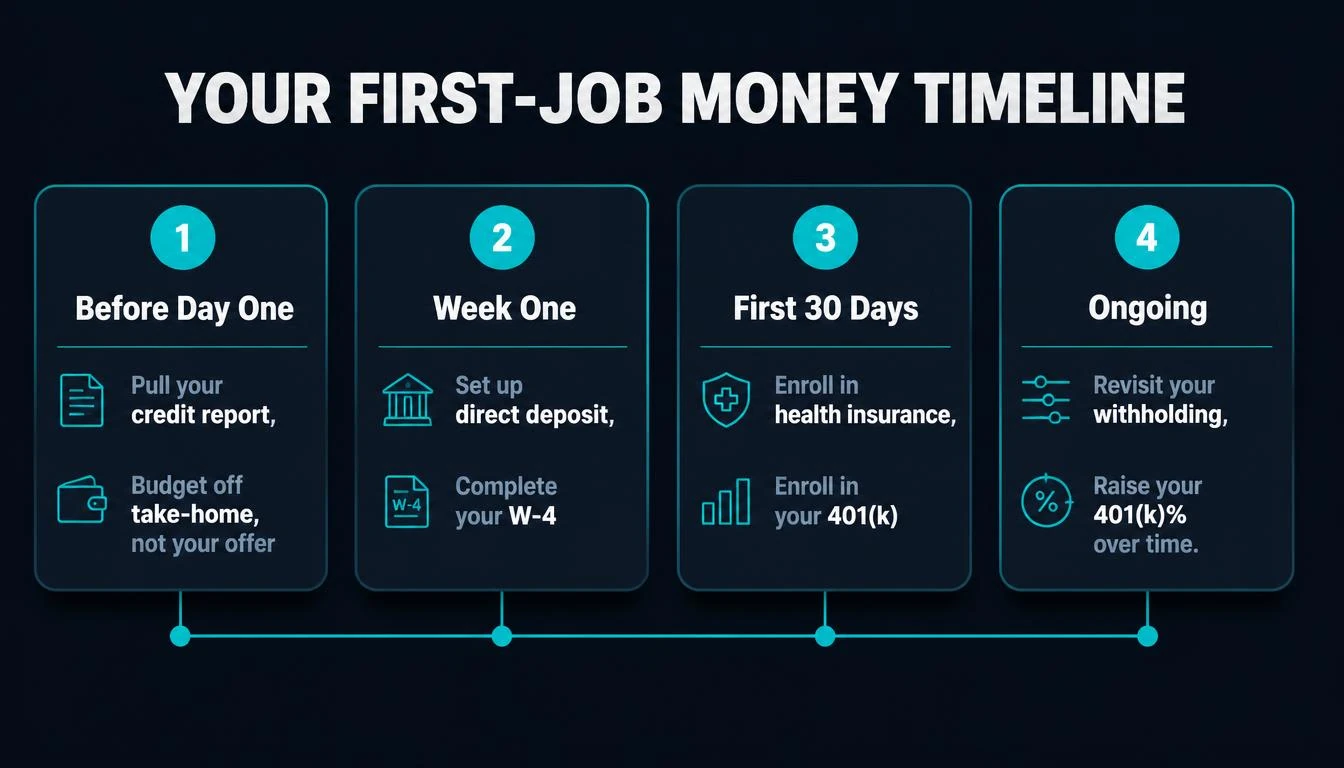
This first job money guide walks through all of it in order: what to handle before your first day, what to lock in during week one, what’s due within your first 30 days, and what to keep doing after that. It’s not a loose pile of tips. It’s the actual sequence, with the deadlines that matter and figures checked directly against primary sources as of October 2026.
Each section below links out to a deeper guide on that specific piece — reading your pay stub line by line, negotiating your starting salary, deciding on the 401(k), choosing a health plan, building your first real budget. Use this page as the map. Go deep wherever you need to.
Quick answer: In your first 30 days at a new job, set up direct deposit, complete your W-4, enroll in health insurance and your 401(k) before the window closes (commonly around 30 days), and budget off your real take-home pay — roughly 70 to 80 percent of your offer, not the number in your offer letter.
What Your First Paycheck Actually Looks Like
Your offer letter has one number on it. Your bank account shows a smaller one. That gap is what trips up almost everyone the first time.
Here’s what happens in between. Your employer withholds federal income tax, and usually state and local tax too, based on what you put on your W-4. Then FICA comes out — Social Security and Medicare, a flat 7.65% that no W-4 setting changes. Then, if you’ve already enrolled, your 401(k) contribution and your share of health insurance premiums come out before you ever see the money.
As a rough estimate, and this varies a lot by state, filing status, and what you’ve elected, take-home pay often lands somewhere around 70–80% of gross pay for an entry-level salary. That’s not a promise. It’s a ballpark. The only way to know your actual number is your actual pay stub.
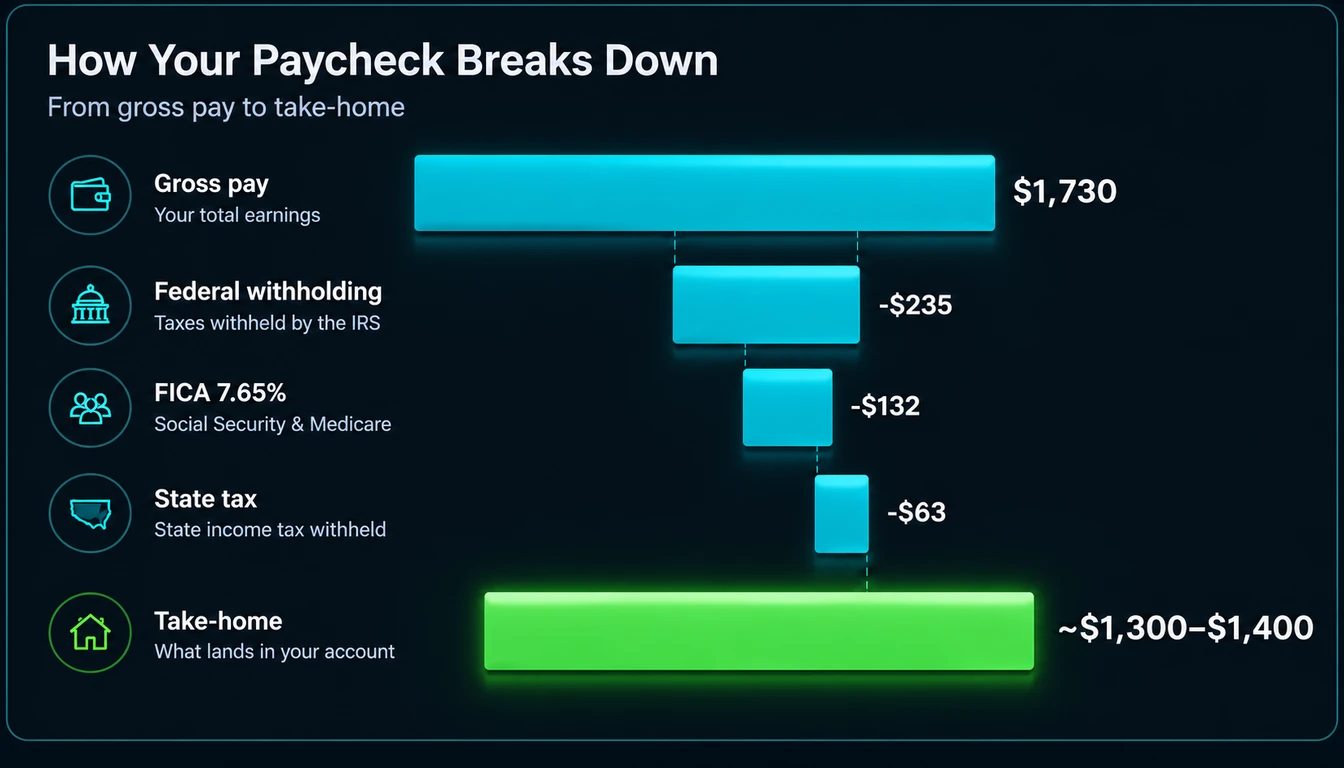
Here’s what that looks like with real numbers. Say your offer is $45,000 a year, paid biweekly — about $1,730 gross per paycheck. By the time federal withholding, FICA, and a state tax come out, a lot of first paychecks at that income level land somewhere in the neighborhood of $1,300–$1,400 take-home, before anything else — a 401(k) contribution, a health premium — is even subtracted. This is a hypothetical example built to show the shape of the math. It’s not a prediction of your paycheck. Your real number depends on your state, your filing status, and what you’ve elected, which is exactly why your own pay stub is the only source that counts.
That’s exactly what the companion guide, How to Read a Pay Stub: Every Line Item Decoded for First-Timers, walks through line by line. Come back here for the full sequence. Go there when you want to understand every line on your own stub.
First job money terms, decoded — a quick reference for words that’ll show up constantly in your first few weeks:
- Gross pay — what you’re paid before anything is taken out.
- Net pay (take-home pay) — what actually lands in your account.
- Withholding — the portion of each paycheck your employer sends to the IRS on your behalf, based on your W-4.
- FICA — the combined Social Security and Medicare tax. A flat percentage of your pay; your W-4 doesn’t touch it.
- 401(k) match — money your employer adds to your retirement account when you contribute, usually up to a set percentage of your salary.
- Vesting — the schedule that determines when employer-matched retirement money is actually, permanently yours if you leave the job.
- HDHP — a health plan with a lower monthly premium and a higher deductible, often paired with an HSA.
- PPO — a health plan with a higher premium but more flexibility in which doctors and providers you can use.
- HSA — a tax-advantaged account for medical expenses, available if you’re enrolled in an HDHP.
Before Your First Day
A few things are easier to handle before you’re also trying to learn a new job.
- Pull your own credit report. Some employers run background or credit checks as part of onboarding. You want to know what’s on there before anyone else looks. Free reports are available at annualcreditreport.com.
- Mentally budget off the smaller number, not the offer number. If your offer is $50,000, don’t plan your rent around $50,000. Plan around your estimated take-home — see the rough range above — until you have an actual pay stub to work from.
- If you haven’t accepted an offer yet, this is also the window to negotiate. Even entry-level offers have more room than people assume.
- If this isn’t technically your first job, don’t skip ahead. A summer job, an internship, or part-time work earlier this year still counts — and it changes one thing that matters: your tax withholding. Holding more than one job in the same calendar year, or starting partway through the year, are two of the most common reasons withholding ends up wrong. More on exactly why in the withholding section below.
Your First Week: Paperwork That Actually Matters
Most first-week paperwork is forgettable. A few pieces aren’t.
- Set up direct deposit. Some banks waive monthly fees once direct deposit is active, worth checking before you pick where your money lands.
- Complete your W-4 (and state W-4, if your state has one). This is what controls your withholding, and you can change it later — more on that below.
- Confirm your actual first pay date. Depending on where your start date falls in the company’s pay cycle, your first paycheck can land later than you’d expect. Ask HR directly instead of guessing.
- Keep sensitive documents secure. Anything you handed over for I-9 verification — Social Security card, passport — should go somewhere safe once you’re done with it, not stay in a bag.
Your First 30 Days: Benefits Enrollment
This is the section with the real deadlines, and the one most first-time employees underestimate.
New-hire benefits elections commonly need to be made within about 30 days of your start date. That’s a common window, not a universal law, so confirm your exact deadline in your offer letter or HR portal rather than assuming 30 days applies to you. Miss it, and some plans make you wait up to a year for the next open enrollment.

Two decisions sit inside that window.
Health insurance. Compare the plans your employer offers, commonly a choice between something like an HDHP (higher deductible, lower premium, pairs with an HSA) and a PPO (higher premium, more flexibility). If you’re under 26, you may also have the option to stay on a parent’s health plan instead of enrolling at work. Under the Affordable Care Act, young adults can generally remain on a parent’s plan until age 26 — a rule still in effect as of 2026. Plan types vary in how they apply this, so confirm with the specific plan. The full comparison lives in Health Insurance Open Enrollment: A First-Timer’s Guide at 22.
HSA or FSA, if you’re offered one. If your plan is a high-deductible health plan, you likely qualify for a Health Savings Account; most other plans pair with a Flexible Spending Account instead. The two work very differently — eligibility, rollover rules, and portability all differ — and picking without understanding the difference can cost you a tax advantage you won’t get back. The full comparison is in HSA vs FSA: Which Should You Choose at Your First Job?
401(k) enrollment. If your employer offers a match, contributing at least enough to get the full match is close to free money — an immediate return no investment choice on its own can match. Here’s why, with a concrete hypothetical: say your employer matches 50% of what you contribute, up to 6% of your salary, and you’re making $45,000 a year. Contributing that 6% means about $2,700 a year comes out of your own paycheck, and your employer adds roughly another $1,350 on top, just for contributing. Opt out, and that $1,350 simply doesn’t exist. Match formulas vary by employer, so check your own plan’s specifics rather than assuming this example applies to you. Some plans also have an eligibility waiting period before you can enroll at all — if you’re not eligible on day one, set a reminder for whenever you are. The full decision gets a complete breakdown in 401(k) Enrollment at Your First Job: What to Actually Pick (And What to Avoid). Torn between the Roth and Traditional versions? Roth 401(k) vs. Traditional 401(k): The Gen Z Breakdown walks through the real numbers.
Educational note, not financial advice: the right choice between plan types, and exactly how much to contribute, depends on your own income, debt, and health needs. This guide covers the general mechanics, not a recommendation for your specific situation.
A few more first-30-days items that are easy to skip: update your beneficiaries on your 401(k), HSA, and any life insurance — almost nobody thinks to do this on day one, and it matters. If you had a 401(k) with a previous employer, ask about rollover options now rather than letting it sit forgotten.
Checking Your Tax Withholding
Your W-4 isn’t a one-time form. It’s adjustable any time your situation changes, and for a first job, it’s worth checking rather than assuming it’s right.
You’re especially likely to need an adjustment if:
- You had another job earlier this calendar year (very common if this is a new job after a summer or part-time position)
- You started partway through the year rather than in January
- You have income from outside this job
The IRS’s Tax Withholding Estimator — a free tool at irs.gov, confirmed current as of this writing — is built for exactly this. It checks your withholding and tells you whether to submit a new W-4, without asking for your name, Social Security number, or bank information. Have your most recent pay stub, and if relevant your most recent tax return, on hand before you start. It takes about 25 minutes.
Educational note, not tax advice: withholding rules depend on your specific income, filing status, and state. This is a pointer to the tool, not a substitute for checking your own numbers.
Come tax season, read our guide on how to file taxes for the first time with your first W-2 to see how your withholding turns into a refund or a bill.
If you want the full step-by-step on filling out the form itself — not just when to revisit it — see How to Fill Out a W-4 Form in 2026 (Step-by-Step).
For how to read the result on your actual paycheck once it’s updated, that’s How to Read a Pay Stub: Every Line Item Decoded for First-Timers.
Building Your First Budget
Once you’ve seen an actual paycheck, not an estimate, it’s time to build a real budget around it.
The simplest starting framework is the 50/30/20 split:
- 50% needs — rent, utilities, transportation, groceries
- 30% wants — everything that makes life enjoyable: eating out, hobbies, entertainment
- 20% savings — an emergency fund first, then other goals

It’s a starting point, not a law. Adjust the percentages if your rent alone eats more than 50%, which happens often in higher cost-of-living areas. The point is having some intentional split, instead of finding out at the end of the month where it all went.
Start your emergency fund before anything else in that 20%. The standard target is 3–6 months of expenses, which can feel out of reach starting out, so start smaller. Automate a transfer every payday, even $25 or $50, before you spend anything else. Treat it like a bill you pay yourself, not something you get to “if there’s anything left.”
The full breakdown, including how to adapt this specifically to a first entry-level paycheck, is in What to Do with Your First Big Paycheck: A 7-Step Money Checklist — paired with Dollar Vista’s free Gen Z Budget Template if you’d rather start from a ready-made template than build one from scratch.
What to Keep Doing After Month One
The first month is the heavy-lift month. After that, it’s maintenance.
- Keep any existing debt current. Student loans, credit cards — on-time payments matter more to your credit than almost anything else you’ll do this year.
- Revisit your withholding if anything changes: a raise, a second job, a change in filing status.
- Increase your 401(k) contribution percentage over time, especially with raises, instead of leaving it at whatever you set on day one.
- Reassess your budget periodically. Your first budget won’t be your last one, and that’s normal.
- Start thinking about credit on purpose. This gets skipped in almost every “first job” guide out there, but your first paycheck is also the best moment to start building credit intentionally instead of by accident. A steady income makes you a stronger candidate for a starter credit card or becoming an authorized user, and on-time payments from here on build exactly the credit history you’ll need later for an apartment, a car, or eventually a mortgage. That’s a deep topic on its own — Dollar Vista’s upcoming Credit & Banking cluster picks it up from here.
First Job Money Mistakes to Skip
- Budgeting off your offer-letter number instead of your real take-home pay.
- Missing the benefits enrollment window. Nobody told you it was ~30 days, not “whenever you get around to it.”
- Skipping the 401(k) match to “deal with it later.” Later often means never — and it’s money left on the table.
- Never actually opening your pay stub to see where the money goes.
- Ignoring withholding entirely, especially if you had another job earlier in the year.
Key Takeaways
- Your take-home pay is lower than your offer-letter number, typically by 20–30%, because of taxes, FICA, and any benefits you’ve elected — budget off the real figure on your pay stub, not the offer.
- Benefits enrollment commonly runs on a ~30-day clock from your start date. Confirm your exact deadline; missing it can mean waiting up to a year.
- Contributing enough to get your full 401(k) match is close to free money — skipping it has a real dollar cost, not just an opportunity cost.
- If you worked another job earlier this year or started mid-year, check your tax withholding — the IRS’s free Tax Withholding Estimator is built for exactly this situation.
- Young adults can generally stay on a parent’s health plan until age 26 under the ACA, still true as of 2026, which may change whether enrolling at work makes sense yet.
- The 50/30/20 split is a starting framework, not a rule — adjust it to your real costs, and automate your savings so it happens without relying on willpower.
First Job Money Guide: Frequently Asked Questions
Why is my first paycheck smaller than I expected?
Federal (and usually state) tax withholding, FICA, and any benefits you’ve already elected — like a 401(k) contribution or health premium — all come out before you see the deposit. Take-home pay for an entry-level salary often lands around 70–80% of gross, though this varies by state and your own elections, so your actual pay stub is the only accurate source.
When do I need to enroll in benefits at a new job?
Many employers use a window of around 30 days from your start date, but this isn’t universal — check your offer letter or HR portal for your specific deadline. Missing it can mean waiting until the next open enrollment period, sometimes up to a year later.
Should I contribute to my 401(k) right away, even if I have student loans?
At minimum, most people are better off contributing enough to get the full employer match, since it’s close to an immediate guaranteed return that’s hard to beat elsewhere. Whether to go beyond the match while also paying down debt is a more personal call — covered in full in the dedicated 401(k) guide.
Do I need to adjust my tax withholding for a new job?
It’s worth checking, especially if you had another job earlier this year, started partway through the year, or have income outside this job. The IRS’s free Tax Withholding Estimator, at irs.gov, is built for this and takes about 25 minutes.
Can I stay on my parents’ health insurance instead of enrolling at my job?
Generally yes. Under the Affordable Care Act, young adults can typically remain on a parent’s health plan until age 26, and this rule is still in effect as of 2026. Plan types vary in how they handle it, so confirm with the specific plan.
What budgeting method should I use for my first paycheck?
The 50/30/20 split (50% needs, 30% wants, 20% savings) is a simple starting framework, not a rule, just a place to start adjusting from based on your actual costs.
How much should I have in an emergency fund when I’m just starting out?
The eventual target most sources point to is 3–6 months of expenses, but you don’t need that on day one. Start with any automatic amount per paycheck, even $25 or $50, and build from there.
Conclusion
None of this has to happen perfectly, and it doesn’t have to happen all at once. What matters is knowing the order: get your paperwork right in week one, don’t let the 30-day benefits window close without a decision, check your withholding if your work history is anything but a clean single job, and build a budget around what actually lands in your account, not what your offer letter said.
Every piece of this has a deeper guide waiting if you want it: how to read your actual pay stub, how to negotiate before you even accept the offer, how to decide on the 401(k), how to pick a health plan, how to build the budget itself. Start wherever you are in the timeline, not from the beginning if you’ve already passed it.
If you’re holding your first pay stub right now and none of the numbers make sense yet, that’s the next stop: How to Read a Pay Stub: Every Line Item Decoded for First-Timers.
What caught you off guard most about your first paycheck? Drop it in the comments below — chances are someone else is about to hit the same surprise.